
The first cool morning is often when a summer manicure starts to feel slightly out of step, even if the calendar has only just turned. Early fall nails 2026 work best in that in-between moment when you want more warmth and depth, but still want your hands to look light, personal, and easy to live with.
Instead of chasing a complete seasonal makeover, start with the detail that would make your current manicure feel more grounded. A richer edge, a quieter base, or one carefully placed accent can change the mood without making the result feel costume-like, especially when the shape and finish already suit the way you use your hands.
Warm Brown Squares with Tiny Leaf Marks
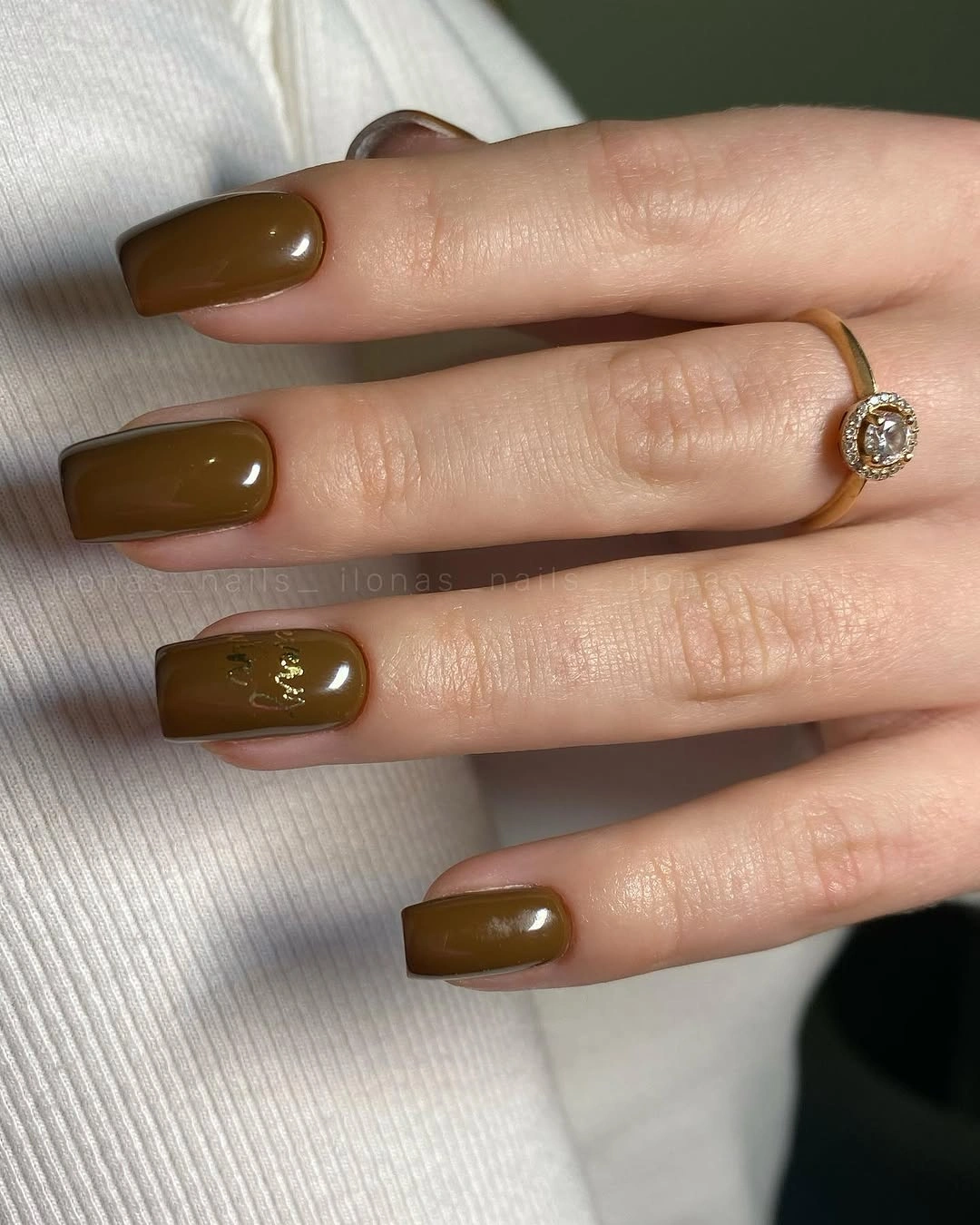
These short rounded-square nails use a glossy warm brown across the set, with tiny pale marks that resemble leaves placed on only a few nails. The solid surface stays dominant, so the small decoration feels like a quiet interruption rather than a full pattern. The compact edge also keeps the darker color neat and clearly framed.
The detail works because it changes the rhythm without changing the palette. Brown supplies the early-fall depth, while the light marks keep the hand from reading as one uninterrupted block; their small scale also lets the finish remain the first thing noticed. A single accent nail would create the same idea with even more restraint.
For an easy early fall nails short version, keep the brown on four nails and place the pale mark on one finger near the tip. A muted beige mark will look softer than white, while a slightly larger leaf shape will stay readable on a smaller surface. The tradeoff is simple: fewer details are easier to maintain, but the manicure loses some of the quiet variation that makes this set interesting.
Milky Pink on a Soft Rounded Silhouette
A short-to-medium rounded shape carries a translucent milky pink color with a smooth glossy surface and no visible motif. Because every nail follows the same pale direction, the curved edges and even spacing become the design rather than a supporting detail. The result stays light while still looking deliberate against the knit background.
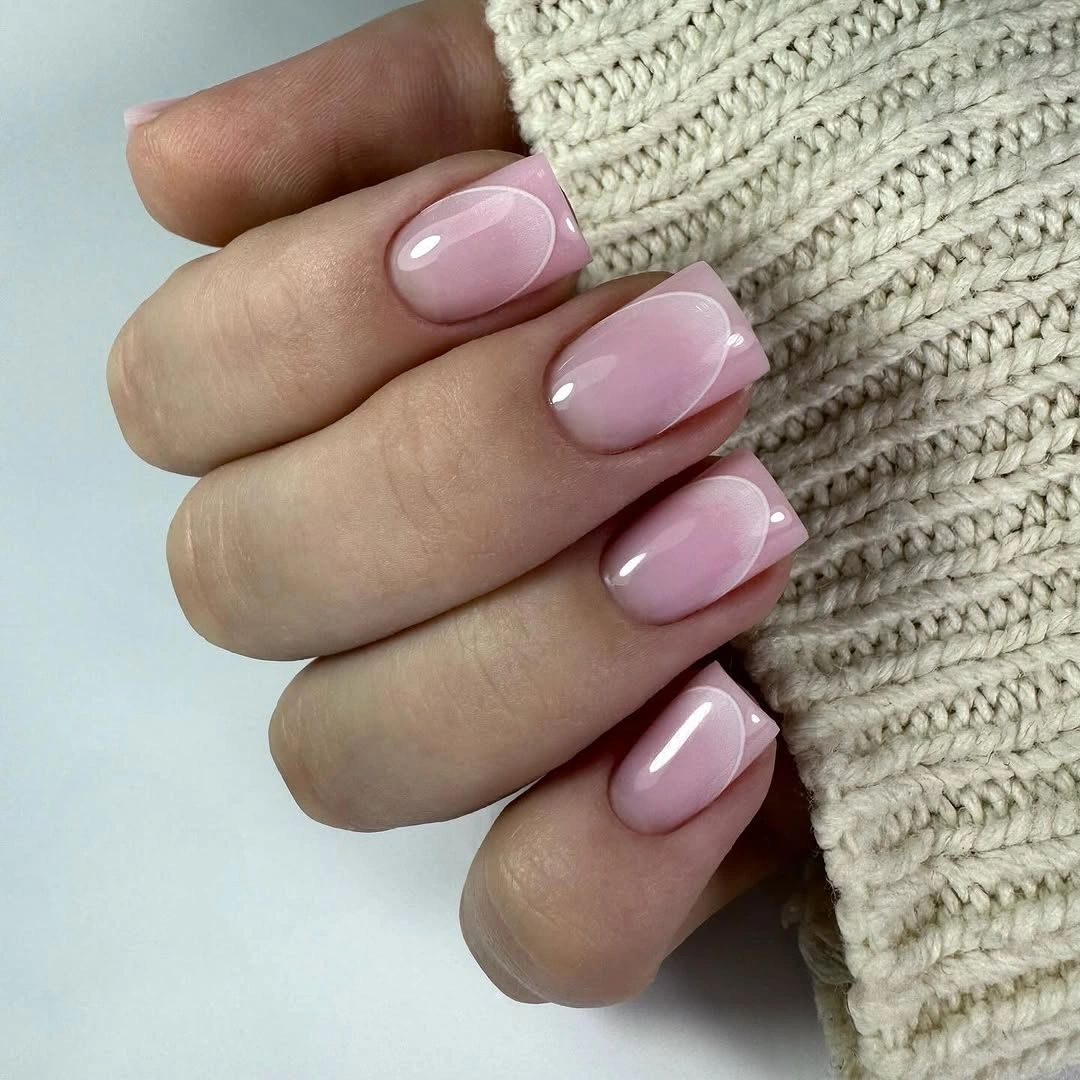
This is a useful reminder that early-fall color does not need to be dark to feel considered. The cool pink gives the hand a clean pause between stronger palettes, and the absence of art makes the shape easy to see from every angle. Its strength is consistency, so any uneven edge would become more noticeable than it would under a busy pattern.
Anyone wanting a warmer version can choose a sheer blush or pale beige without changing the structure. Keep the length short if you want a low-maintenance option, because the uniform surface looks polished when the outline remains tidy. A single fine shimmer accent would add movement, although leaving the nails plain preserves the calmest reading of the idea.
Deep Red Almonds with White Oval Accents
Medium almond nails begin with a deep red base and add slim white oval accents near the center of several nails. The pale shapes are simple and contained, so they sharpen the red rather than competing with its glossy depth. The tapered outline gives the graphic marks a graceful frame while keeping the overall design easy to understand.
The contrast succeeds because the light accents repeat a single shape instead of introducing several unrelated motifs. Red remains the main color, white supplies a clean pause, and the narrow placement leaves enough dark surface to keep the manicure visually grounded. On a shorter oval, the ovals could become small arcs without losing the same relationship.
To make this design more practical, use the red on three nails, one pale accent on the ring finger, and a soft nude on the thumb. That arrangement keeps the focal point but reduces the amount of precise detail. If the red feels too formal, a berry version will soften the contrast while preserving the almond line and the small light mark.
Mustard Orange with Pink Marbled Accents
Long almond nails pair a mustard-yellow solid with decorative nails that combine orange, pink, and pale marbled or floral-looking marks. The warm solid finger gives the set an anchor, while the accent nails carry more movement through layered color and irregular placement. The pointed length provides room for the marks to stretch without filling the entire surface.
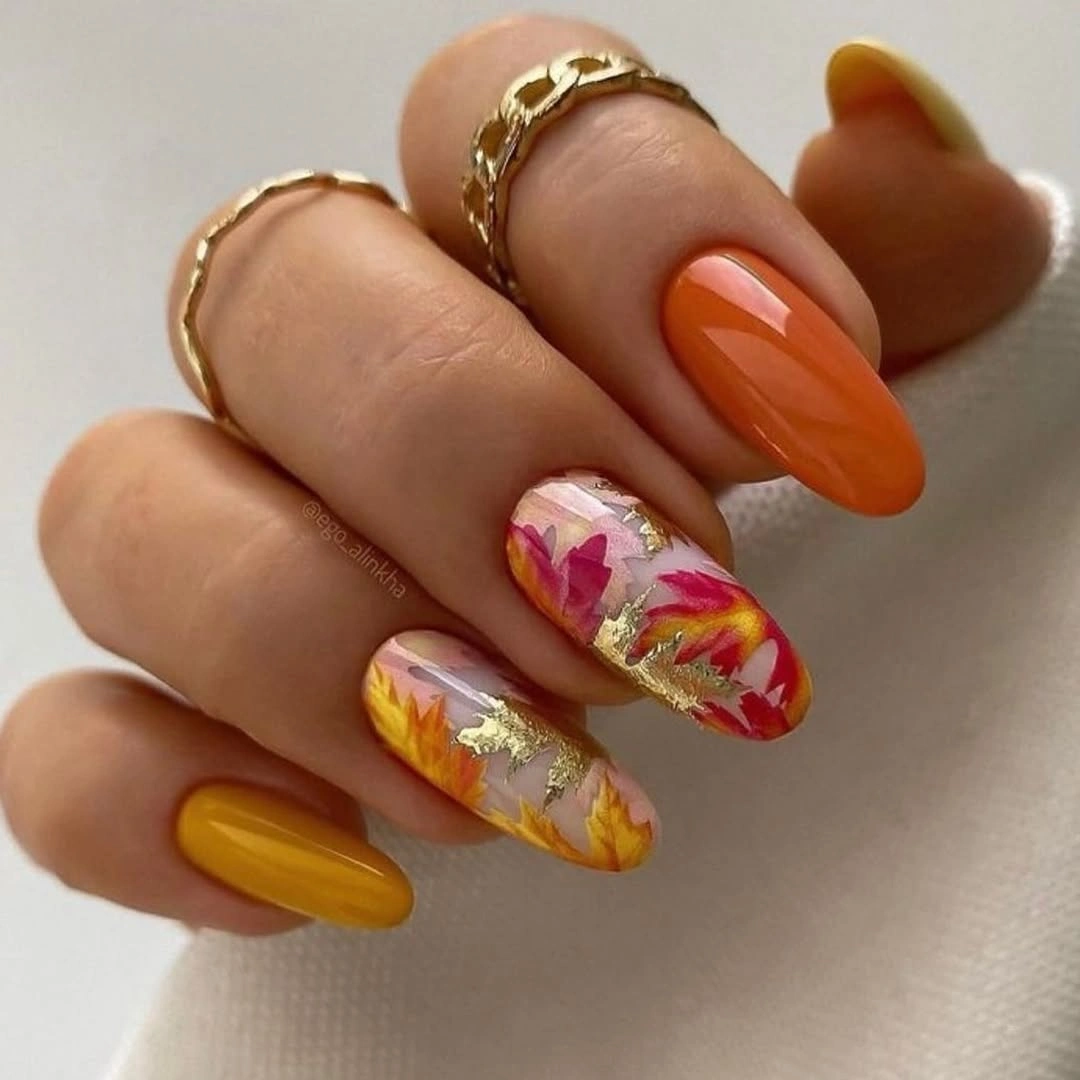
The palette feels seasonal because yellow and orange create warmth while pink prevents the composition from becoming heavy. Repeating the yellow on a solid nail gives the busier accents somewhere to settle, and the uneven pattern keeps the hand from looking mechanically matched. The visual payoff depends on contrast, so reducing the number of accent colors would make the design quieter but less expressive.
A medium almond can carry the same idea if the marbled details are enlarged and limited to two nails. Keep mustard on the remaining fingers, or replace it with a softer ochre when a brighter yellow feels too strong beside everyday clothing. Longer tips show the layered pattern best, but they also make edge upkeep more visible, which is the honest cost of the more dramatic version.
Glossy Orange Red on Medium Almond Nails
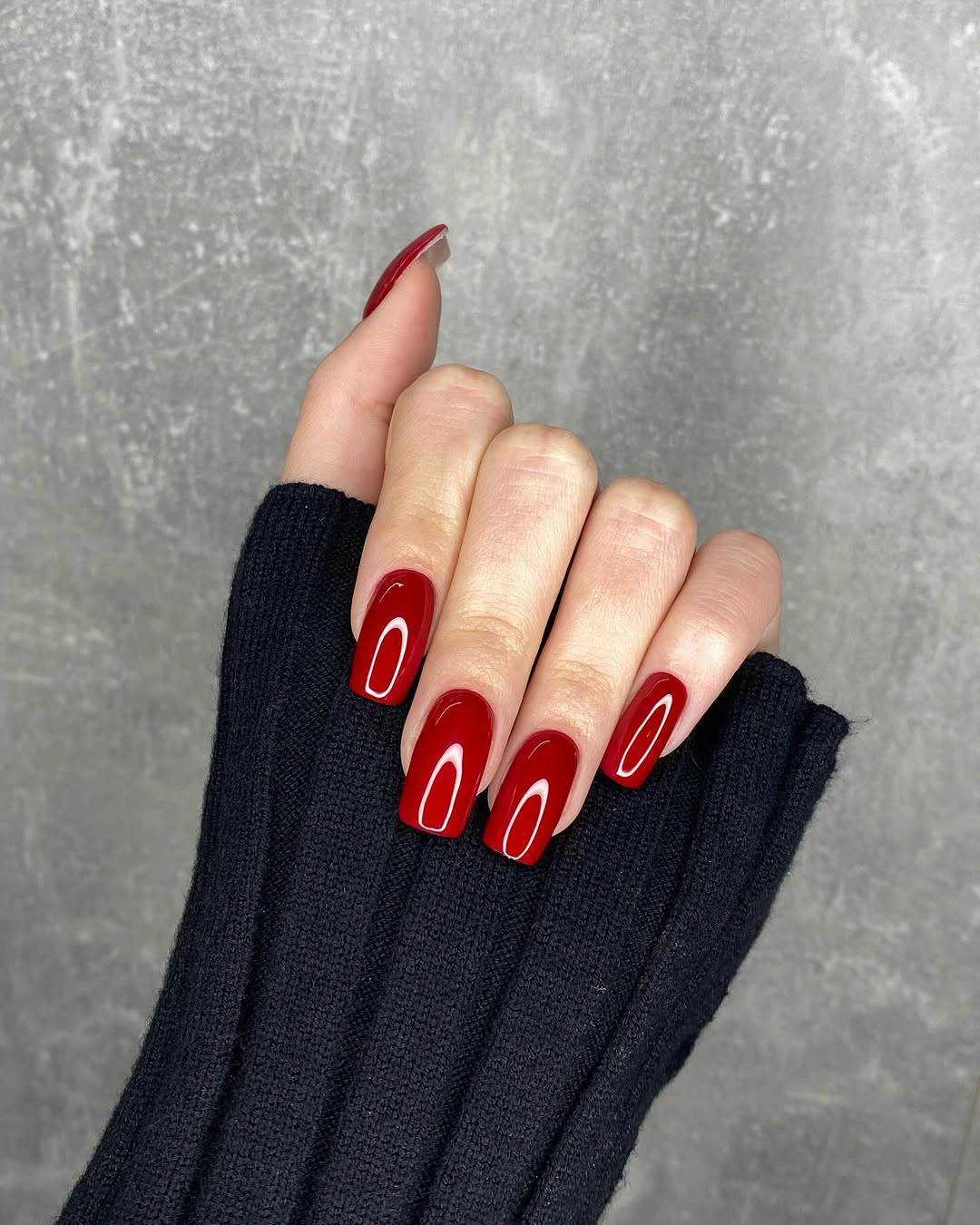
These medium almond nails use a saturated orange-red as a nearly uniform color, with a smooth glossy finish that catches a bright highlight on each curved surface. There is no separate motif to distract from the shade, so the warmth and shape work together as one clear decision. The tapered silhouette keeps the vivid color from appearing visually blunt.
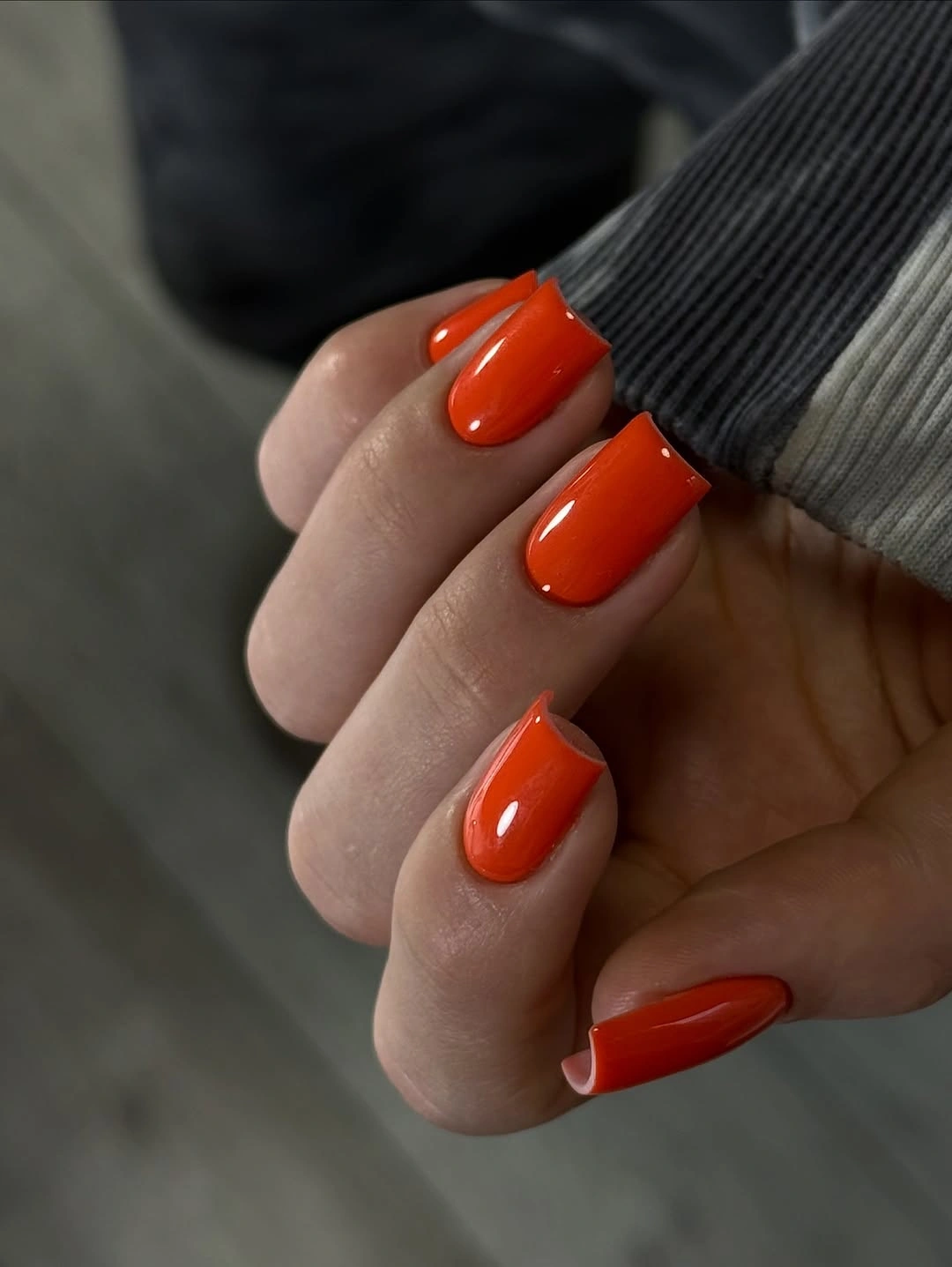
A solid set like this can feel seasonal through temperature alone. The orange-red brings the warmth associated with turning leaves, while the almond length adds polish without requiring painted lines or decorative accents. Its simplicity also makes it easier to compare with the more detailed ideas in this collection.
If you prefer early fall nails simple, keep the color on a shorter oval or rounded-square shape and let the finish remain glossy. Three orange-red nails with two soft nude accents will lower the intensity without losing the central hue. The main limitation is that a saturated color stays visually loud, so rings and other accessories may need to remain quiet around it.
Sheer Nude with Copper and Smoky Reflective Patches
Long almond nails begin with a sheer nude base and add irregular copper, red, and smoky reflective patches across selected surfaces. The patches look abstract rather than like a repeated motif, and their broken placement lets the light base show through between darker areas. The long taper gives the reflective marks a narrow vertical path to follow.
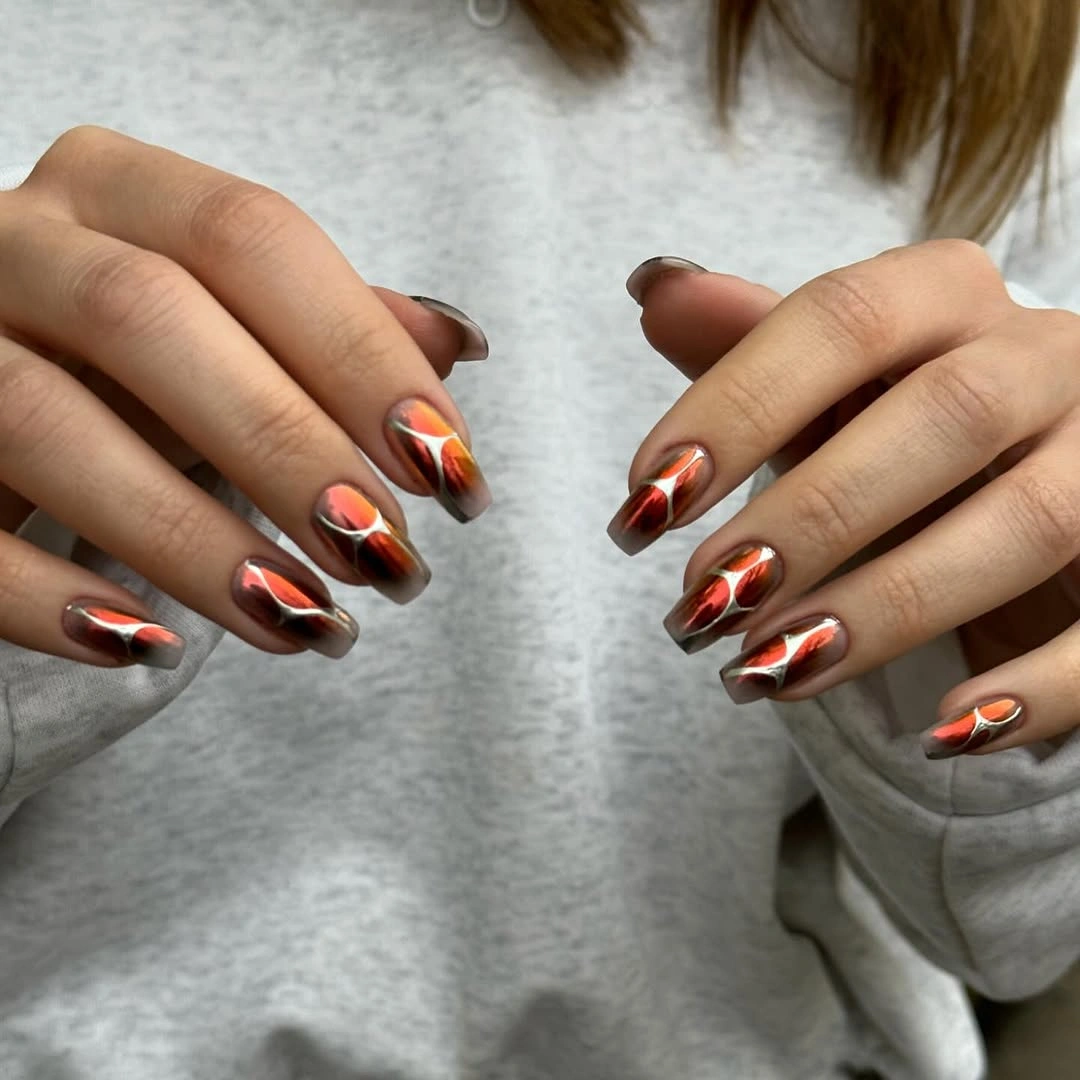
The design has depth because the nude ground interrupts the darker flashes. Copper warms the composition, red strengthens the center, and smoky tones keep the shine from becoming uniformly bright. The visual effect changes as the hand moves, but the important choice is still the open base and the way each accent leaves some space around itself.
For a shorter adaptation, use one copper patch on two nude nails and leave the rest a single warm brown. Larger blocks will read more clearly than many fine fragments, especially when the nail surface is smaller. A sheer base also makes grow-out easier to notice near the cuticle, so moving the accent toward the tip can be a practical compromise.
Pale Pink with Red Curves and Fine Flecks
Short rounded-square nails use a pale pink foundation with thin red curved outlines and small floating flecks on selected fingers. The red marks sit close to the edge or within the open center, creating a fine graphic frame while leaving most of the light base visible. The compact shape gives the design a neat, contained scale.
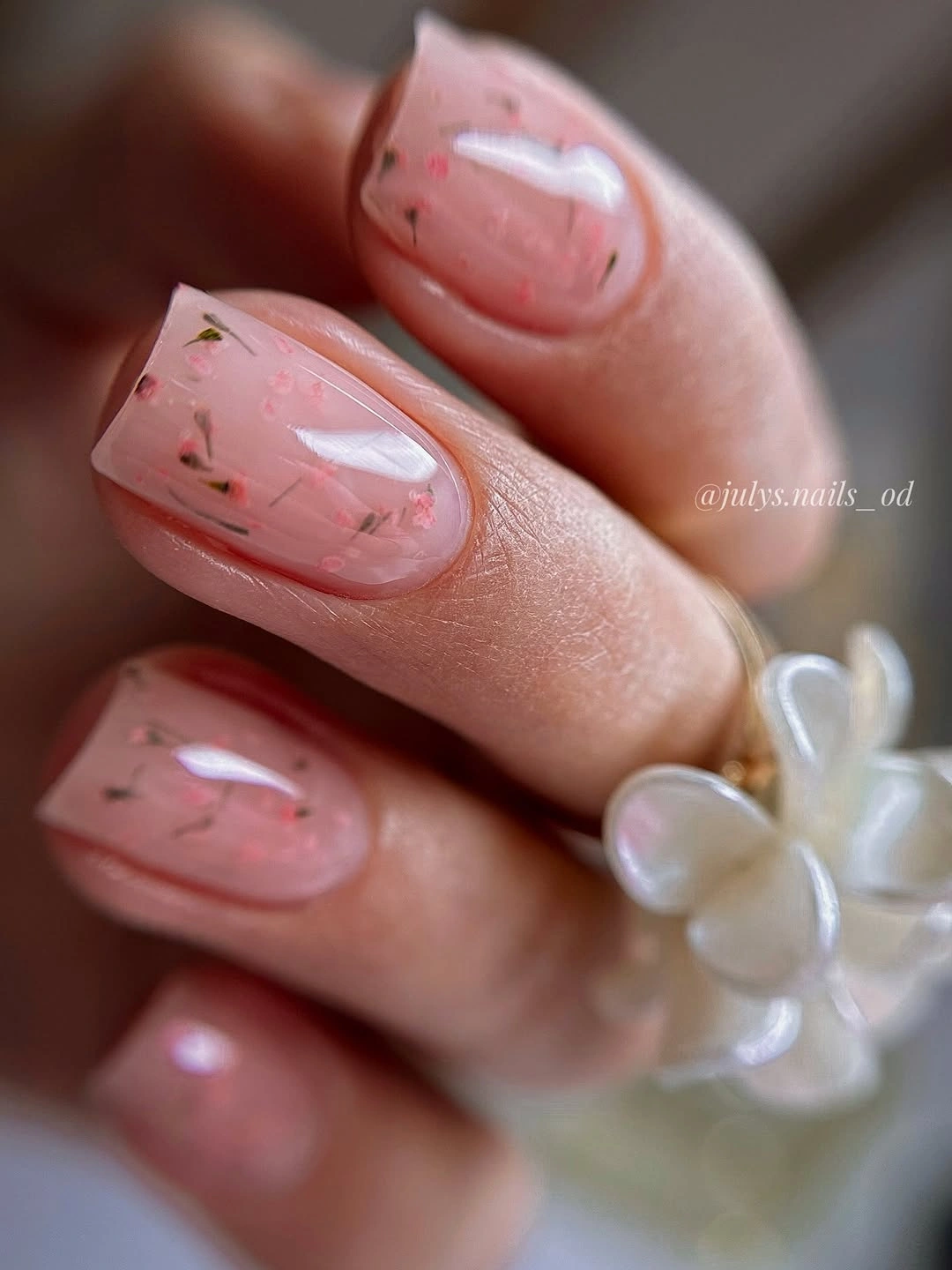
What gives this idea its early-fall character is the controlled contrast rather than a dense seasonal symbol. Red adds warmth to the cool pink, and the fine marks create a little movement without covering the surface. Because the design depends on line placement, its success comes from preserving clear spaces between marks instead of adding more decoration.
On very short nails, use one red curve near the sidewall and omit the smaller flecks. That keeps the outline visible as the nail grows and prevents the pale base from becoming crowded. If you want a softer palette, replace red with muted berry, but keep the line noticeably darker than the pink so the same edge-led effect remains.
Milky White with Two Spotted Accent Nails
Short rounded-square nails are mostly milky white, while one or two accents carry scattered black and warm marks that read as a restrained spotted pattern. The open pale surface remains visible around every mark, and the small pattern is concentrated rather than repeated across the whole hand. The short shape makes the contrast feel playful but still tidy.
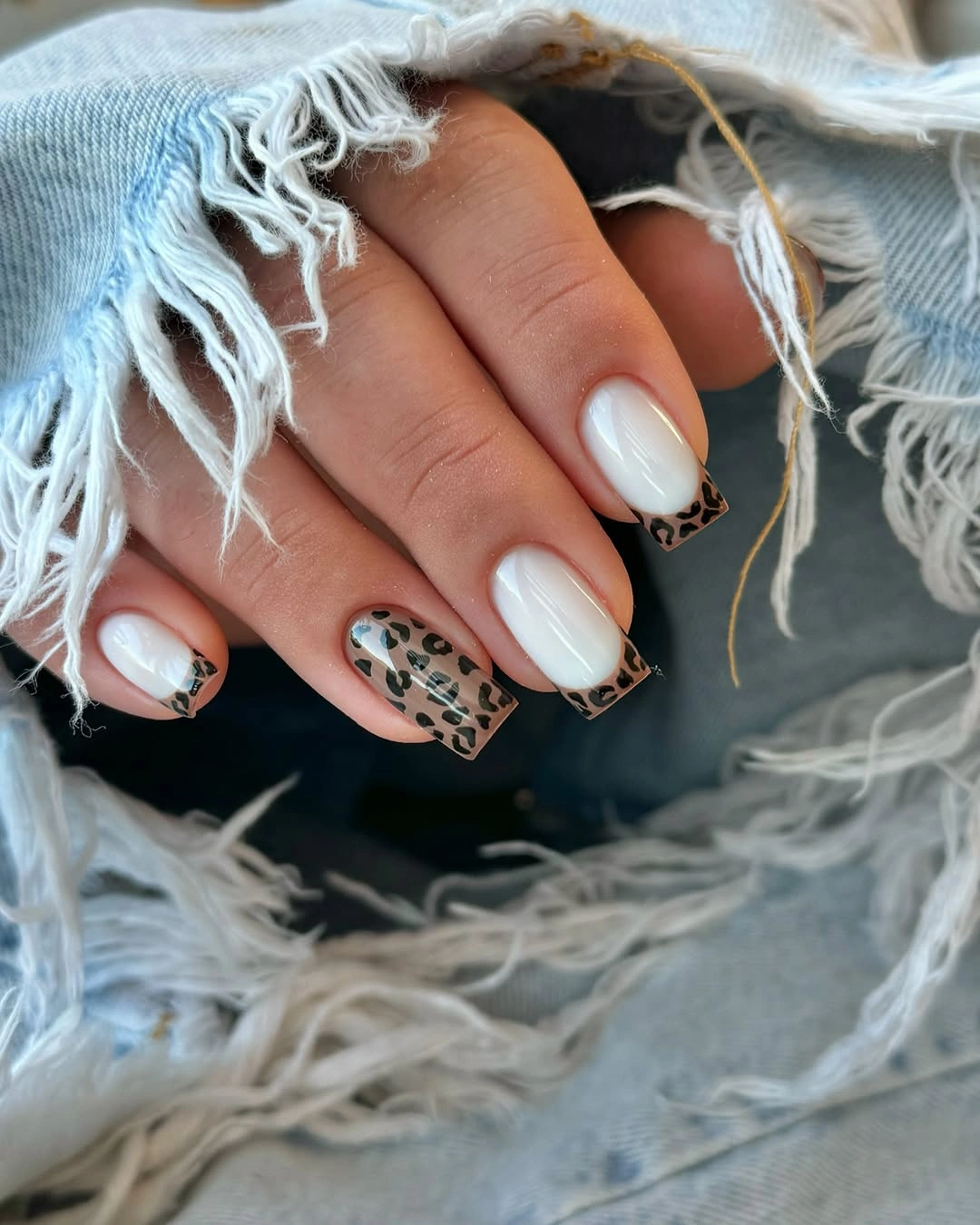
The light base creates a visual pause, which is why the dark spots can stay irregular without making the manicure feel messy. Their varied spacing adds a hand-drawn quality, while the white fingers keep the pattern from taking over. This is a good way to use an animal-like accent without committing to a full print or a high-detail set.
For a smaller nail surface, keep the spots on one accent nail and turn the second accent plain cream. A beige base will warm the look, but the marks should remain dark enough to hold their shape. The limitation is that scattered dots can look accidental if they are too tiny, so a few deliberate shapes will read better than many barely visible specks.
Sheer Pink with Burgundy and Green Floral Marks
Medium rounded-square nails rest on a pale pink or sheer base, with small burgundy and green floral-looking marks placed on selected accent nails. The remaining nails stay quiet, allowing the colored details to appear as concentrated points rather than a continuous print. The rounded edge softens the contrast and keeps the set light.
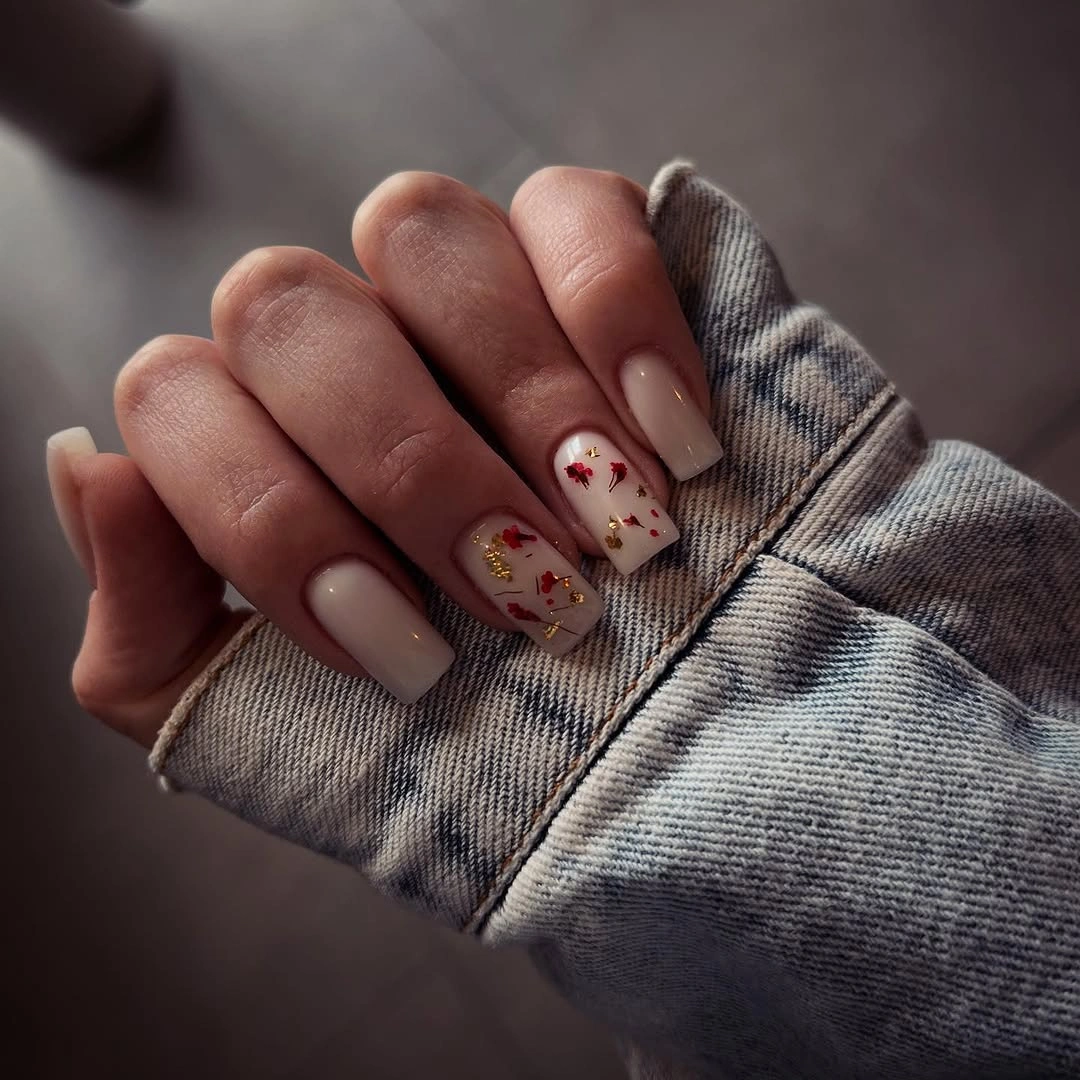
The color relationship is what makes the small marks useful: burgundy adds depth, green supplies a cooler counterpoint, and pink keeps both colors connected to a light background. Because the accents are spaced apart, the hand has a clear visual rhythm instead of a dense field. The idea works best when the marks remain small but identifiable.
Try one decorated nail per hand if you want a simpler early fall nails designs direction. A larger leaf or flower can replace several tiny marks on a short shape, reducing the chance that the pattern becomes indistinct as it wears. A nude base will make the colors warmer, while a cooler pink will make the green feel more noticeable.
Pale Mint Solids with a Clean Short Edge
Short rounded nails are coated in an opaque pale mint green with an even glossy surface and no visible art. The color is the complete focus, and the compact shape keeps its freshness from becoming overly sweet or elongated. A bracelet and light clothing appear around the hand, but the manicure itself stays a single clear color block.
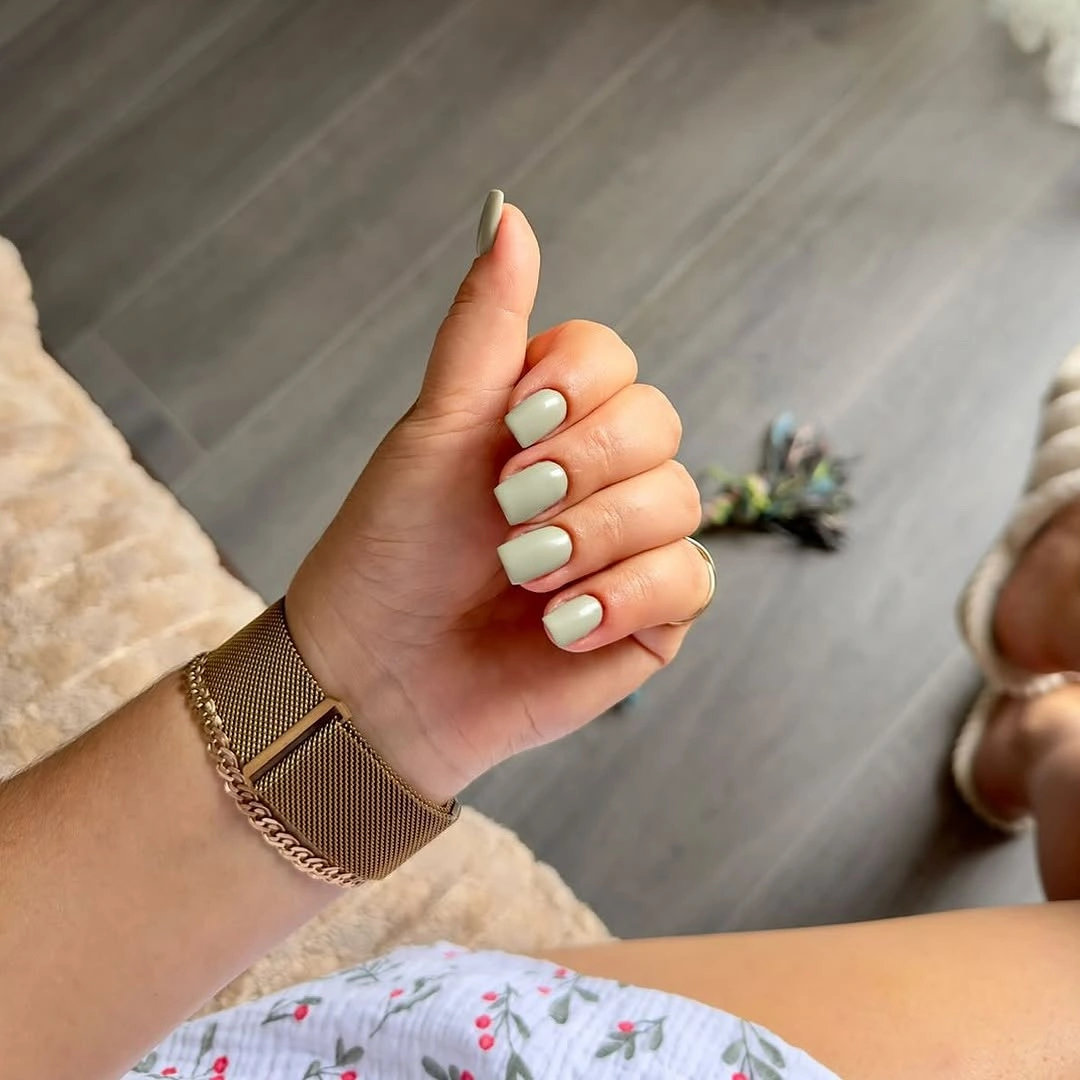
Mint can bridge late summer and early fall when the silhouette is simple and the shade is slightly softened rather than neon. Its cool temperature gives relief from warmer browns and oranges, and the lack of accents makes the hand look orderly. This is a color-led option for readers who want seasonal variety without obvious motifs.
Use mint on three nails and pair it with a warm beige if a full cool set feels too bright. The same color will look more muted on a short square shape, while a glossy surface will keep it lively. Because the design has no decorative cover, uneven application or visible growth will stand out, so keeping the edges clean matters more than adding extra detail.
Deep Teal on Long Square Tips
Long square nails use a dark teal-green color with a glossy surface and straight, squared tips. The set is uniform, so the length and the cool depth of the green create the visual statement without any additional motif. The color sits between blue and green, which gives it more dimension than a flat black while retaining a deep fall mood.
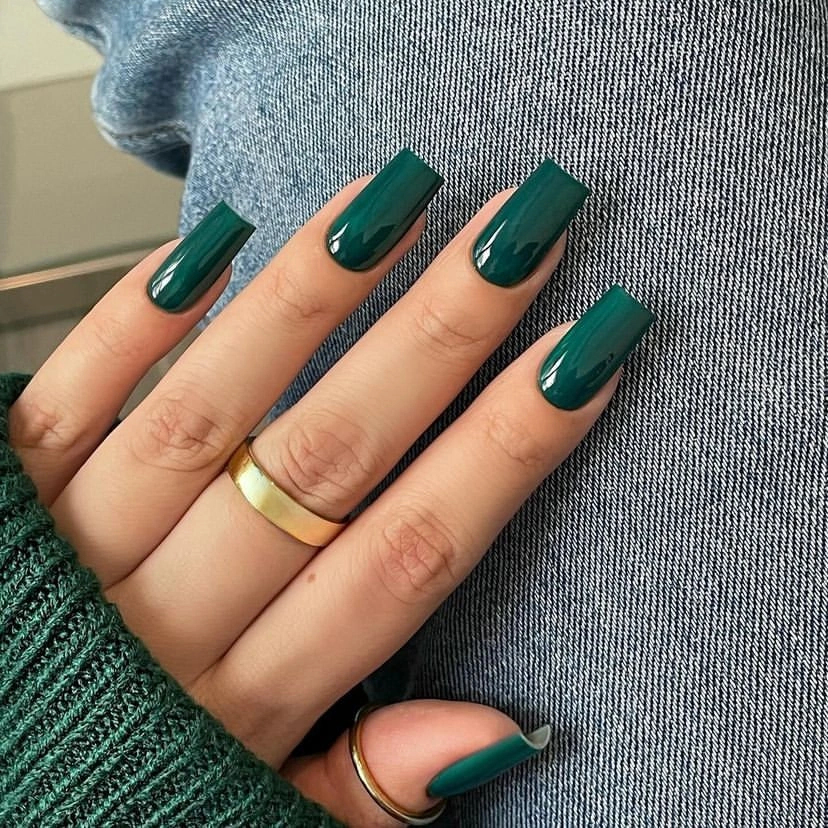
The square edge gives the dark color a firm outline, while the glossy finish prevents the long surface from looking dull. Teal also changes slightly beside gray or denim, making it a useful alternative to brown or burgundy when you want a cooler early-fall palette. The design is strongest when the shade remains uninterrupted.
A medium square will keep the color relationship while making the length easier to wear. If you want one small variation, use a muted teal on the thumb and ring finger rather than introducing a new motif. Long square tips show the color beautifully, but they also make chips, uneven edges, and fabric-catching more consequential than they would be on a shorter shape.
Cream Nails with Minimal Black and Yellow Marks
Short square nails start with a pale cream base and add tiny black and yellow graphic marks near the center of selected fingers. The accents are small enough to leave the base dominant, yet their dark outlines make them visible at the compact length. The arrangement feels playful because the marks are not repeated as a strict full-hand pattern.
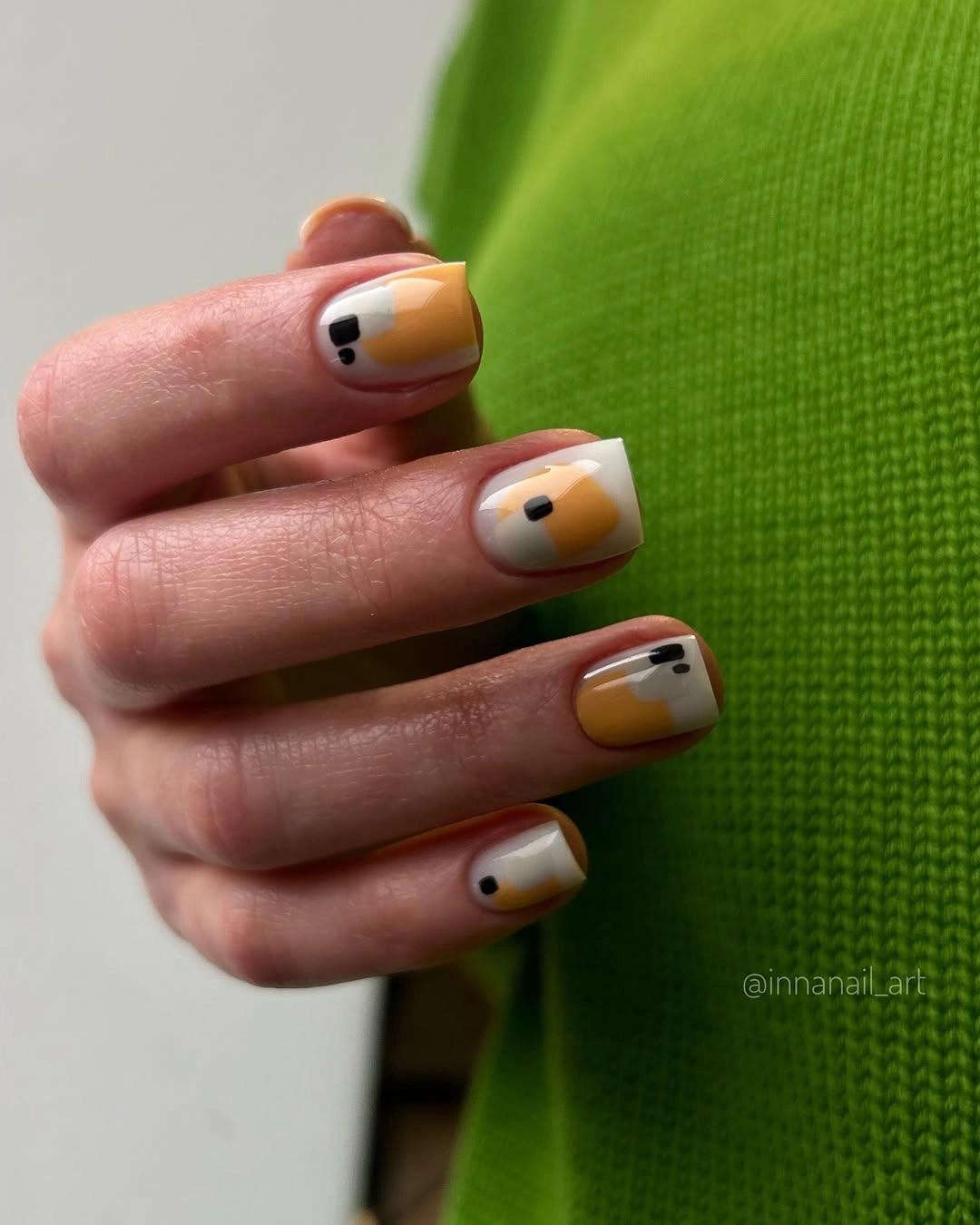
Warm cream softens the black, while yellow gives the otherwise pale design a small point of energy. The balance depends on scale: the marks need enough room around them to look intentional, and the short square shape supplies a clear boundary. A larger single mark would create a bolder version without changing the palette.
When adapting this idea, keep the black outline and choose either yellow or a muted ochre for the fill. That two-color edit is easier to repeat on shorter nails and keeps the pattern from becoming visually crowded. The small marks may show wear before a solid color does, so placing them on one or two fingers is a sensible maintenance choice.
Glossy Pink Almonds with Red Abstract Lines
Long almond nails use a glossy pink base with red edging and red abstract line motifs on the accent nails. The lines vary in direction, but the repeated red keeps the set connected while the pale pink surface leaves room around each mark. The almond silhouette lengthens the visual path of the lines and makes the accents easy to notice.
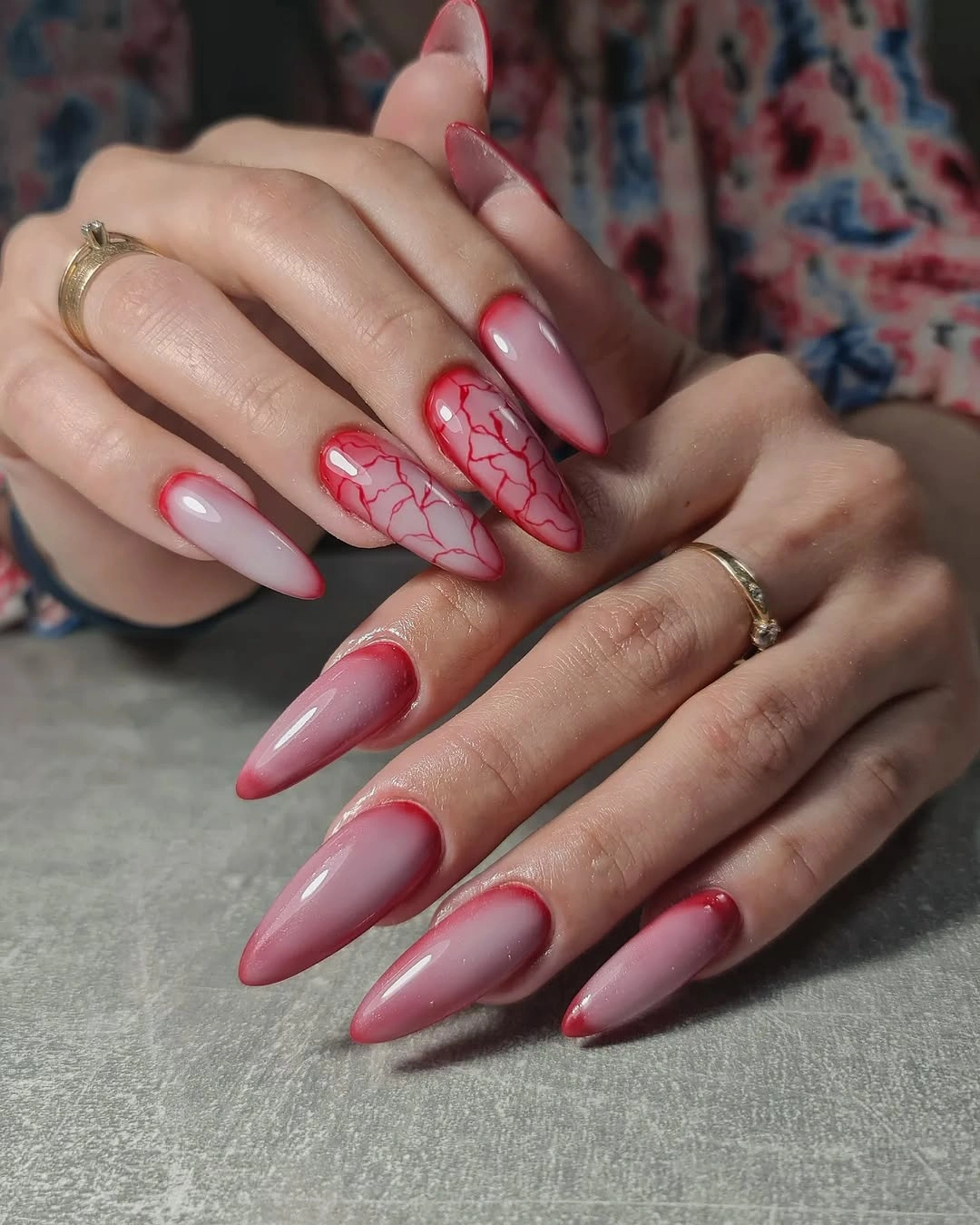
The design is balanced through repetition and relief. Pink and red belong to the same warm family, yet the red is strong enough to define the edge and guide the eye; plain pink nails then give the decorated fingers space. The varied line placement feels more organic than identical stripes across every nail.
A shorter oval can use one red curve on two pale nails and keep the other fingers pink. Choose a wider line rather than adding multiple thin strokes, because a small surface needs clear shapes to retain the same rhythm. The longer version carries more visual drama, while the shorter edit is easier to coordinate and less demanding when the details begin to grow out.
Soft Pink with Dark Brown French Tips
Long tapered nails combine a sheer pink base with dark brown French tips that follow the pointed edge. The light center remains open, so the design reads as a narrow contrast rather than a full dark coating. The clean transition from pale base to brown tip gives the long shape a graphic outline without adding separate decoration.
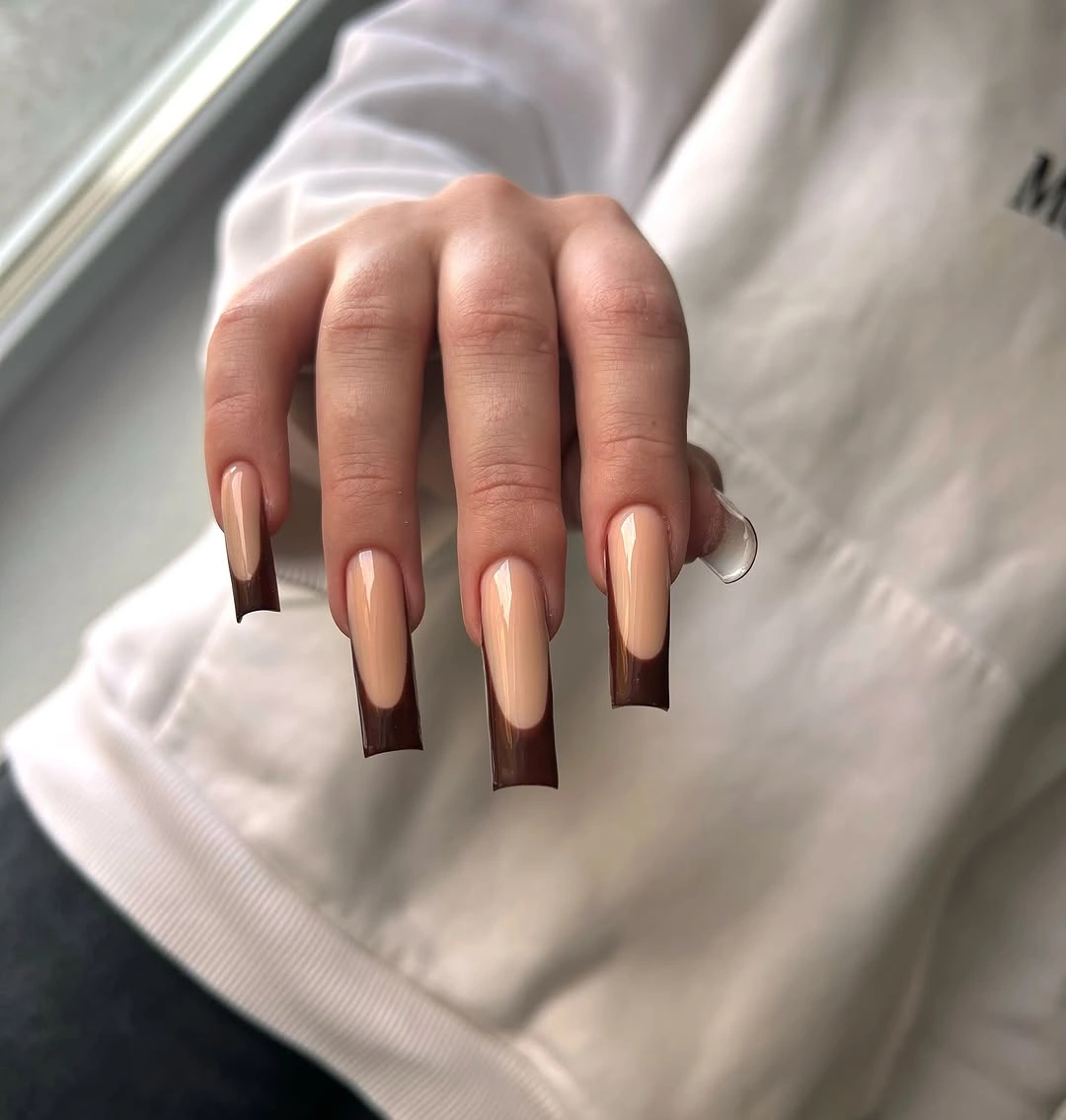
Brown changes the usual French rhythm into something more autumnal while the pink keeps the result from becoming heavy. The tip placement is especially important because it emphasizes the length and the direction of the taper at the same time. Leaving the center clear also makes the manicure feel lighter than a full dark set.
For a shorter square or oval, make the brown edge slightly wider so it does not disappear on the reduced tip. You can soften the contrast with chocolate brown instead of near-black, or use a beige base if sheer pink feels too cool. The narrow line may require regular edge upkeep, but the open center makes small growth less distracting than a full dark block near the cuticle.
Soft Sheer Pink with Fine Golden Sparkle
Short rounded-square nails are a sheer blush pink with fine sparkle scattered through the pale surface. There is no strong motif or color block, so the manicure changes mainly through light and the subtle grain of the finish. The rounded shape keeps the delicate color approachable and gives the sparkle a neat boundary.
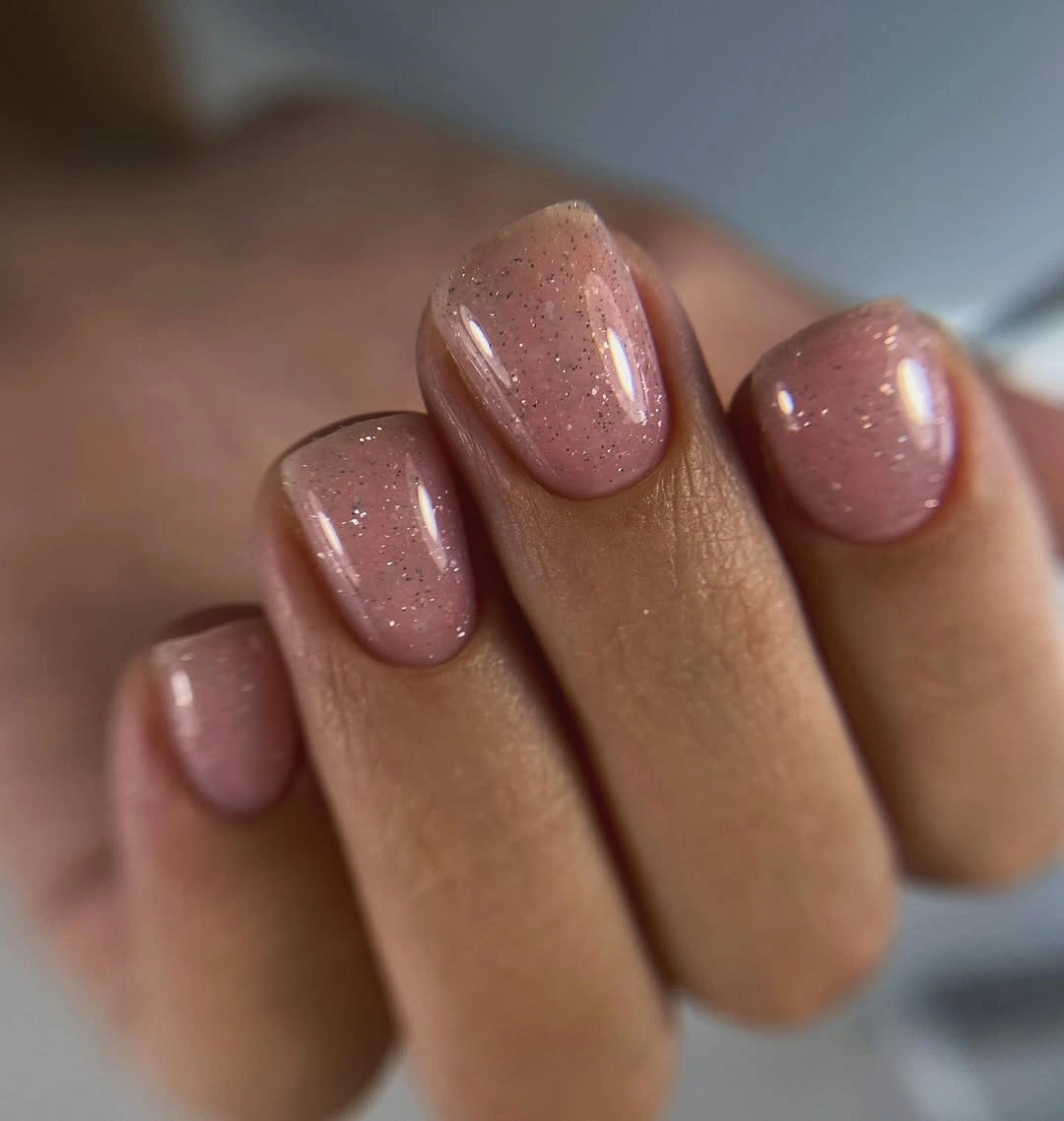
This option brings a little seasonal warmth without relying on a dark shade. The gold-like flecks lift the pink, while the translucent base lets the natural variation of the color remain visible instead of turning the hand opaque. It is quieter than a glitter tip, but it still has movement when the fingers change position.
Use the same finish on a short oval if you prefer a softer outline, or put a denser sparkle only on the ring finger for more contrast. A warm beige-pink will make the flecks appear richer, while a cooler blush will keep them subtle. The main limitation is visual delicacy: the small sparkle can disappear in low light, so it is best chosen for a refined effect rather than a bold statement.
Simple Burgundy on Medium Square Nails
Medium square nails alternate a deep burgundy with one lighter accent, keeping the overall arrangement simple and mostly solid. The darker fingers create a rich base, while the lighter nail prevents the hand from becoming one continuous wine-colored block. The square edge reinforces the clean, edited quality of the palette.
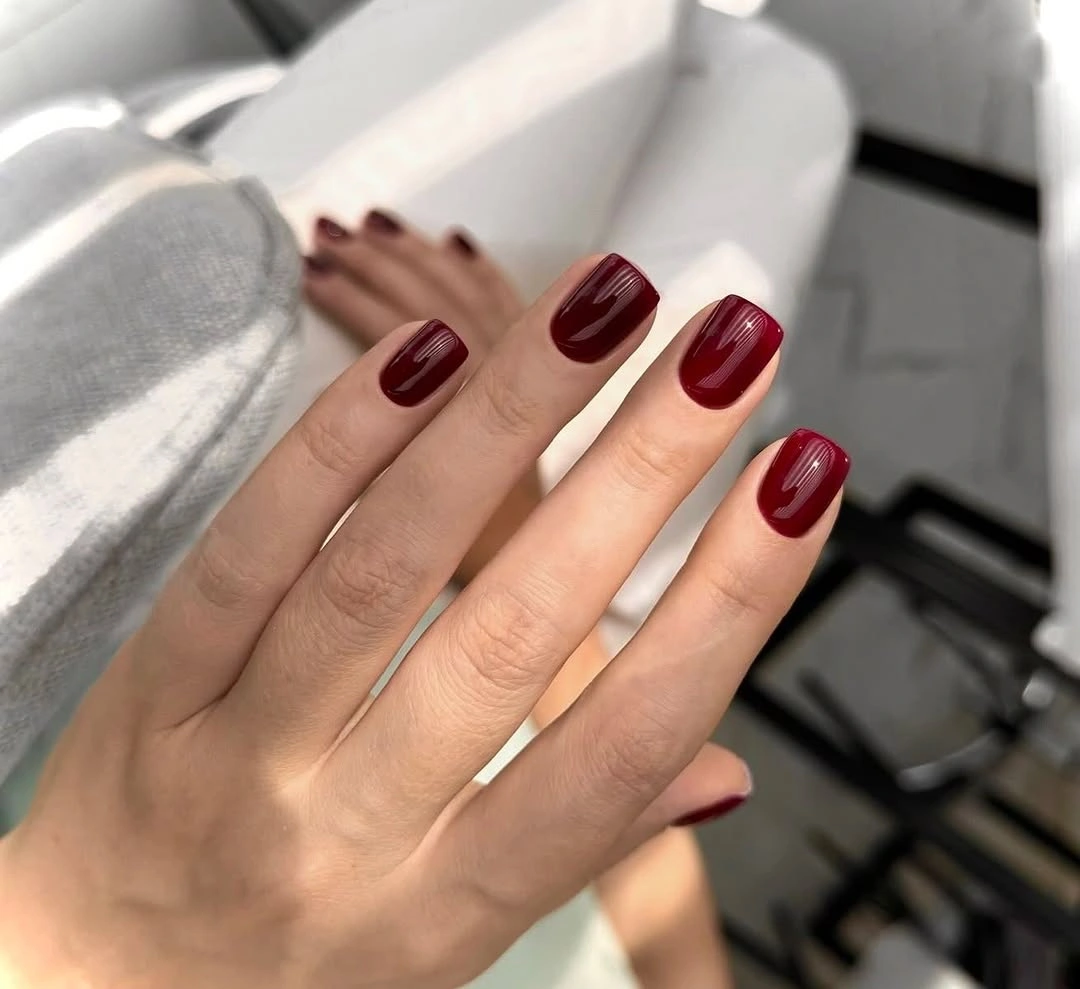
The visual interest comes from value contrast rather than from a painted motif. Burgundy gives the set its early-fall weight, and the lighter accent works as a pause that lets the neighboring color appear deeper. This is a useful design when you want a dark manicure with a small change of pace but no busy detail.
For a shorter version, repeat the light shade on the thumb and ring finger, or keep only one accent if you prefer a stronger solid-color impression. A muted berry can replace burgundy without changing the structure. The simple finish is easy to adapt, but it also means surface marks and uneven edges will be visible, so tidy shaping becomes part of the look.
Dark Blue Purple Panels with Glitter
Long square nails combine translucent nude surfaces with dark blue-purple panels, fine glitter, and small reflective details. The decorated fingers are richer than the plain nude ones, creating a strong alternation between open light space and dense color. The straight tip gives each panel a clear frame and helps the glitter look intentional rather than scattered.
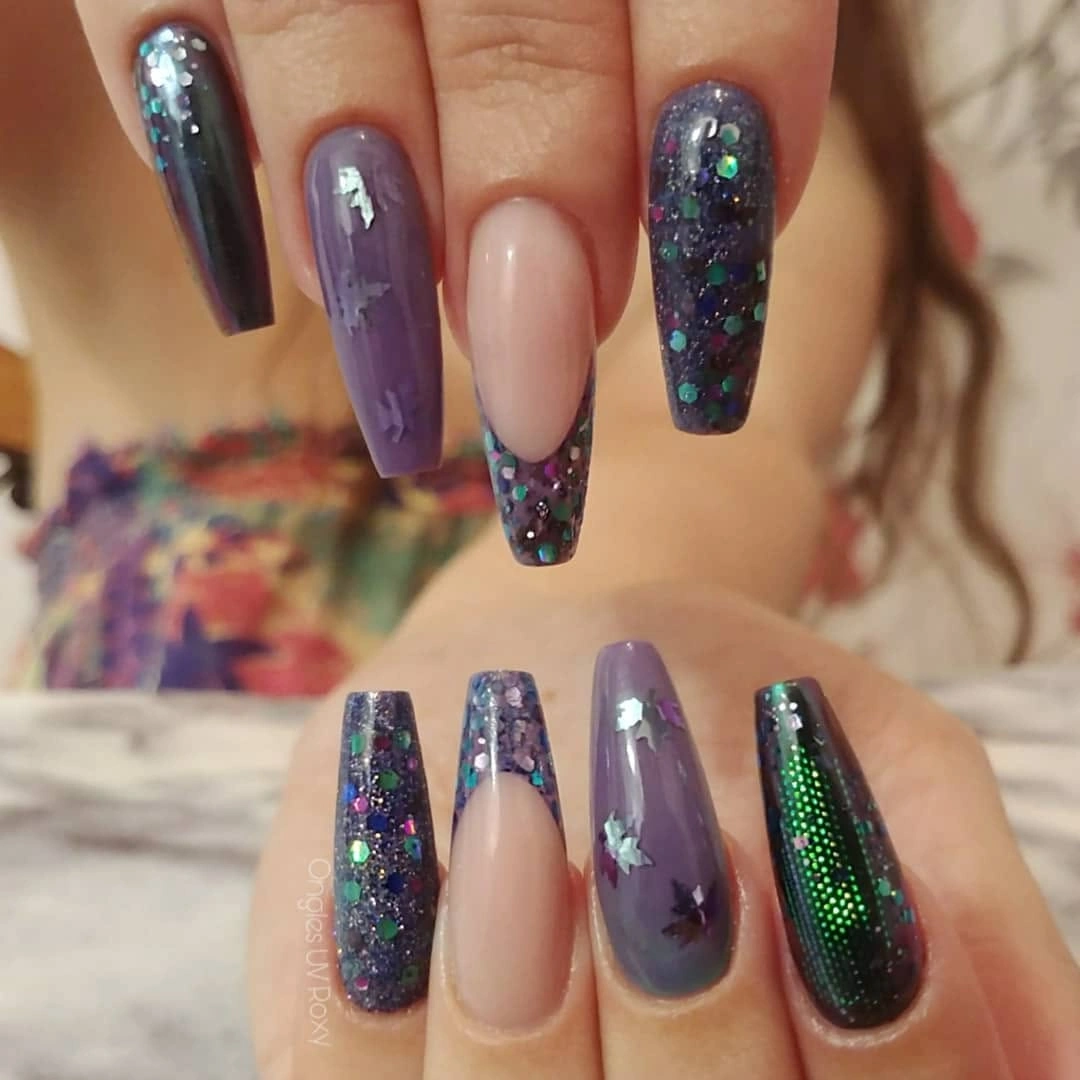
The contrast works through density. Nude nails provide relief, while the deep panels carry the sparkle and keep the hand from looking uniformly pale; small reflective points then echo the glitter without covering every surface. This is more theatrical than a solid dark set, but the repeated panel shape keeps it organized.
On a medium square, use the dark panel on two nails and reduce the glitter to a narrow strip. That preserves the light-dark relationship while making the detailed areas easier to maintain. A shorter nail cannot show as many small accents clearly, so the practical adaptation is to keep one strong reflective feature rather than trying to reproduce every visible mark.
Muted Olive with One Silver Glitter Nail
Medium-to-long square nails use muted olive green solids with one gray-silver glitter accent. The olive color occupies most of the hand and creates a calm earthy field, while the single reflective nail supplies a cool point of contrast. The straight shape keeps the mixed finish orderly and stops the glitter from taking over.
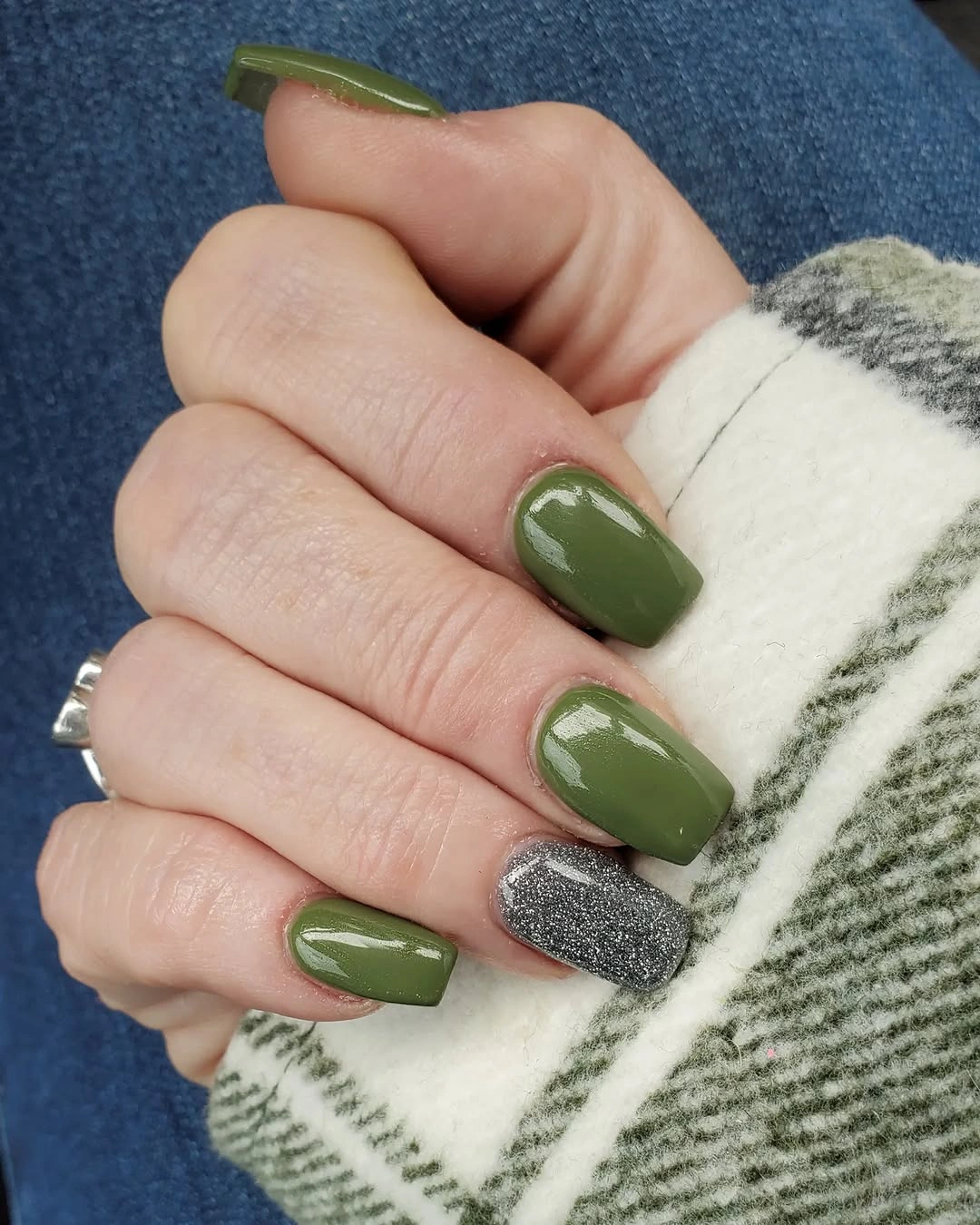
Olive and silver work because they differ in both temperature and surface. The green feels soft and grounded, while the glitter catches light sharply, so the accent becomes a small change in texture as well as color. Keeping it to one nail prevents the metallic surface from competing with the muted base.
For a shorter shape, place silver on the ring finger and use olive on the rest, or replace it with a fine silver line over the green. The accent is easy to identify but may need more care if its texture catches on knit fabrics. A warmer gold would make the set cozier, while silver preserves the cooler contrast visible here.
Taupe Nails with Black Botanical Line Work
Short rounded-square nails use a sheer taupe base with delicate black botanical lines on two accent nails. The drawings remain open, with the neutral ground showing through rather than being covered by a filled motif. The compact shape keeps the line work close and readable while the other nails provide a quiet taupe frame.
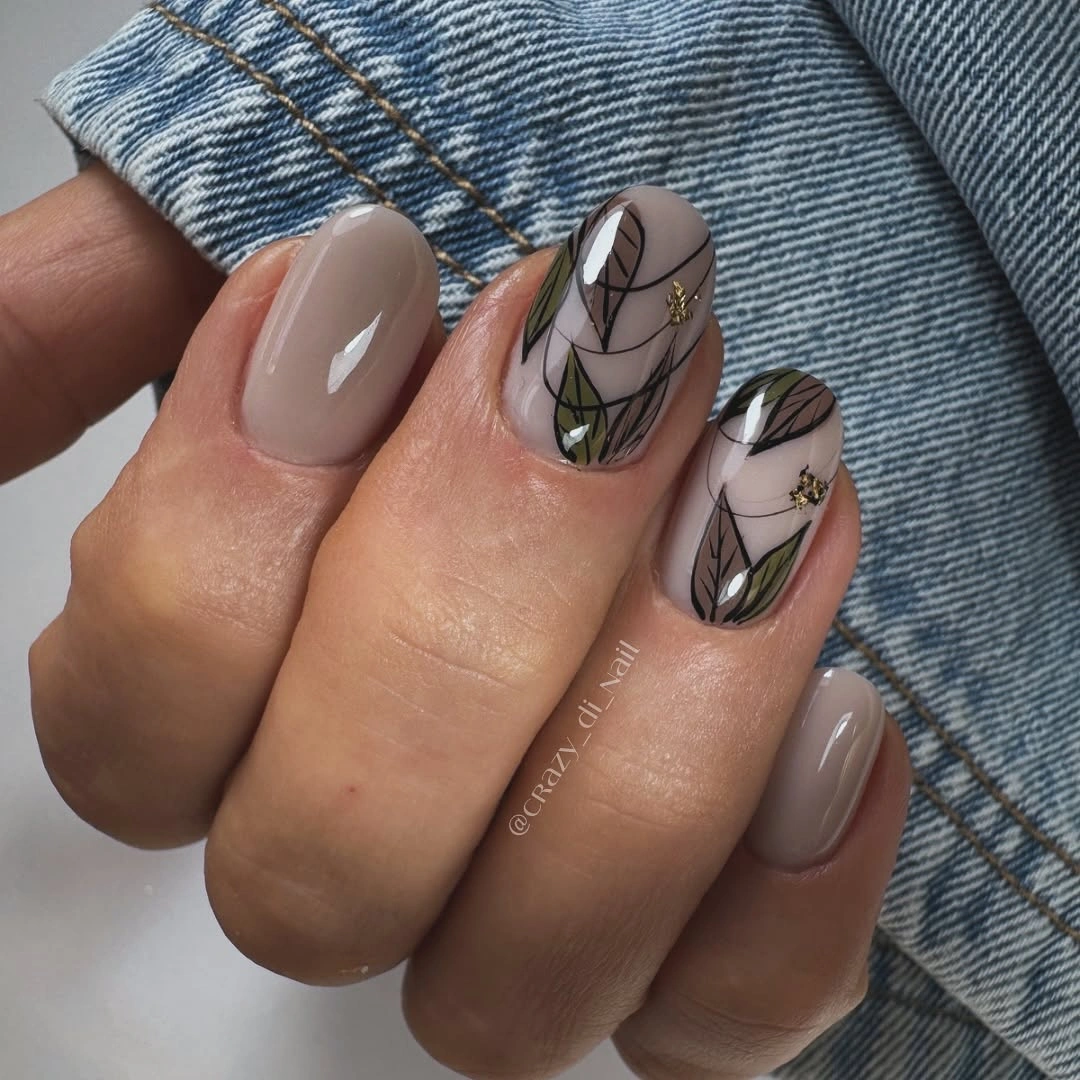
The design feels seasonal through restraint. Taupe brings a warm neutral undertone, black gives the fine lines enough definition, and the empty space stops the botanical marks from becoming heavy. Concentrating the drawing on two nails also creates a clear focal point instead of asking every finger to carry equal detail.
If you want early fall nails designs with less upkeep, place one full botanical accent on the ring finger and leave the middle finger plain taupe. Use a slightly wider line on a shorter nail so the drawing remains legible. A beige base will brighten the result, but keeping the background quiet is what lets the black marks retain their delicate character.
Blush Nails with Warm Gold Glitter Tips
Medium almond nails pair a pale blush base with warm gold glitter tips and a few slim colored accents near the edge. The sparkle is concentrated at the tips, so the center of each nail remains light and the almond line stays visible. The design feels dressed up, but its color structure is still easy to read.
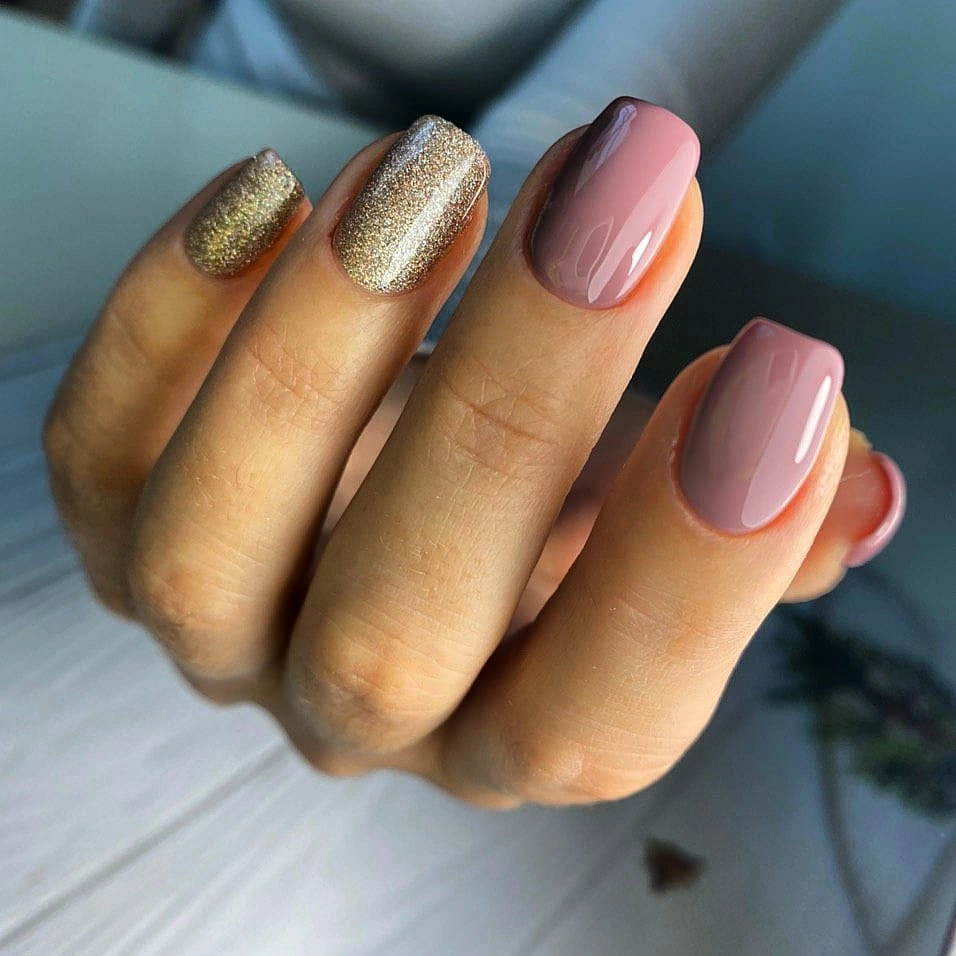
Gold adds warmth to the blush without turning the manicure dark, which makes this a softer transition into fall. The tip placement creates a clear finish line, while the pale center provides relief from the reflective material. Small colored touches can echo the glitter, but they are most effective when they remain secondary.
For shorter almond or oval nails, widen the glitter into a simple curved French edge and skip the tiny extra accents. That makes the main contrast visible on less surface area and reduces the number of details that need to stay sharp. If you want less sparkle, use a muted metallic or warm beige tip, though the light-catching edge is the feature that gives this idea its lift.
Teal and Pale Nails with Curved Botanical Lines
Short rounded-square nails alternate glossy dark teal solids with sheer pale accents carrying green and blue curved lines. The dark fingers make the light decorated nails stand out, while the curved marks echo the teal and keep the two sides connected. The small scale makes the design feel graphic rather than ornate.
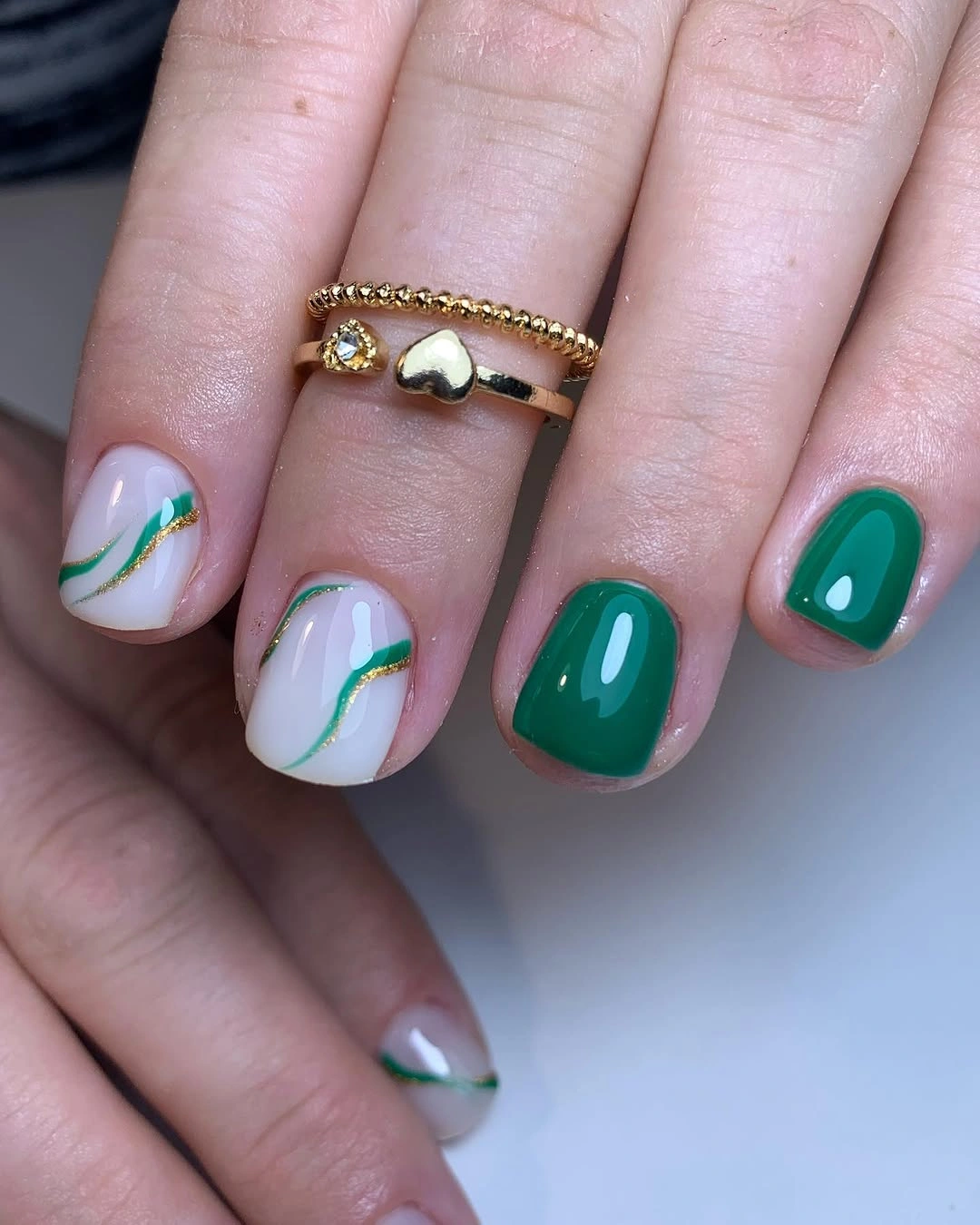
The palette works because the teal supplies depth and the pale nails create room for the fine lines to breathe. Green and blue details stay close to the main color family, so the accents feel related rather than random. The design also shows how one light nail can interrupt a dark set without requiring a full change of color on every finger.
On very short nails, place one broad curved line on the pale accent and keep the rest teal. A warm cream background will change the mood, while a cool white will make the blue marks crisper. The detailed accents may need careful touch-ups, but limiting them to two nails keeps the maintenance more realistic than repeating the pattern everywhere.
Milky White with Tiny Black and Gold Bursts
Short rounded-square nails are milky white with small black and gold leaf-like or starburst details concentrated near the tips. The pale base remains the largest visible area, while the dark and metallic marks create tiny focal points that keep the set from feeling blank. The short edge gives the decoration a tidy frame.
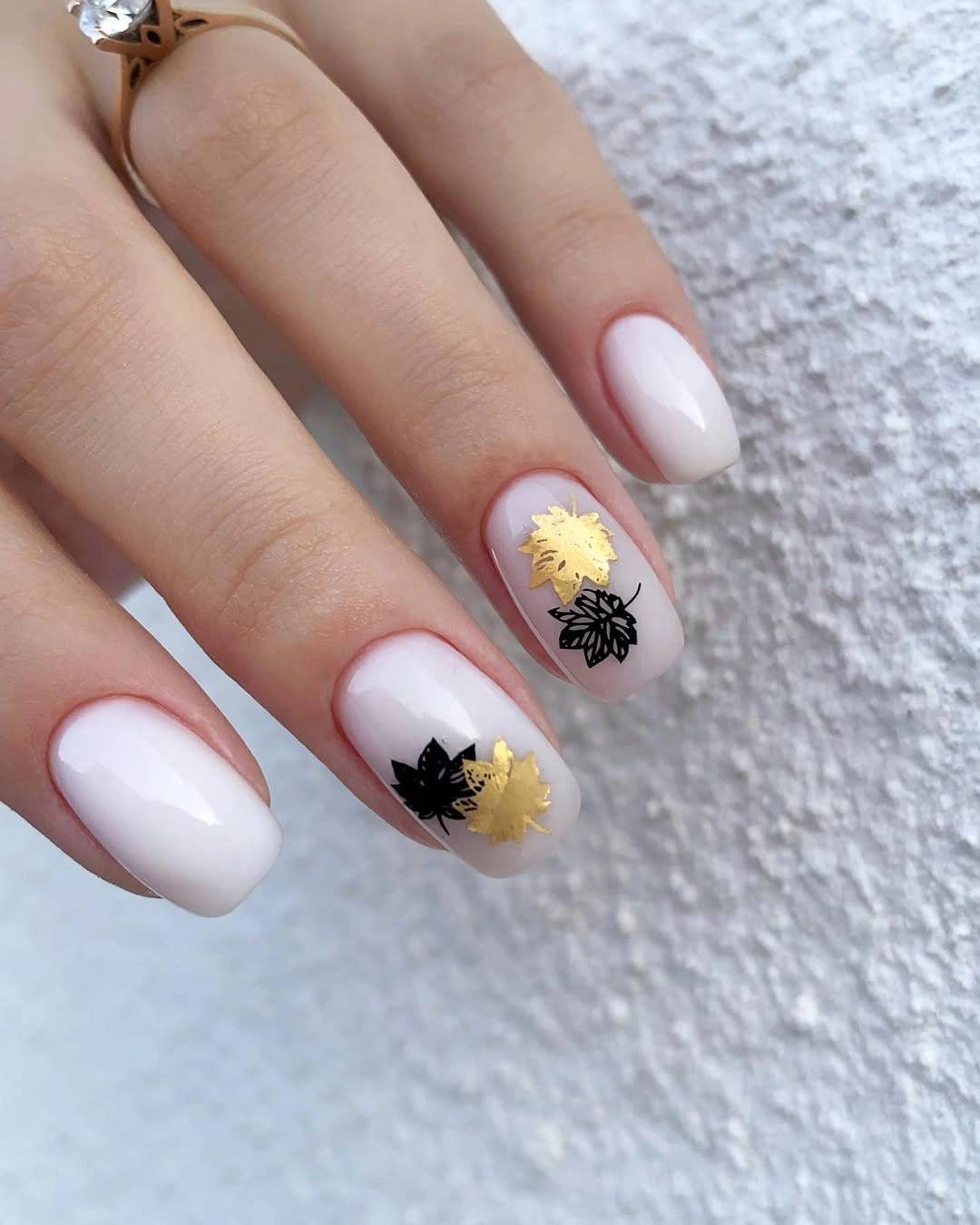
Black adds definition and gold brings warmth, so the two accents perform different jobs on the same light ground. Their small placement suggests the season without using a large motif, and the open white surface makes the hand look airy. This is a restrained early fall nails ideas option when you want detail but not density.
For a simpler adaptation, keep the black mark on one nail and use gold only as a single dot on another. The larger the nail becomes, the more space you can leave around each detail; on a very short tip, two clear shapes will read better than several tiny ones. The design remains delicate, so a careful edge and limited decoration are more valuable than adding extra colors.