
Fall nails for olive skin tone work best when the color decision is more considered than simply choosing a dark polish. Olive undertones can hold smoky greens, wine reds, warm browns, and softened pinks particularly well, yet the most convincing result comes from the relationship between those colors: how much contrast they create, where the deepest tone sits, and whether a neutral base gives the hand room to breathe.
Rather than treating every seasonal shade as equally useful, start by deciding whether you want the manicure to read tonal, warm, or deliberately contrasting. Muted color usually feels quietest when it is repeated, while a saturated accent becomes clearer beside a pale base or a dark neutral. That one choice makes it easier to adapt a detailed idea to your nail length, wardrobe, and tolerance for visible grow-out.
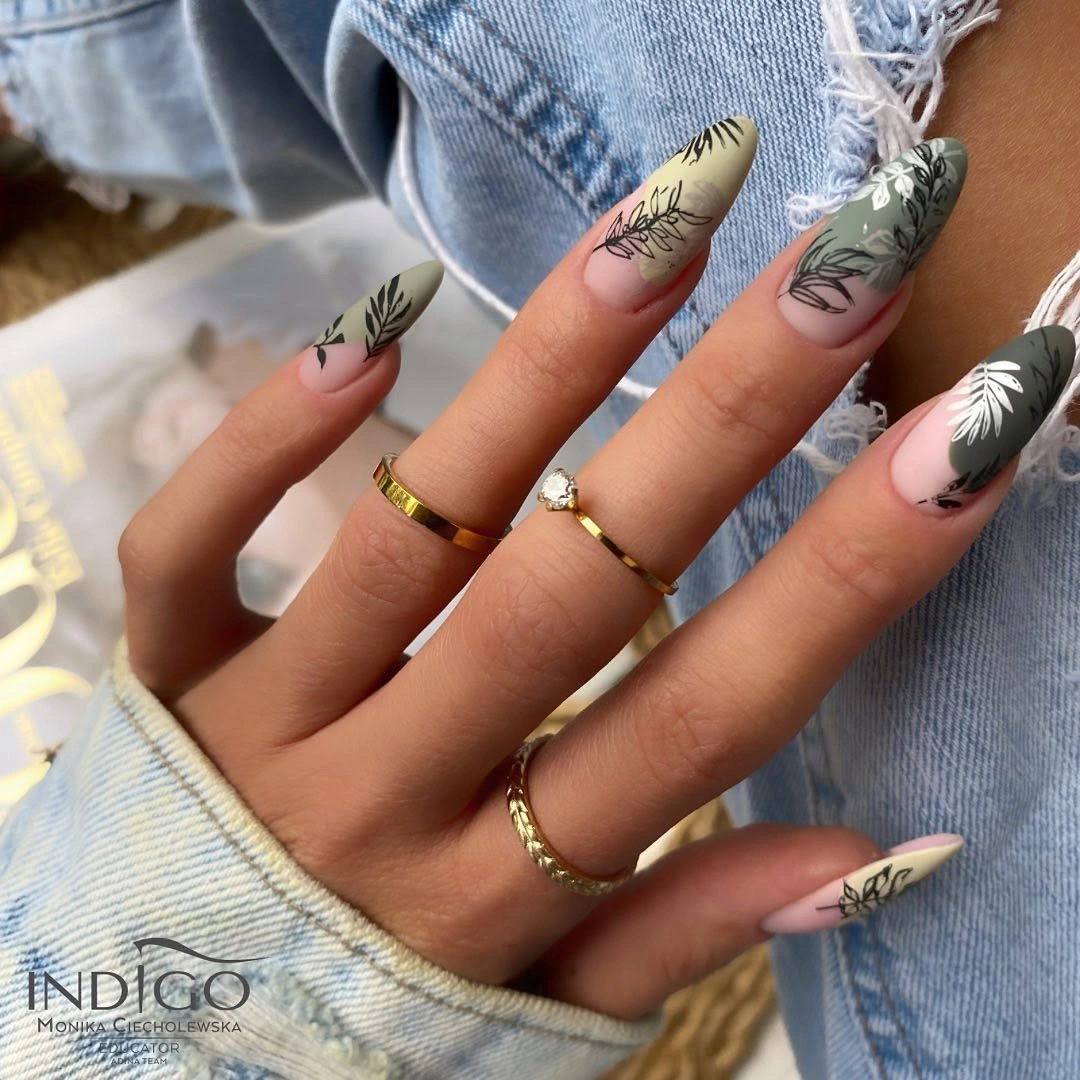
Muted Sage and Soft Pink Botanical Almonds
Soft pink and muted sage create a gentle value shift here, while black and white leaf marks keep the long almond shape from becoming too sweet. The painted foliage stays concentrated rather than covering every surface, so the pale base still reads as a color decision instead of disappearing beneath decoration. That balance is especially effective when olive undertones make both the dusty green and blush tones look settled rather than stark.
What makes this botanical direction feel composed is the distribution of contrast: one green nail carries weight, and the finer dark branches act like punctuation across the lighter nails. A similar color rhythm can be found in sage green fall almond nails, but this version proves that a softer pink can be just as useful as a neutral support.
For a shorter almond or oval shape, keep the green as one accent and reduce the leaves to a single curved sprig near each tip. That preserves the airy spacing that gives the design its calmness. Dense leaf clusters would change the visual temperature and make the manicure read darker, which may be exactly right for someone who wants a more dramatic botanical result.
Glossy Oxblood on Short Rounded Nails
Nearly black oxblood gives these short rounded-square nails a clean, compact outline. The color is so deep that the glossy surface becomes the main variation, catching enough light to separate the nail edges from the skin without a painted motif. On olive skin, the wine-brown cast feels warmer than pure black, which helps the result stay seasonal while remaining very pared back.
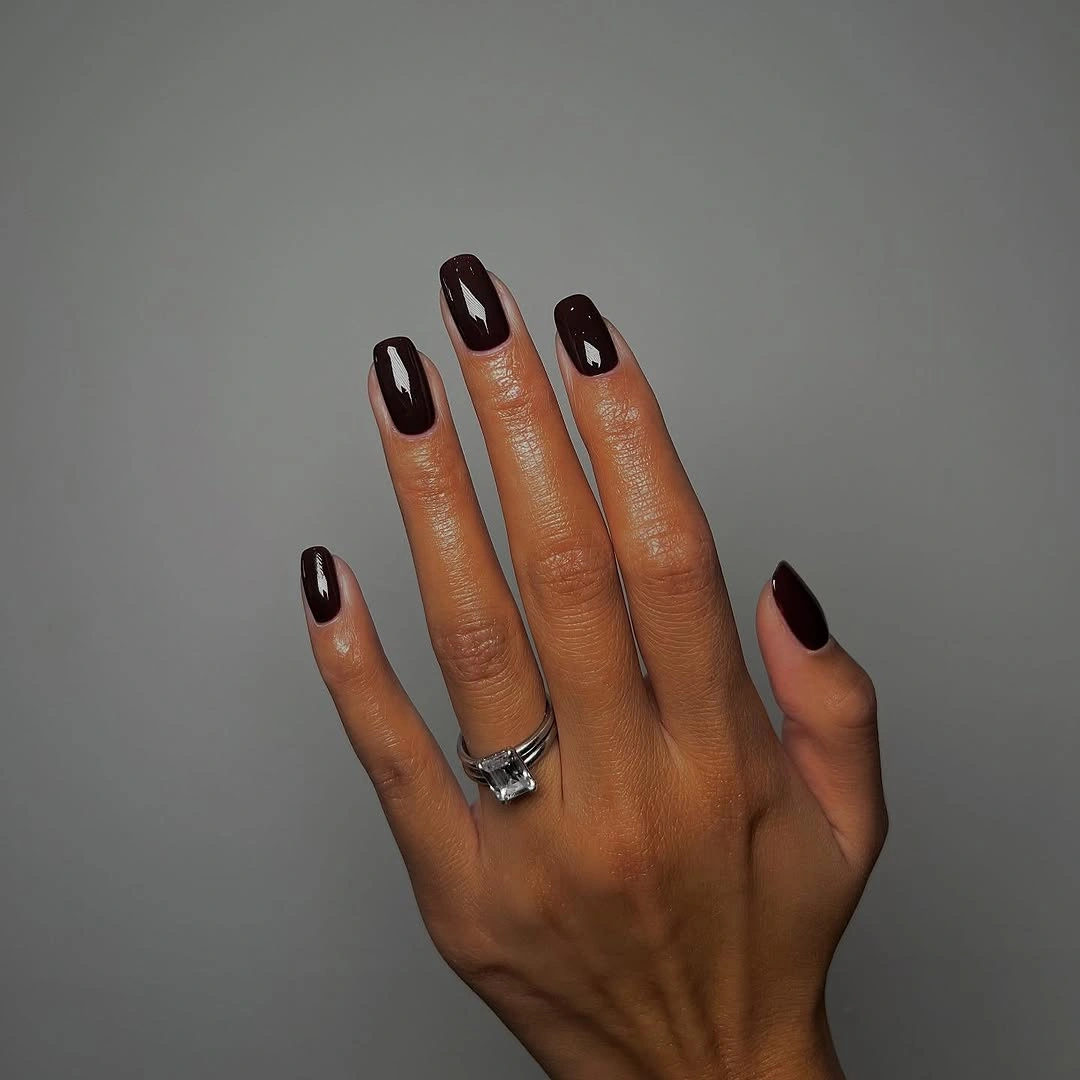
Short nails often benefit from a single color with clear value because there is less surface area for a pattern to establish itself. Here, the dark polish creates contrast through depth rather than through extra detail, and the rounded corners prevent that contrast from looking overly sharp. If you prefer a little more brightness, shifting toward the brick-red tone in the next look would keep the same autumn weight with less visual severity.
The practical tradeoff is visible wear at the free edge: a very dark, uninterrupted finish does not hide small chips the way a mixed design can. Keeping every nail at a similar length matters as much as the shade itself. This is a strong choice for someone who wants a manicure to function like a deep neutral accessory rather than the focal point of an outfit.
Orange Stripes and Rich Autumn Accents
Orange, ivory, burgundy, and warm brown are pushed to their most decorative range on these long pointed nails. Fine stripes, leaf-like details, small flower forms, and jewel-like accents share the hand, but the repeated orange keeps the many decisions connected. The sharp length gives each motif its own space, so the design reads as intentionally layered instead of crowded into one central patch.
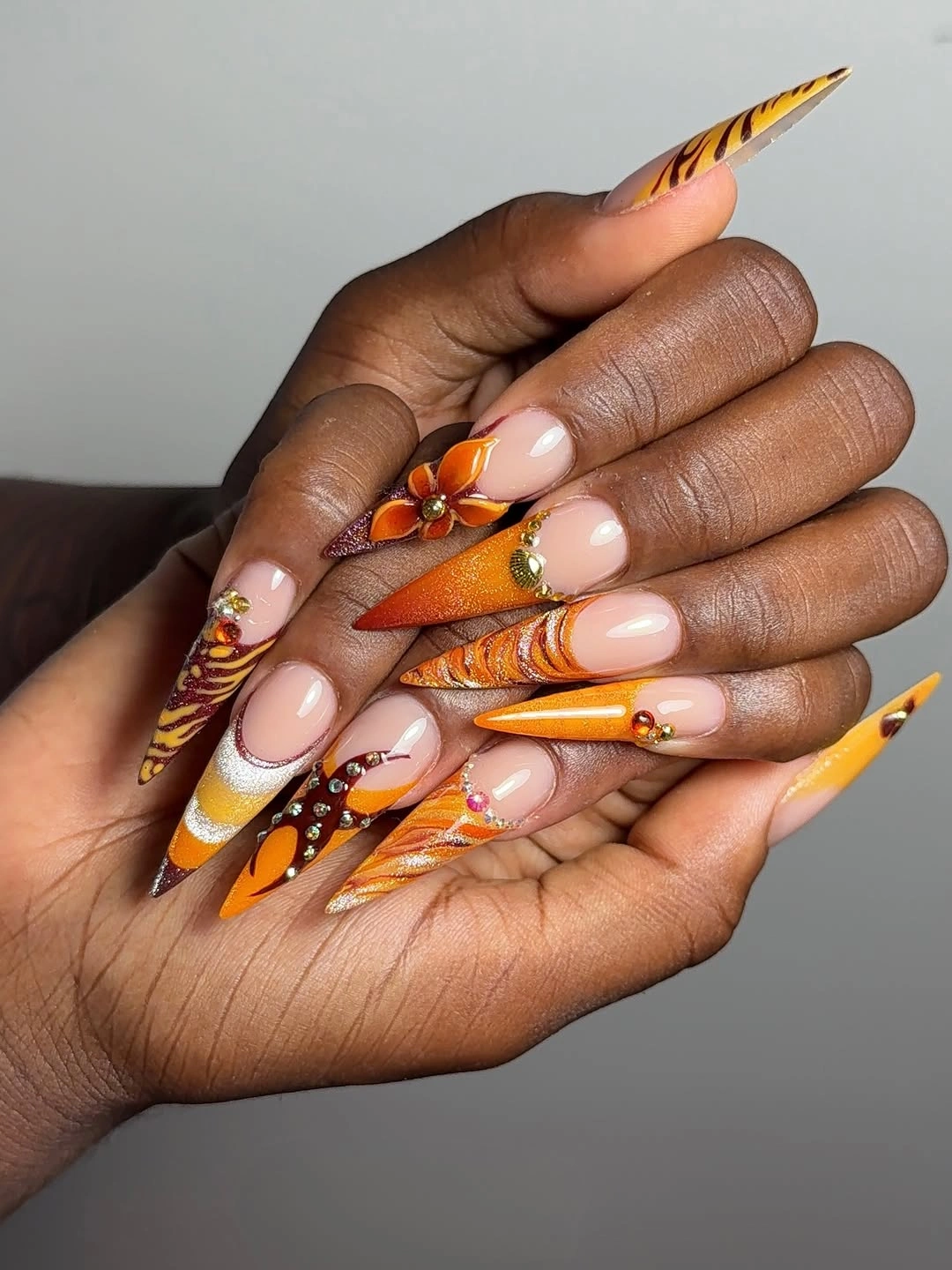
Color repetition is doing more work than symmetry here. A warm orange appears in several places, burgundy returns as a darker counterweight, and pale sections stop the animal-inspired lines from becoming visually heavy. That is a useful strategy for fall color nails for olive skin: choose one warm note to repeat, then let the darkest details frame rather than dominate the palette.
A reduced version should not try to copy every nail. Pick either the striped orange theme or the floral-and-gem idea, then keep the other nails in burgundy and ivory solids. The full treatment asks for length and a taste for detail; a restrained version keeps the same color story but makes daily maintenance and outfit pairing much easier.
Warm Brick Red Almond Shape
A warm brick red gives this medium almond manicure a softer fall presence than the near-black wine finish. Because the color is even across each nail, the shape becomes noticeable: the tapered sides lengthen the hand, while the rounded tip keeps the red from looking too formal. Olive undertones can make this kind of earthy red feel integrated with skin rather than sharply separated from it.
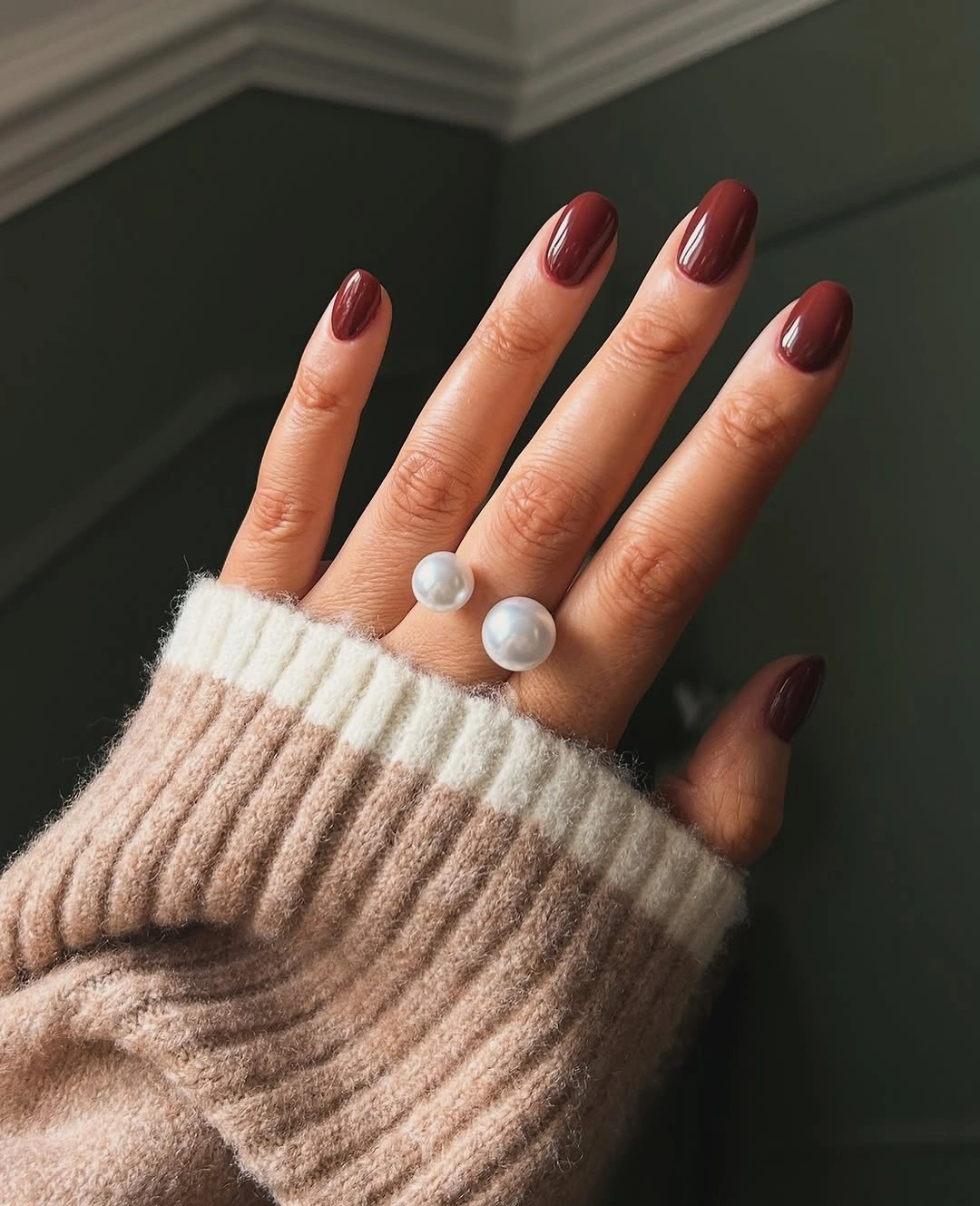
Value, not ornament, creates the appeal. Brick red sits between brown and true scarlet, so it offers visible warmth without the high contrast of a bright red or the drama of oxblood. That middle position is useful when you want an autumn color that still works with denim, camel knits, and darker evening fabrics without competing with every texture around it.
Choose this direction if you want the polish to read polished from a distance and quietly warm up close. A shorter oval version would make the color feel even more practical, while a longer almond increases its presence. The limitation is simply that a solid finish offers no visual distraction from uneven shaping, so filing the sidewalls evenly is part of the final look.
Cool Blue and Charcoal Solid Mix
Charcoal, smoky gray-blue, cobalt, and a dark brown-black are arranged as separate short nail colors instead of blended into one pattern. The result feels intentional because the colors share a low, moody value even when their temperature changes. Cobalt supplies the strongest saturation, while the gray and dark neutrals keep that blue from becoming the only thing the eye notices.
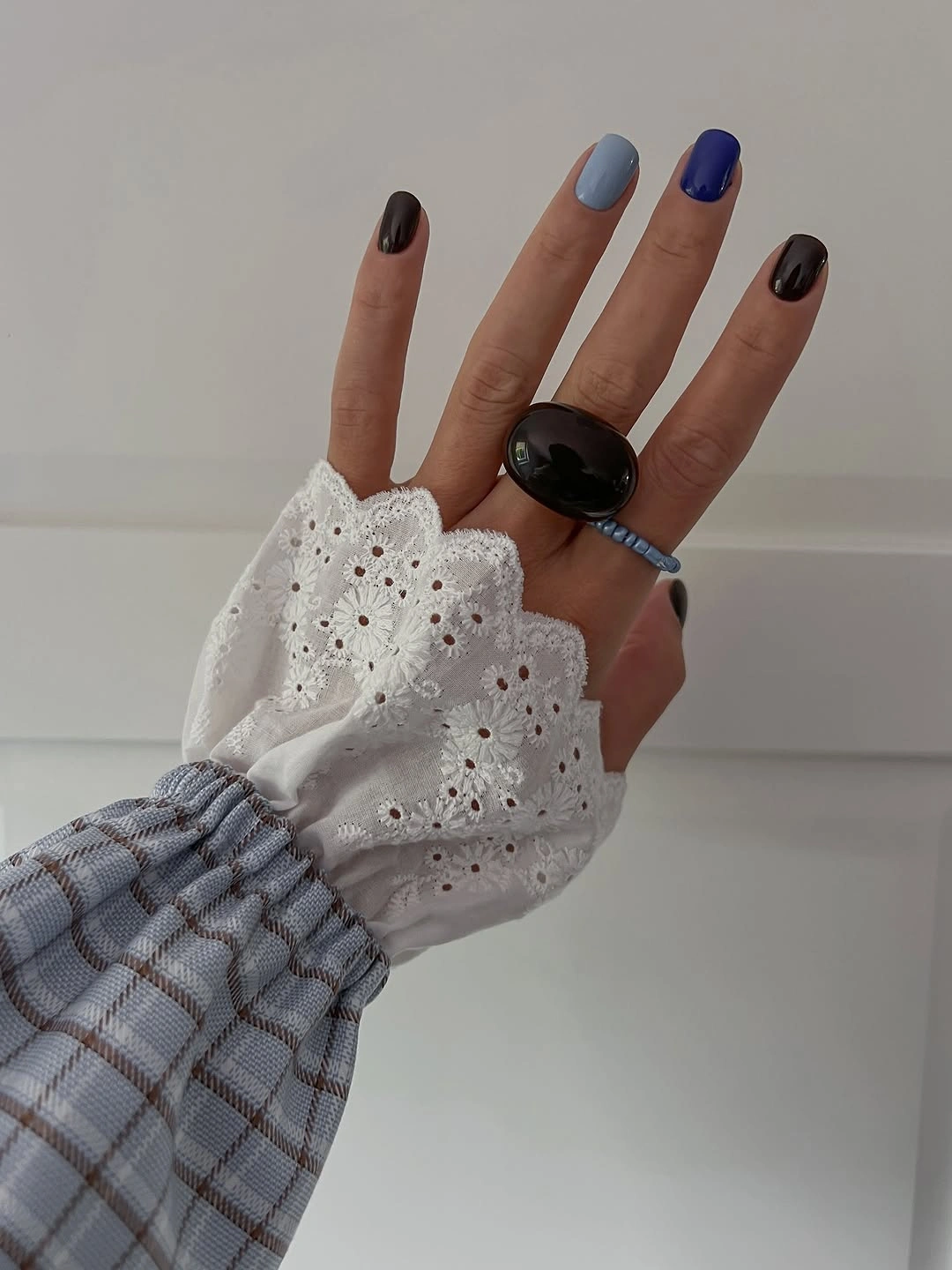
Mixed solids are most convincing when the hand has a clear tonal center. In this case, the darkest shades behave like anchors and the lighter gray-blue functions as a pause between them. Someone drawn to cooler fall colors can use the same logic with slate, navy, and softened teal, changing only one variable at a time instead of adding a new bright color to every finger.
The main tradeoff is that a random assortment can look disconnected if the finishes or undertones drift too far apart. Keep every shade glossy or every shade softly muted, and repeat the deepest color at least twice if possible. This option is useful when you want variety without committing to line art, gems, or a full accent nail.
Emerald Waves with Open Negative Space
Saturated green follows the tips and sidewalls of these nude almond nails in loose, wavy paths. The curve leaves a broad portion of the base visible, which makes the green feel lively rather than dense. The dark-to-light contrast is clear, but the movement of the lines softens it, allowing the design to sit between a French manicure and a graphic abstract accent.
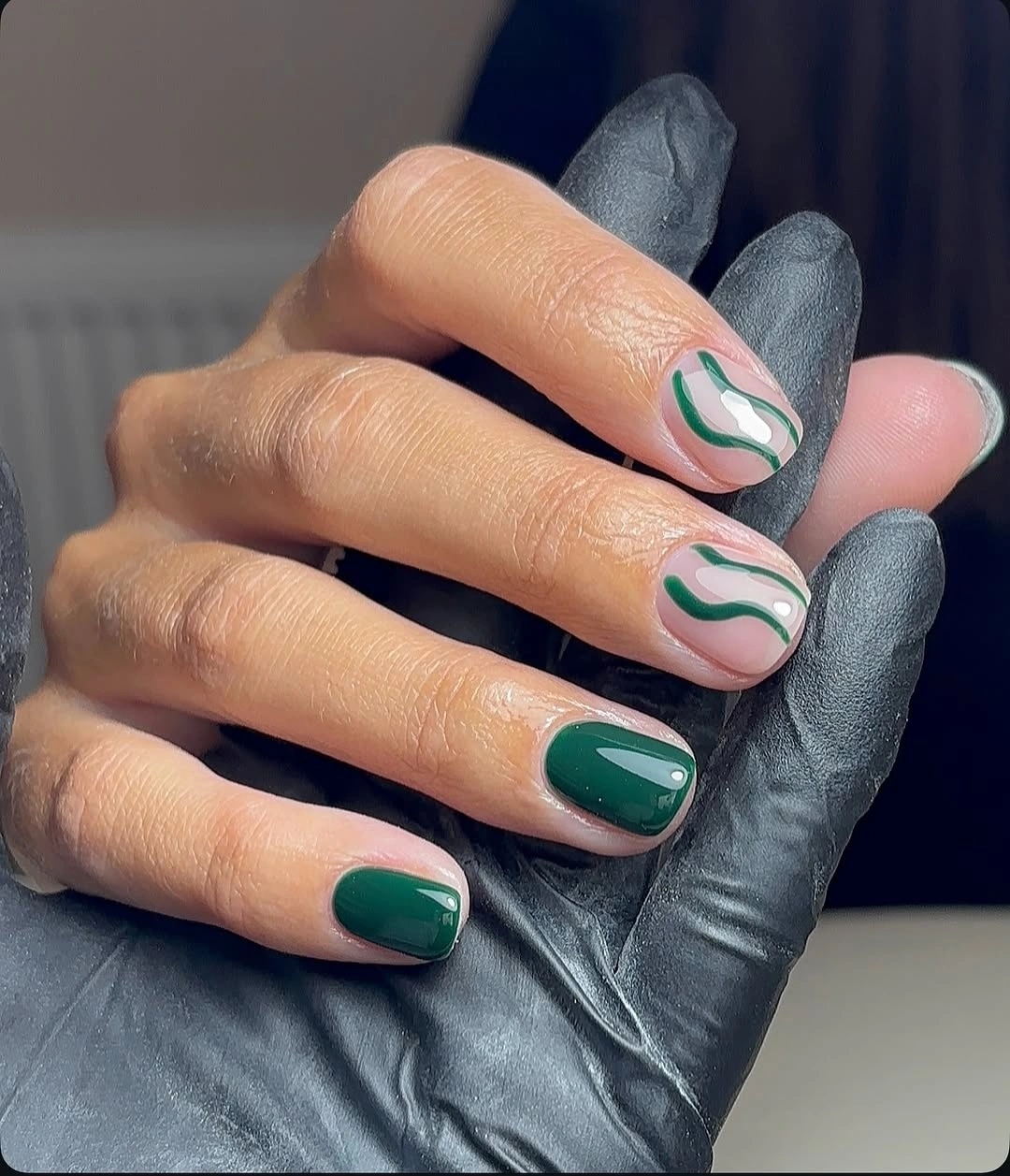
Negative space is the key color relationship here. By exposing the pale base, the green gets to read as an accent with a defined edge instead of a block of coverage. That approach can flatter olive skin particularly well because the green is intense, while the surrounding nude area prevents it from pulling the overall manicure too cool or too dark.
On shorter nails, make one slim curve instead of several broad ones and let the line begin near the tip. That small adjustment preserves the sense of movement without taking over the nail plate. A fuller green edge will create a stronger fall statement, but it also makes new growth more noticeable when the manicure begins to soften at the cuticle.
Plum Chrome Curves on Sheer Almonds
Reflective-looking plum sections sweep across a sheer nude base in curved, asymmetrical shapes. The long almond silhouette gives those dark arcs enough room to appear fluid, while the unpainted sections keep the finish from reading as a complete metallic cover. Deep plum is the visual anchor, but the spacing lets light and base color remain part of the composition.
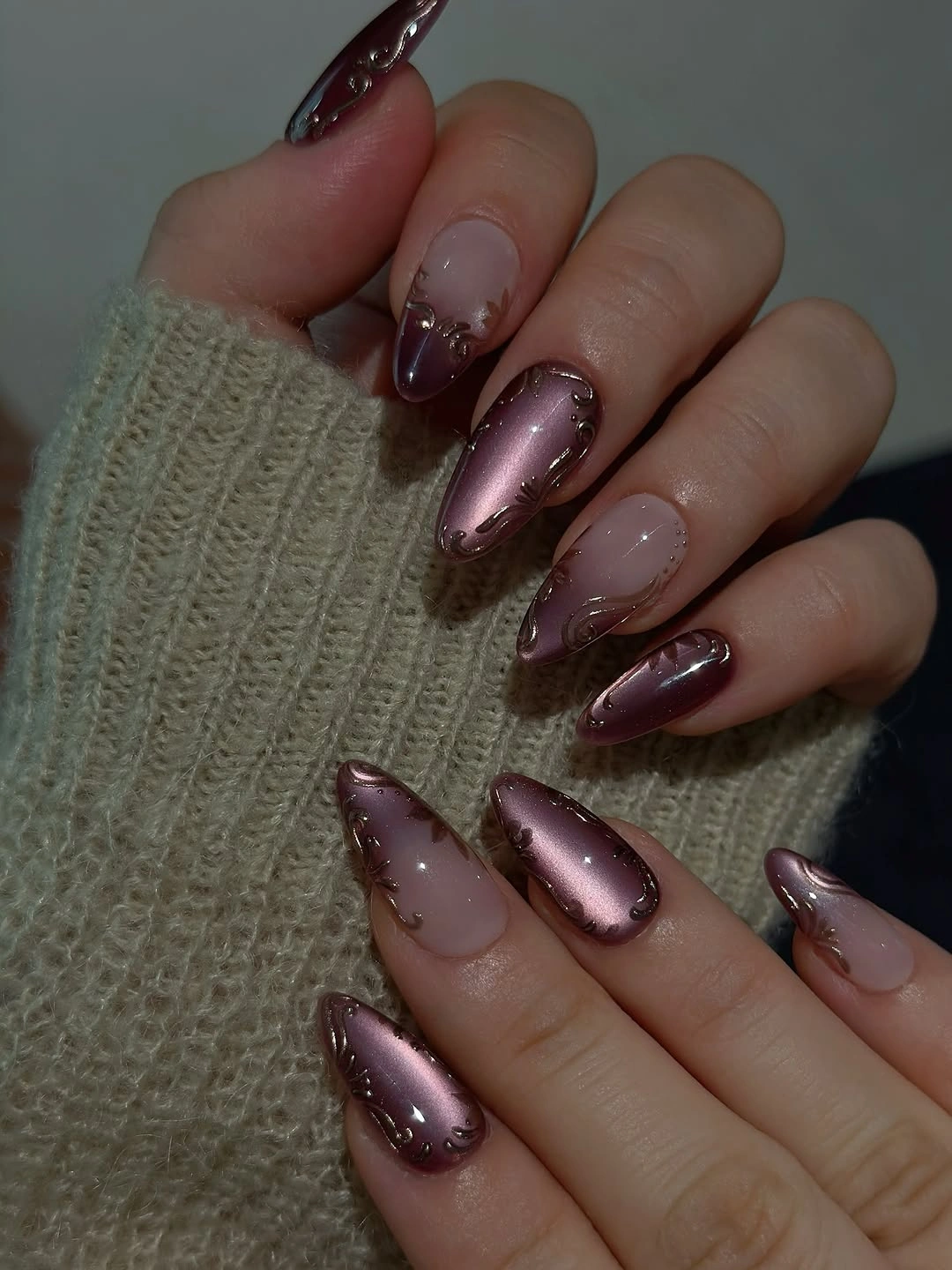
Rather than relying on a warm-versus-cool contrast, this manicure uses finish and placement to create depth. The glossy plum looks strongest where it gathers along the tip, and the lighter interior makes the curve feel more dimensional. A wine-colored accent placed this way is a useful compromise for anyone who likes dark fall nails but does not want every nail covered in a heavy shade.
A careful version would keep the dark arcs slightly different from nail to nail, since identical curves can feel stiffer than the flowing lines shown here. The reflective sections may reveal edge wear faster than a plain sheer base, especially near the tip. Still, the partial coverage gives grow-out more softness than a full plum manicure would offer.
Autumn Charms Across Long Pointed Nails
Brown French curves, burgundy bands, white dots, a small green sprig, and raised gold-brown detail give each pointed nail a separate job. The set is maximal, yet the repeated earth tones prevent the individual motifs from becoming unrelated. Long length is important here because it creates room for the decorative elements to sit beside one another instead of stacking into the same visual zone.
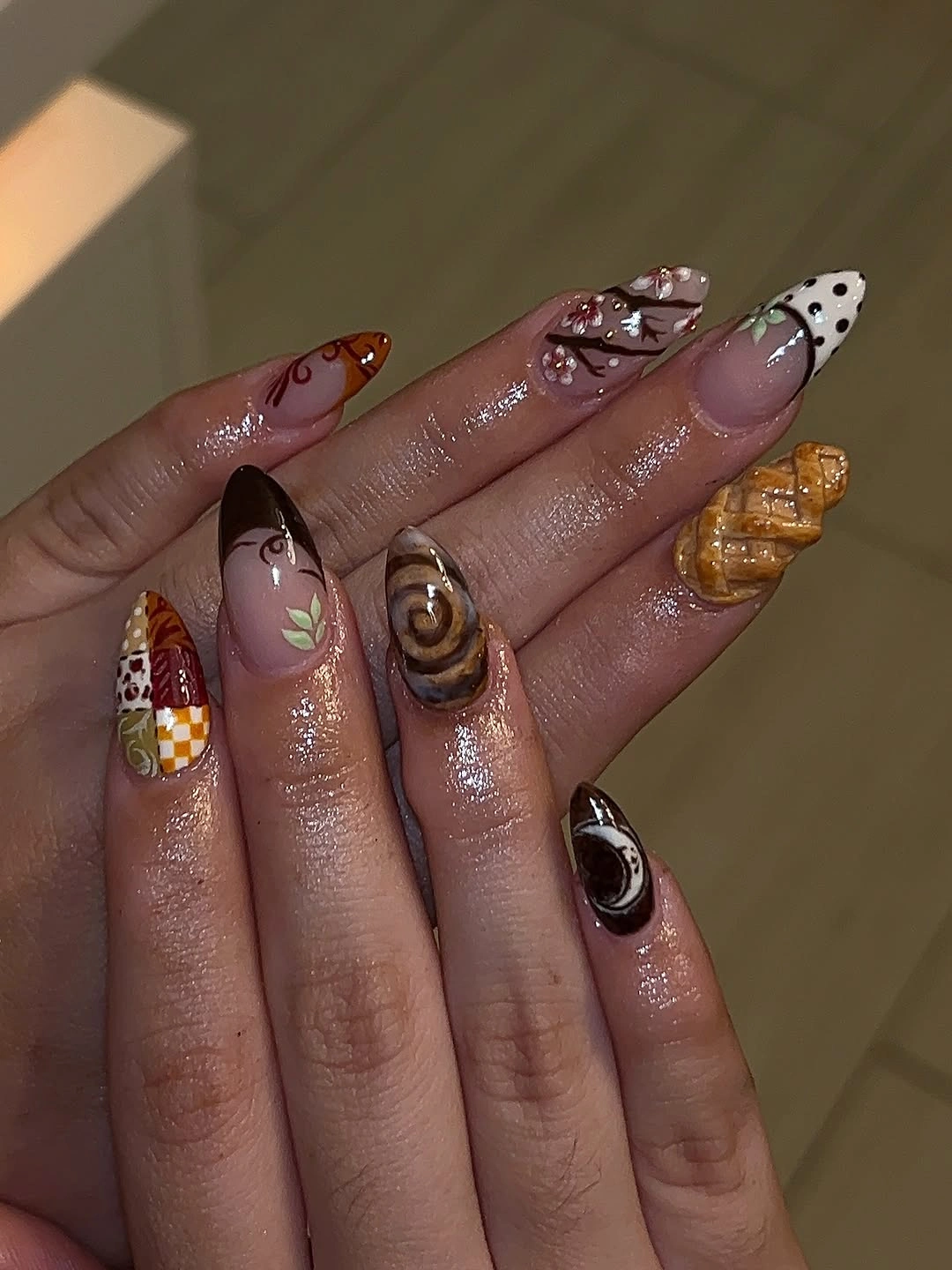
Notice how the pale base stays visible behind the busier nails. That neutral space is what makes the tiny dots, curved edges, and dimensional accent feel readable, especially against olive skin where warm browns can otherwise blend into a single dark mass. A mixed manicure like this benefits from assigning one dominant color family before choosing individual decorative symbols.
For a more wearable interpretation, select three ingredients only: a burgundy curve, a brown French tip, and one small botanical accent. Keeping the raised detail on just one nail also makes the hand easier to live with. The full version is a deliberate statement, not a rule for every seasonal manicure, and its appeal lies in that abundance.
Brown Outline Nails with Tiny Red Details
Sheer nude almond nails are edged with warm brown, then interrupted by a small red dotted area and a delicate gold floral-like detail. The design is light in coverage but rich in focal points, which creates a slower visual rhythm than a broad French tip. Each accent sits against a visible neutral base, letting the warm tones look precise rather than muddy.
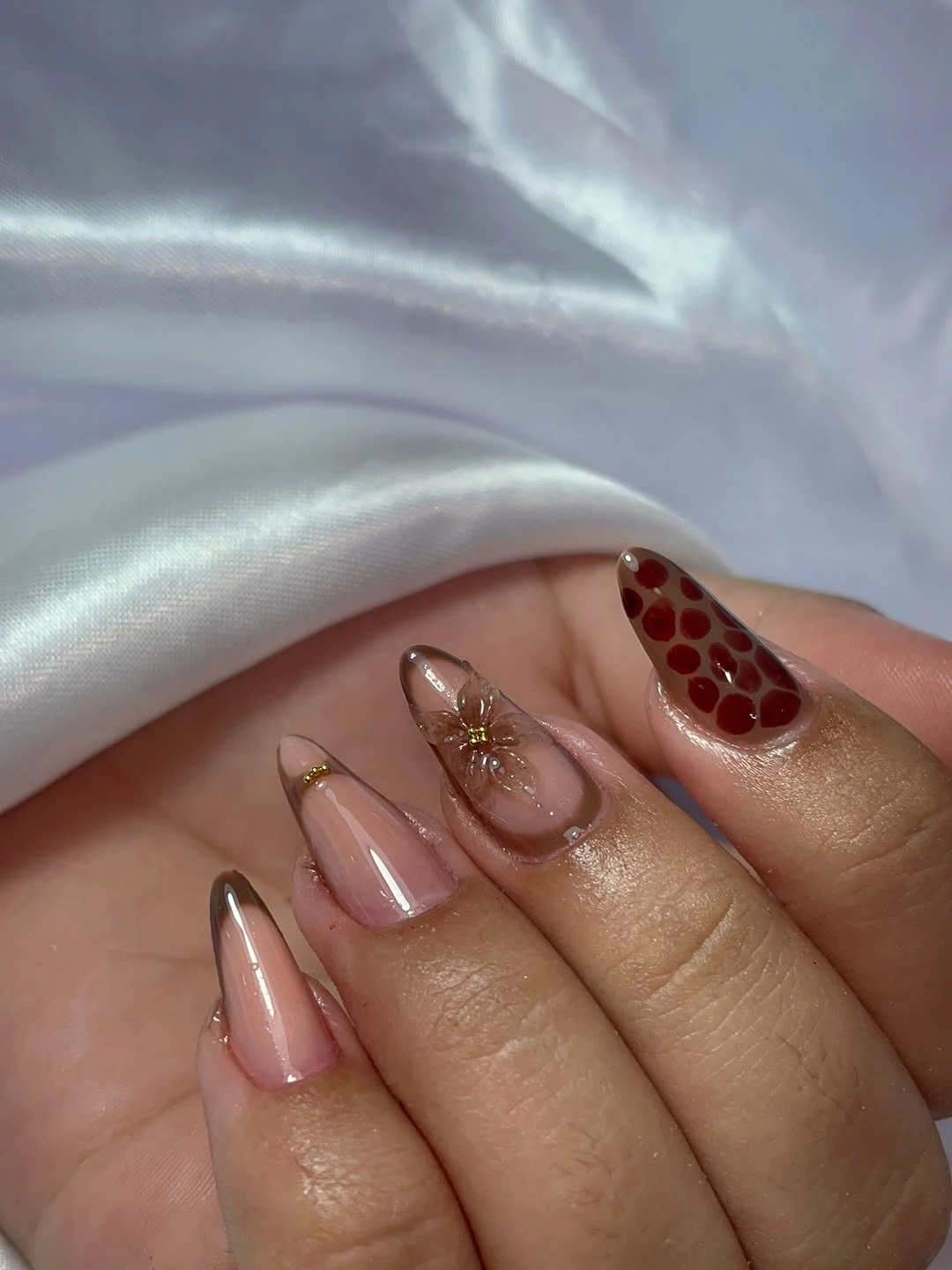
Brown works especially well as an outline when the goal is warmth without the severity of black. It gently frames the nail shape, while the red and gold moments introduce saturation in very small doses. The same principle can help when choosing fall nail colors with chrome and French details: preserve a calm base before adding the strongest accent.
Fine edge work asks for restraint. If the perimeter becomes too thick, the long almond shape loses the open quality that makes this idea distinctive. A shorter nail can use the brown along one side and a single red dot near the tip, retaining the warm contrast while avoiding an outline that visually shortens the nail plate.
Burgundy Outlines and Small Floral Marks
Pale short nails receive a curved burgundy outline near the tips, with tiny orange-brown floral marks breaking up the border. The dark curve gives the rounded shape definition, while the flowers keep the palette from becoming entirely wine-toned. Because the art is compact and placed near the edge, the soft base still supplies most of the lightness in the manicure.
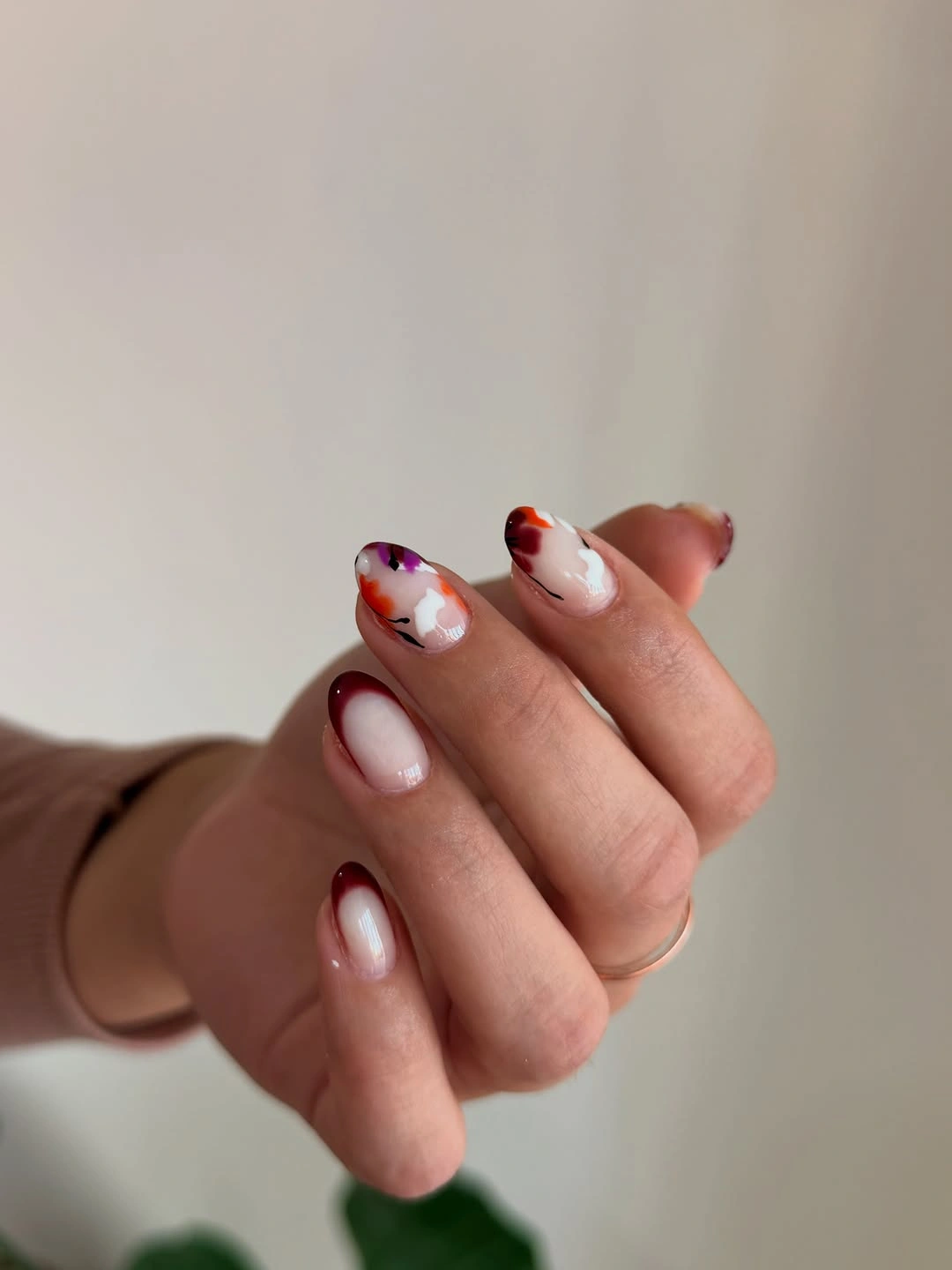
Scale makes this version more practical than a full painted flower design. The burgundy line acts like a framework, then the small warm marks deliver the seasonal note without requiring every finger to become an illustration. That is a useful compromise when you want a fall motif on short nails but still prefer an overall effect that looks clear from arm’s length.
Keep the floral marks limited to a few nails if the burgundy tip is already broad. Adding too many small symbols would make the short surface feel crowded and weaken the clean curve. A cooler red-brown border would give a quieter result, while a brighter red would increase contrast and turn the manicure into a more playful statement.
Orange Abstract Motifs on Milky Pink
Orange, yellow, and white marks sit over a milky pink almond base in an abstract, flower-like arrangement. The light ground makes the warm colors look clean and buoyant, and the medium length gives the small shapes a little room to repeat without touching. This is a more cheerful approach to fall color than the wine and brown looks, yet the warm palette still keeps it seasonal.
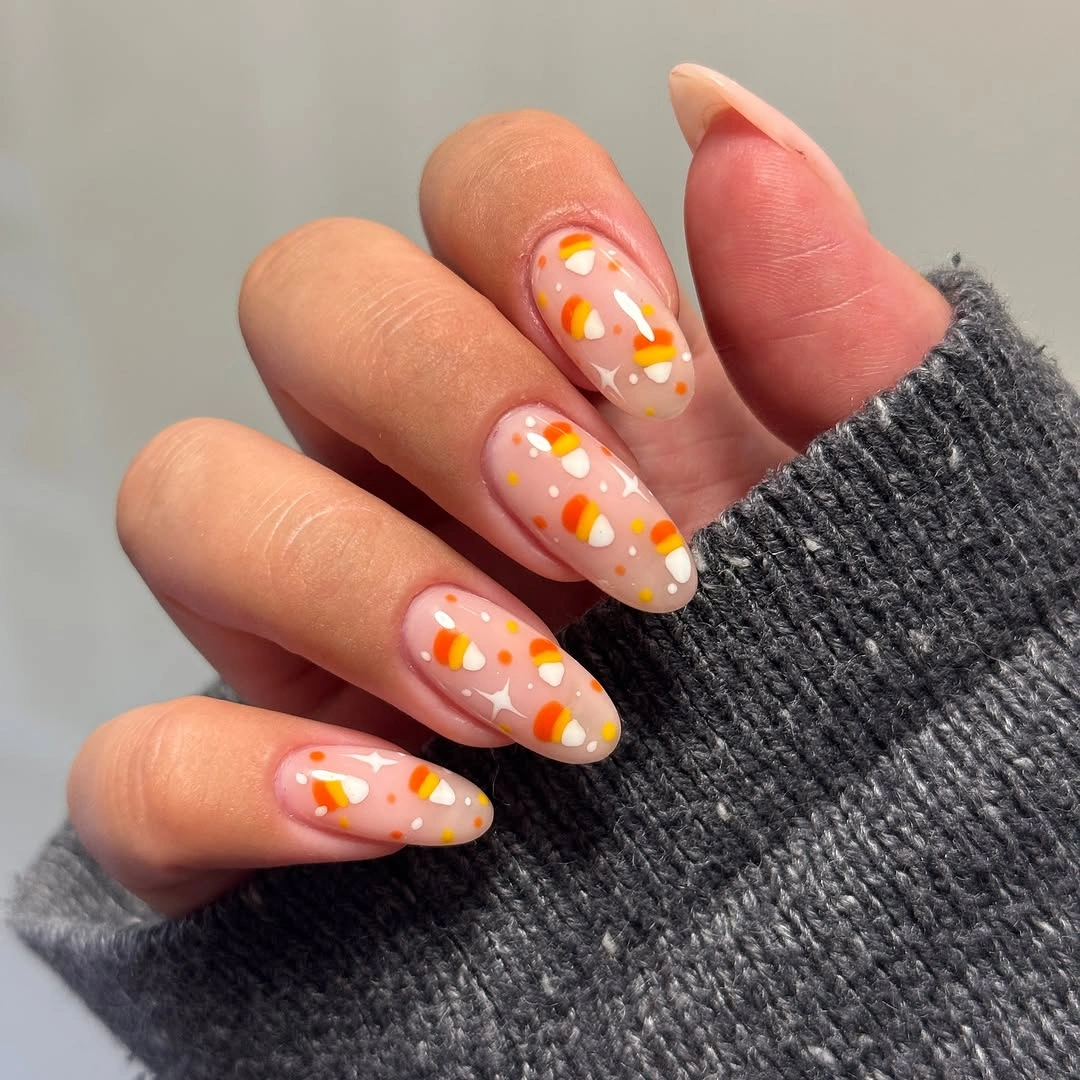
Instead of making contrast through darkness, this design relies on saturation against a soft value. The pink base acts as a buffer between the warm motifs, so orange can look lively without becoming harsh. That is useful for olive skin when you want brightness but prefer a color story that remains gentle next to the natural warmth of the hands.
A minimal adaptation could paint the abstract marks on two nails and leave the others in milky pink or soft peach. That change keeps the upbeat effect while reducing the amount of visual information. The limitation is precision: uneven small shapes can look accidental, so the design benefits from keeping the individual marks loose but clearly separated.
Black French Edges with Tortoiseshell Panels
Black French edges frame mottled beige-brown panels on these long almond nails, with tiny gold stud-like details adding another point of contrast. The dark edge supplies definition, while the warmer interior prevents the result from feeling entirely black. Each component is visually distinct, but the long tapered shape keeps the pattern moving in the same direction from cuticle to tip.
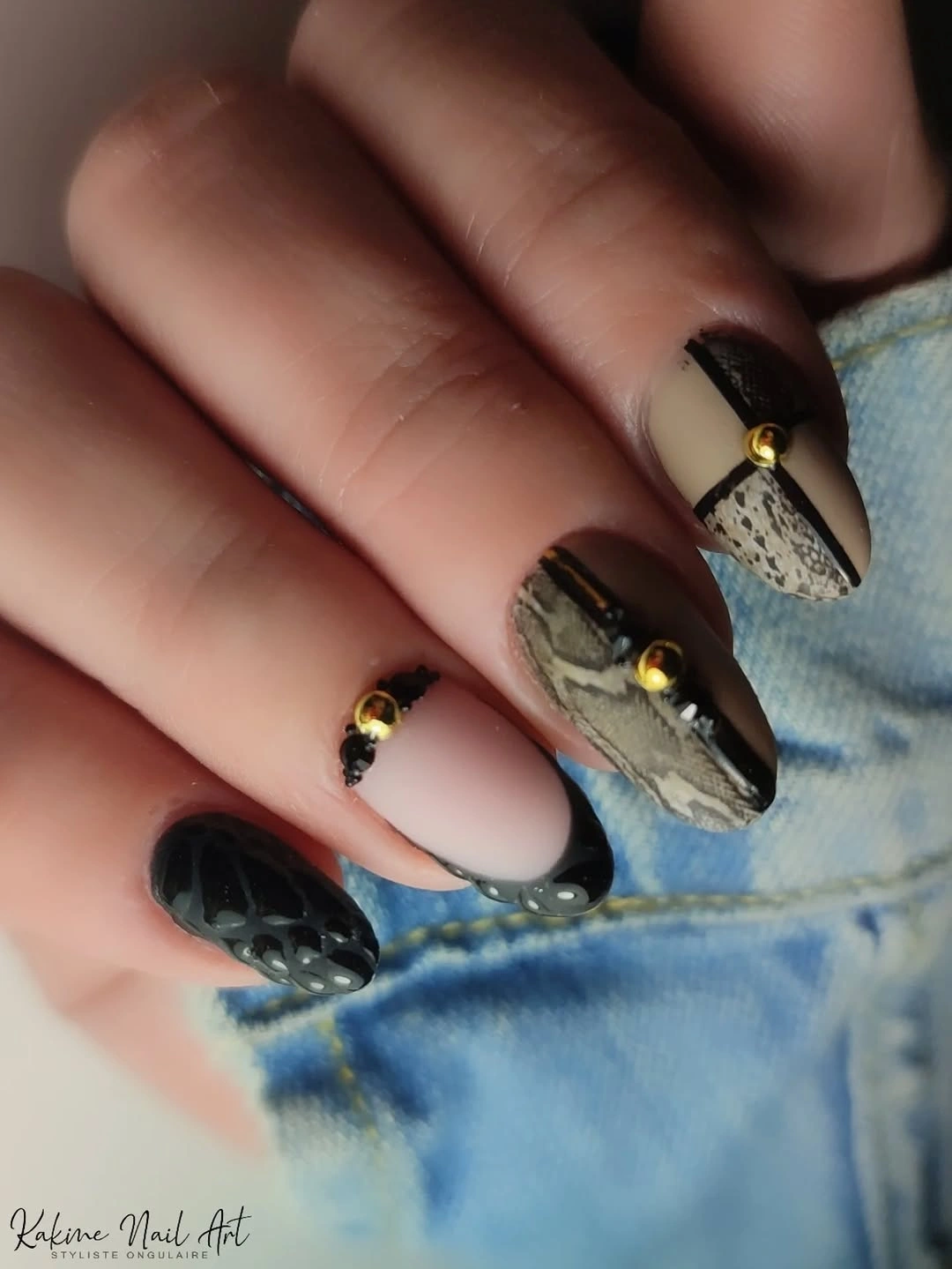
The strongest relationship here is between a hard border and a softer irregular pattern. Black makes the tortoiseshell-style sections appear more deliberate, and the warm mottling keeps the black from looking flat. Someone who enjoys darker fall manicure colors can borrow this method by using only one patterned accent, then repeating the black edge on the remaining nails for a more controlled result.
Because the contrast is high, reducing the nail length will make every component look more concentrated. On a shorter almond, choose a slim black French edge with one mottled accent rather than a panel on every nail. The small gold additions should remain occasional; too many reflective points would compete with the already active brown pattern.
Green Sprigs with a Rose Gold Accent
Fine green sprigs and dots travel over nude almond nails, while one full rose-gold glitter nail shifts the set from botanical to celebratory. The quiet base keeps the leafy details legible, and the glitter has enough contrast to act as a single clear focal point. Olive undertones support both the muted green and warm metallic accent without forcing either color to look overly bright.
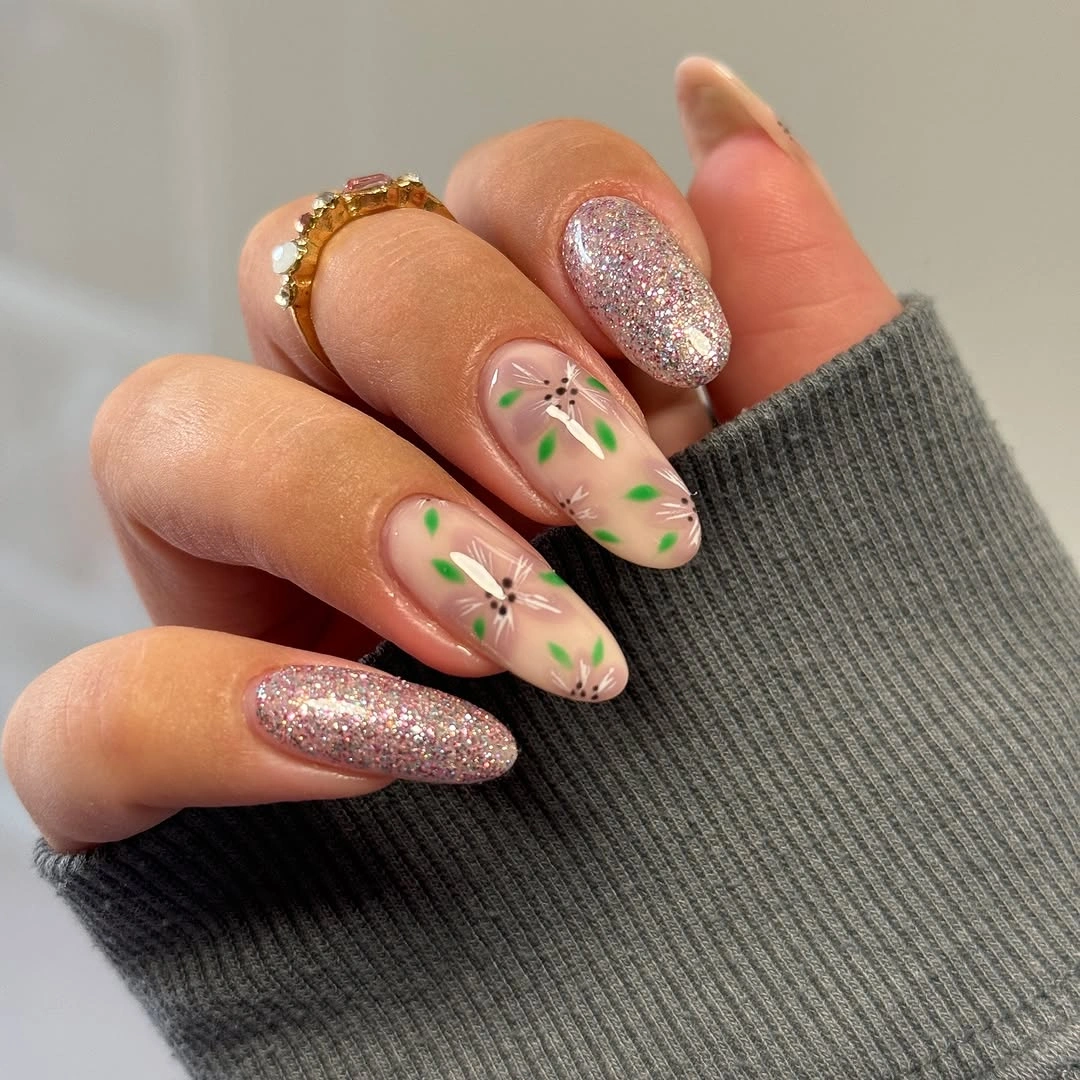
Repetition is carefully limited in this manicure. Green appears as a thin drawing rather than a full block, then the metallic accent introduces a completely different finish on one nail only. That division makes the glitter feel intentional instead of scattered. If you like subtle fall nail art, this is a helpful formula: one textured accent, several fine line details, and a visible neutral base.
For a lower-shine version, replace the full glitter nail with a small rose-gold detail near one tip. The foliage will then become the main story rather than a supporting element. Keeping the green marks narrow is important, since thicker leaves would change the design from delicate and airy to more heavily illustrated.
Textured Green and Animal Print Squares
Short square nails combine a raised-looking green texture, dark reflective sections, and a small animal-print area. The tactile-looking surface gives the manicure its personality, while the darker nails keep the unusual green from floating alone. Even on a compact shape, the variety is readable because each texture or print occupies a separate nail rather than competing inside one small space.
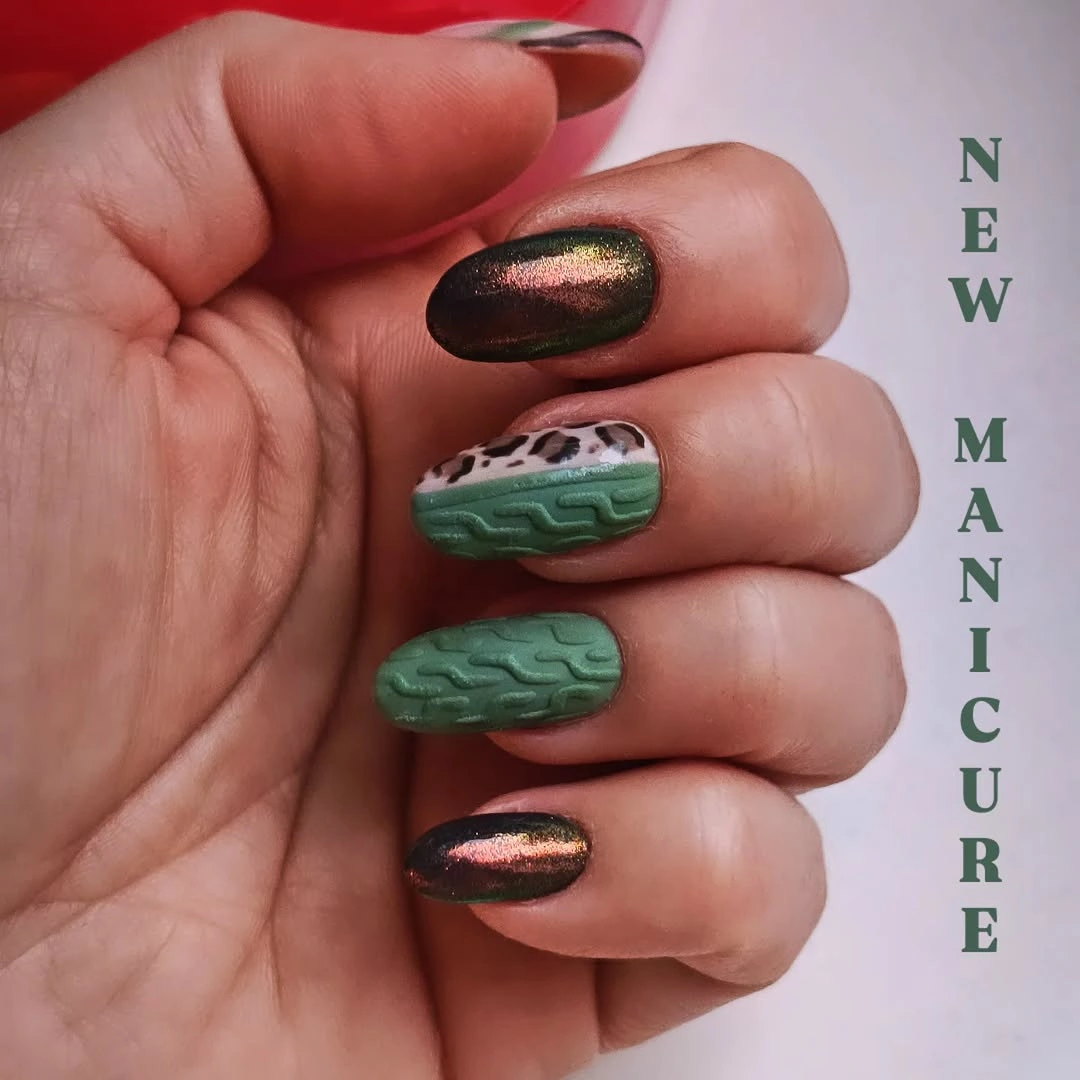
Surface contrast replaces color contrast in much of this look. The green appears more interesting because it has a visible knit-like pattern, and the dark glossy elements offer a smoother counterpoint. That contrast is useful for a fall manicure when you want depth but do not want to introduce another bright shade or a large painted illustration.
Texture can make high-contact areas look worn sooner, so this direction suits someone comfortable with a design that invites close attention. A simpler version could keep the green texture on one accent nail and use plain deep brown or plum on the rest. The animal-print detail should remain small, otherwise the varied finishes will start to compete rather than support each other.
Peach Almonds with White Contour Waves
Peach-pink almond nails carry fine white contour waves that follow the length of each finger. The warm base has enough saturation to feel present, but the narrow white lines never overpower it. Their repeated curves create movement without requiring a motif, making the manicure feel softer and more graphic than a standard French tip.
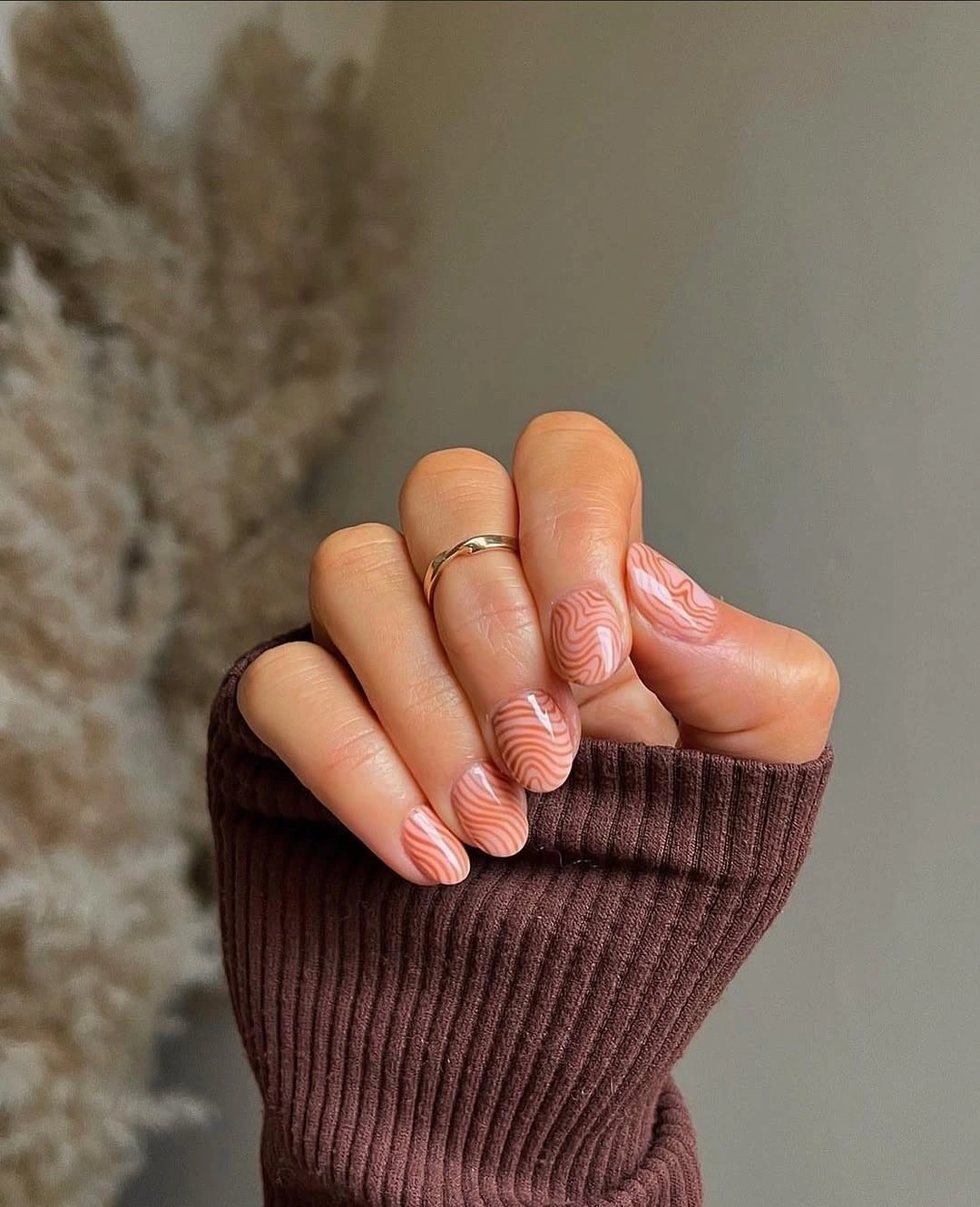
Line placement changes the effect more than color variety does here. The waves travel in slightly different directions, which prevents the set from looking stamped or rigid, while the repeated white links every nail together. On olive skin, the peach base maintains warmth and the white highlights provide a light, clean contrast that is easy to pair with neutral clothing.
To simplify the idea, use one white curve per nail and leave a wider peach margin around it. That keeps the flowing effect but reduces the amount of precise line work required. A bolder version could deepen the base toward terracotta, although doing so would make the white stripes appear sharper and more visually assertive.
Deep Plum Brown on Rounded Short Nails
Rich plum-brown polish covers these short oval nails without any competing accent. The warm dark color has enough red in it to avoid the flatness of black, and the rounded edge gives the manicure a softer outline than a squared shape would. It is a compact fall choice that relies on depth and clean proportion rather than painted detail.
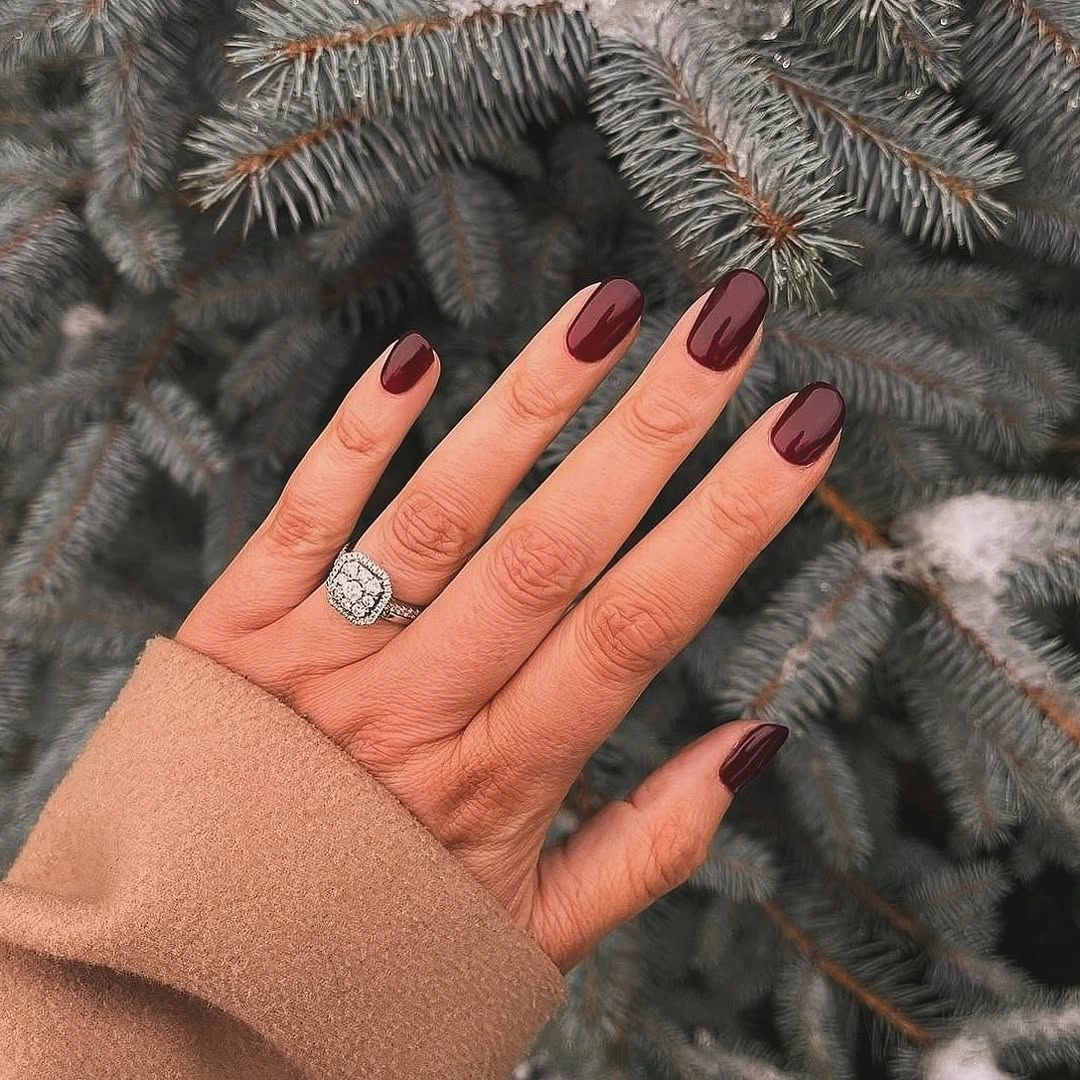
Olive skin can make a dark warm neutral like this feel especially cohesive because its brown and wine notes echo natural warmth rather than creating a stark cool contrast. The glossy finish adds the needed lightness, reflecting along the curve of each short nail. That small finish change is why a dark solid can still look dimensional without glitter or chrome.
Consistency is the practical priority. A rich solid color highlights differences in nail length, so keeping the rounded ends even will matter more than choosing an elaborate accent. If you want less depth, shift toward brick red; if you want more drama, choose the near-black oxblood seen earlier. This shade sits comfortably between those two extremes.
Brown Marble Tips with Gold Leaf Details
Warm brown marbling gathers near the tips of nude almond nails, then meets small gold leaf-like accents. The base remains visible through much of the design, which gives the patterned area a lighter effect than a full brown manicure. Gold brings brightness to the darker marks, creating a warm, layered finish without requiring an all-over glitter treatment.
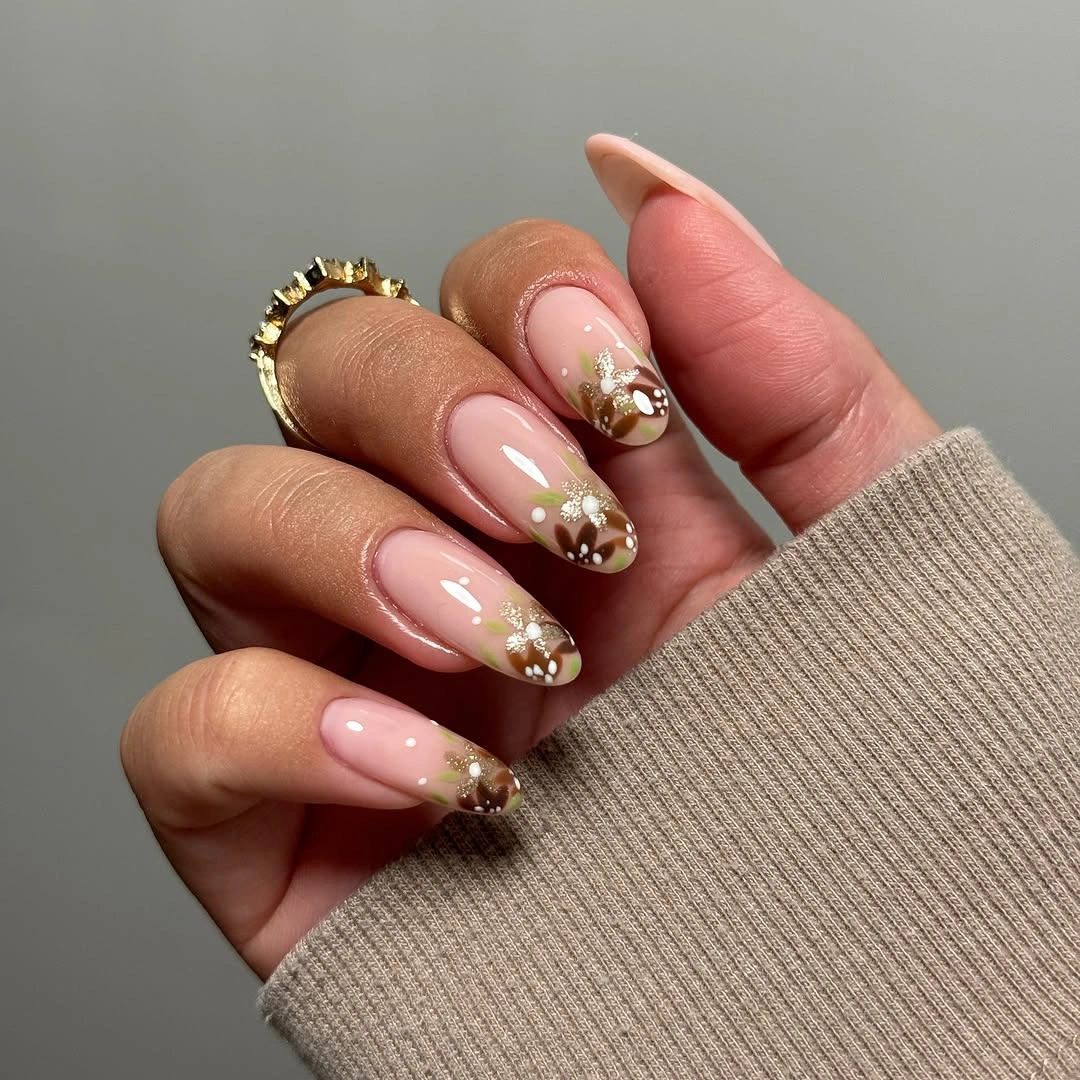
The visual success comes from concentrating the highest contrast at the free edge. Brown and gold sit together at the tip, while the nude center keeps the hand from looking overly decorated. That placement also lets the almond shape stay apparent, since the narrow pale zone near the cuticle continues the length of the nail instead of cutting it off with a dark band.
For a more practical version, choose either marbling or gold leaf rather than layering both on every nail. One metallic accent can be enough to lift the brown pattern. The detailed tip will naturally draw attention as it grows out, so a clean nude base is helpful for anyone who prefers a softer transition between appointments.
Cobalt and Pearly Blue Graphic Squares
Saturated cobalt nails sit beside pearly pale-blue accents traced with white and fine metallic-looking lines. The short square silhouette makes the color blocks feel crisp, while the lighter blue gives the deeper cobalt a place to breathe. This is a cooler fall direction, but the mix of intense and softened blue keeps it from feeling one-note.
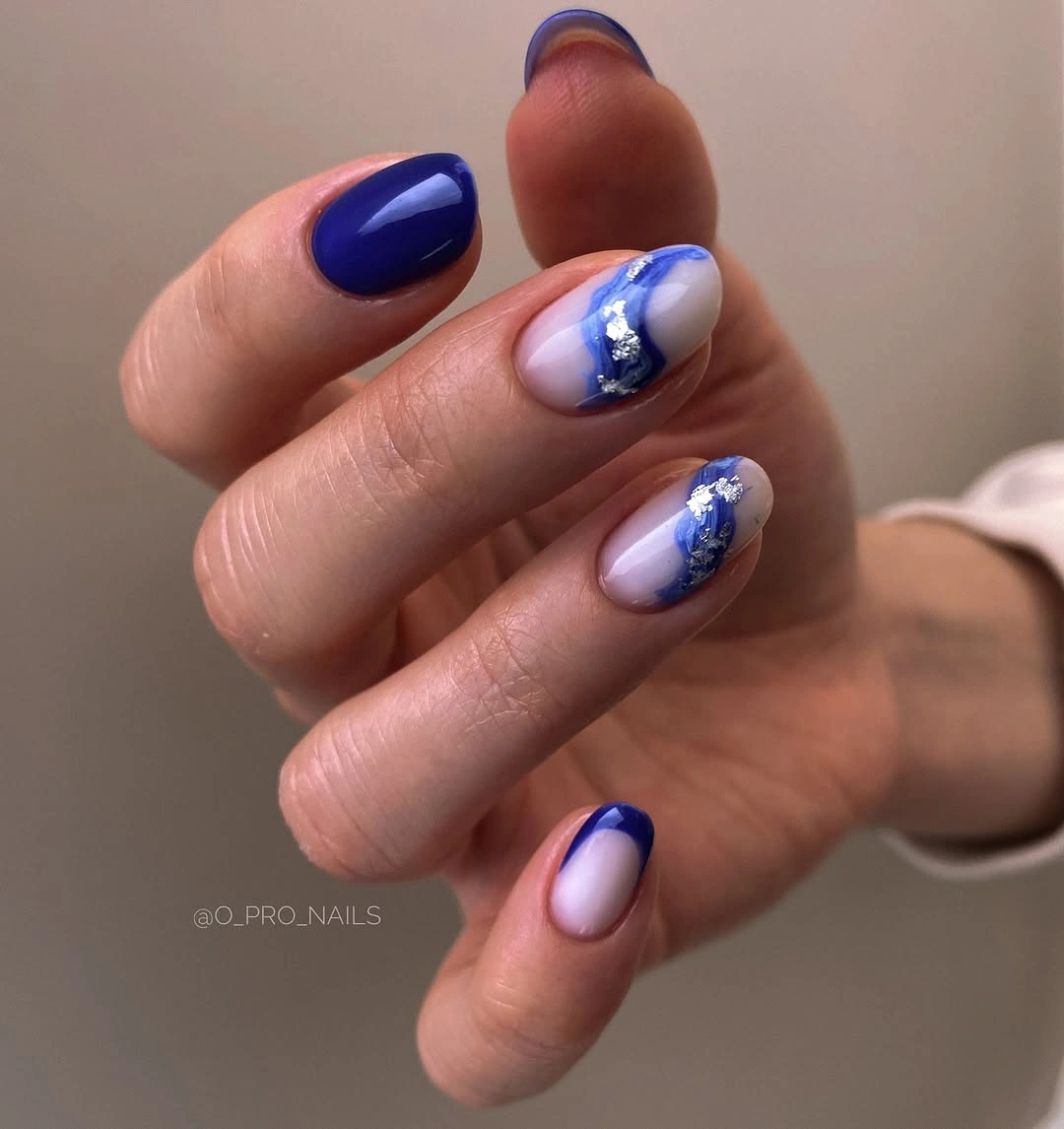
Value contrast, rather than a large pattern, gives the set its energy. Cobalt carries the strongest saturation; the pale accents reflect more light and create a visual pause between dark nails. The white tracing makes that lighter area feel intentionally graphic, which is useful if you want an abstract design that does not depend on floral or animal motifs to read as decorative.
Limit the line art to one or two nails if you prefer a simpler mixed-solid manicure. The square edge already reinforces the boldness of cobalt, so extra detail can make the short shape look busier than it needs to. A softer navy or slate substitution would lower the contrast while keeping the same cool-toned balance.
Tiny Dark Motifs on Nude Short Nails
Small dark and red marks sit near the tips of short nude-pink nails, adding personality without covering the base. The light ground stays visible across most of each nail, which is why the tiny motifs feel like punctuation rather than a full illustrated story. Their scale fits the compact length and keeps the manicure visually light despite the darker details.
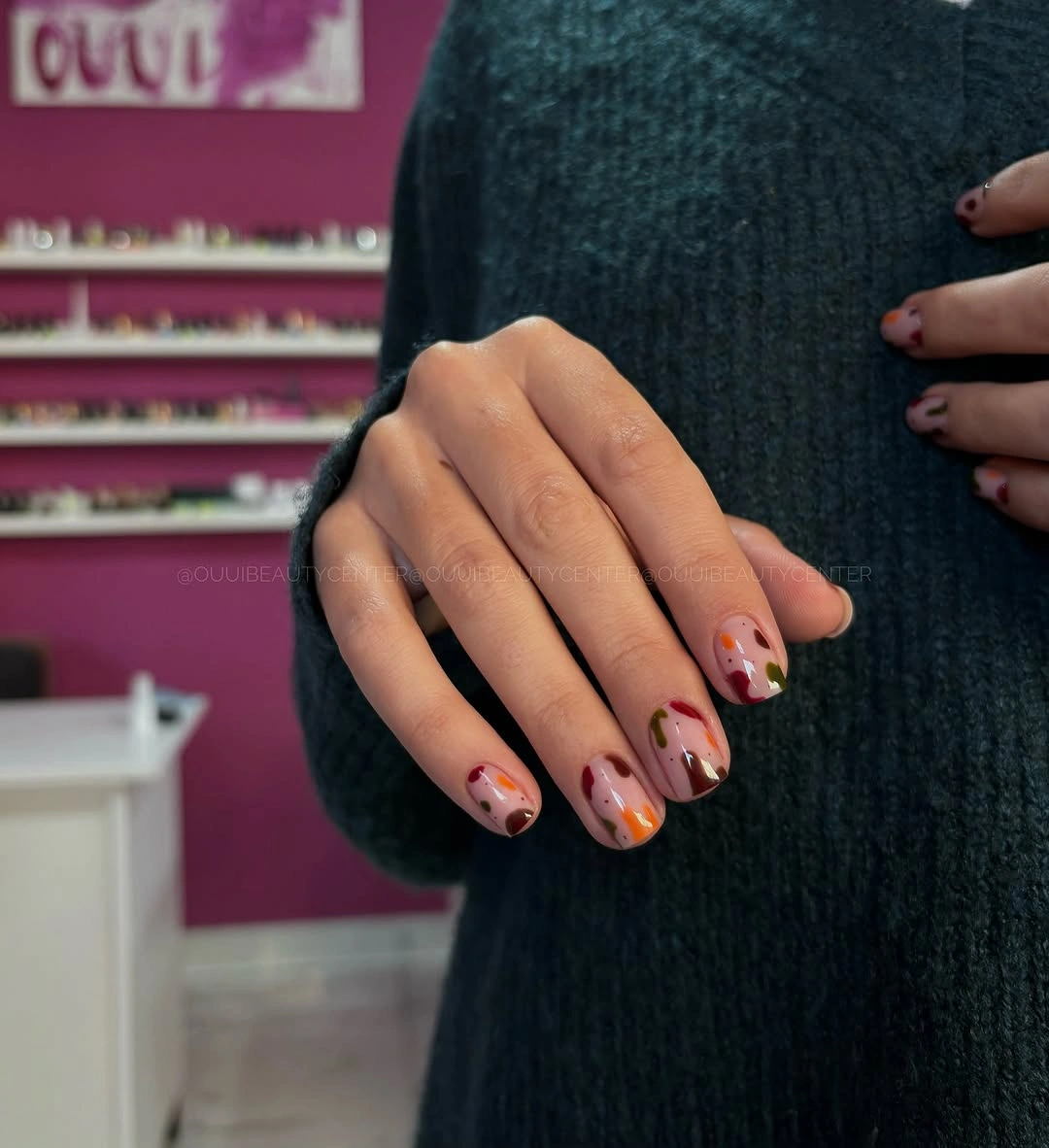
A sparse design like this depends on placement more than complexity. Keeping the marks close to the tip directs attention outward and leaves the cuticle area calm, while the nude base remains adaptable to different clothing colors. If olive skin fall nails usually feel too dark for your style, this approach shows how a small wine or black accent can still deliver seasonal contrast.
The limitation is subtlety: from a distance, the design may read almost like a natural manicure with a little edge. That can be a benefit for someone who prefers quiet detail. To increase its presence without changing the concept, enlarge one motif slightly on the ring finger and leave the rest of the hand as restrained as it is here.
Wine and Muted Green Alternating Almonds
Glossy wine red alternates with muted green across long almond nails, with no illustrated accents competing for attention. The two colors are distinct in temperature and value, yet both carry a softened fall mood that makes the contrast feel deliberate. The long taper helps each solid color read as a separate vertical line rather than a broad block across the hand.
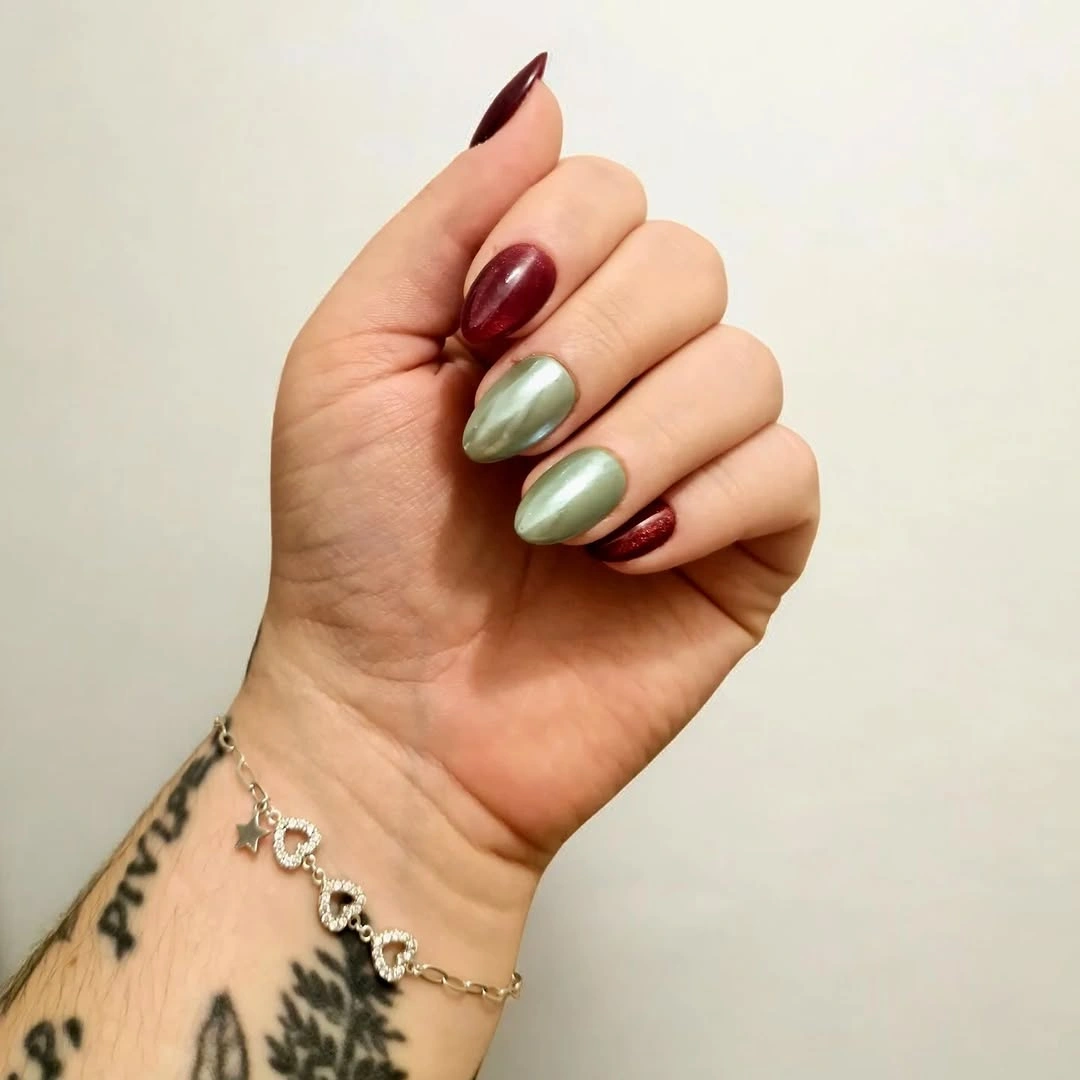
Two-color sets are strongest when neither shade has to explain itself through decoration. Here, burgundy brings warmth and depth, while the pale green provides a cooler, lighter counterweight. Repeating both colors across the hand prevents the palette from looking like a random accent choice, and it gives olive undertones multiple colors to connect with instead of relying on one perfect match.
Keep the finishes the same if you want this contrast to feel polished: all glossy is the clearest route. A single metallic green would shift the focus toward texture, while a matte wine would make the colors look more separated. The straightforward version is also easy to modify, since changing only the green or only the red preserves the underlying balance.
Flowing Burgundy Reverse Tips on Nude
Glossy burgundy waves wrap around nude almond nails through the tips and sidewalls, leaving open centers that keep the design light. The curved borders echo the almond shape instead of cutting straight across it, so the wine color appears fluid and elongated. That partial coverage is what allows such a deep tone to remain airy enough for a long, tapered manicure.
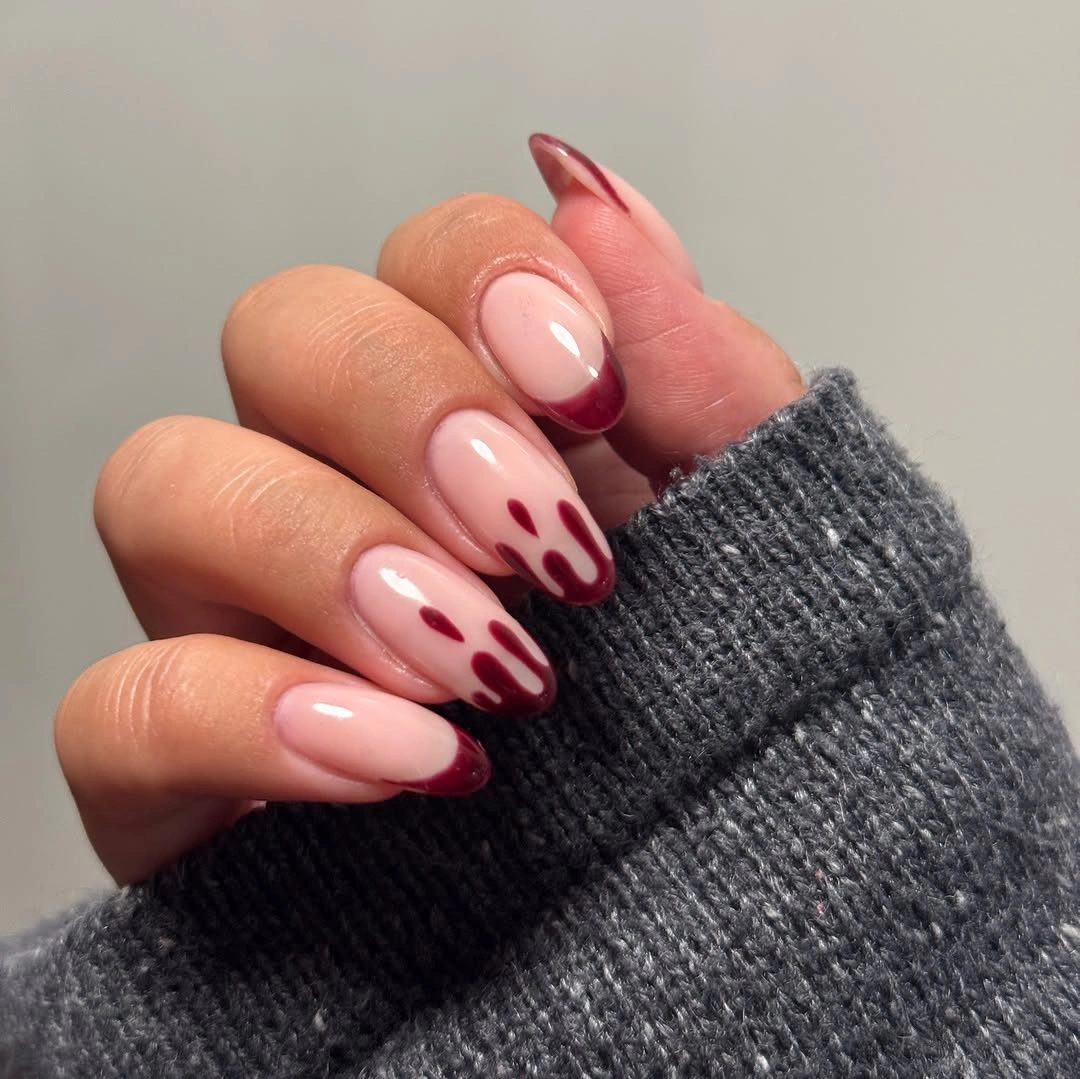
Contrast is controlled by the amount of exposed base. A larger nude center makes the burgundy read as a frame, while a broader wine curve would turn the manicure into a more dramatic color block. The curves also create a softer result than a classic straight French line, making this a useful option for someone who likes dark fall colors but prefers movement over strict geometry.
When adapting this look, preserve the sweep of the line rather than copying every curve exactly. A narrow burgundy edge on shorter nails will still carry the idea, and the nude base will make regrowth less abrupt than a full dark polish. The relationship worth keeping is simple: deep wine at the perimeter, breathing room through the center.