
An accent nail is not a spare canvas for every idea that does not fit elsewhere. It is the point where the eye should pause, which means its success depends on the quieter nails around it. When the contrast is too weak, the feature disappears; when the contrast is too strong, the manicure loses a sense of order. The useful question is what the accent changes in the balance, not how much decoration it can hold.
Choose the feature nail by placement first, then decide whether the surrounding nails should repeat its color, finish, or only its level of restraint. Keep one clear focal point, leave visible space around it, and make the supporting shape consistent enough that the detail reads as intentional. This approach also gives the design a better chance of staying legible as the edge grows and the original proportions shift.
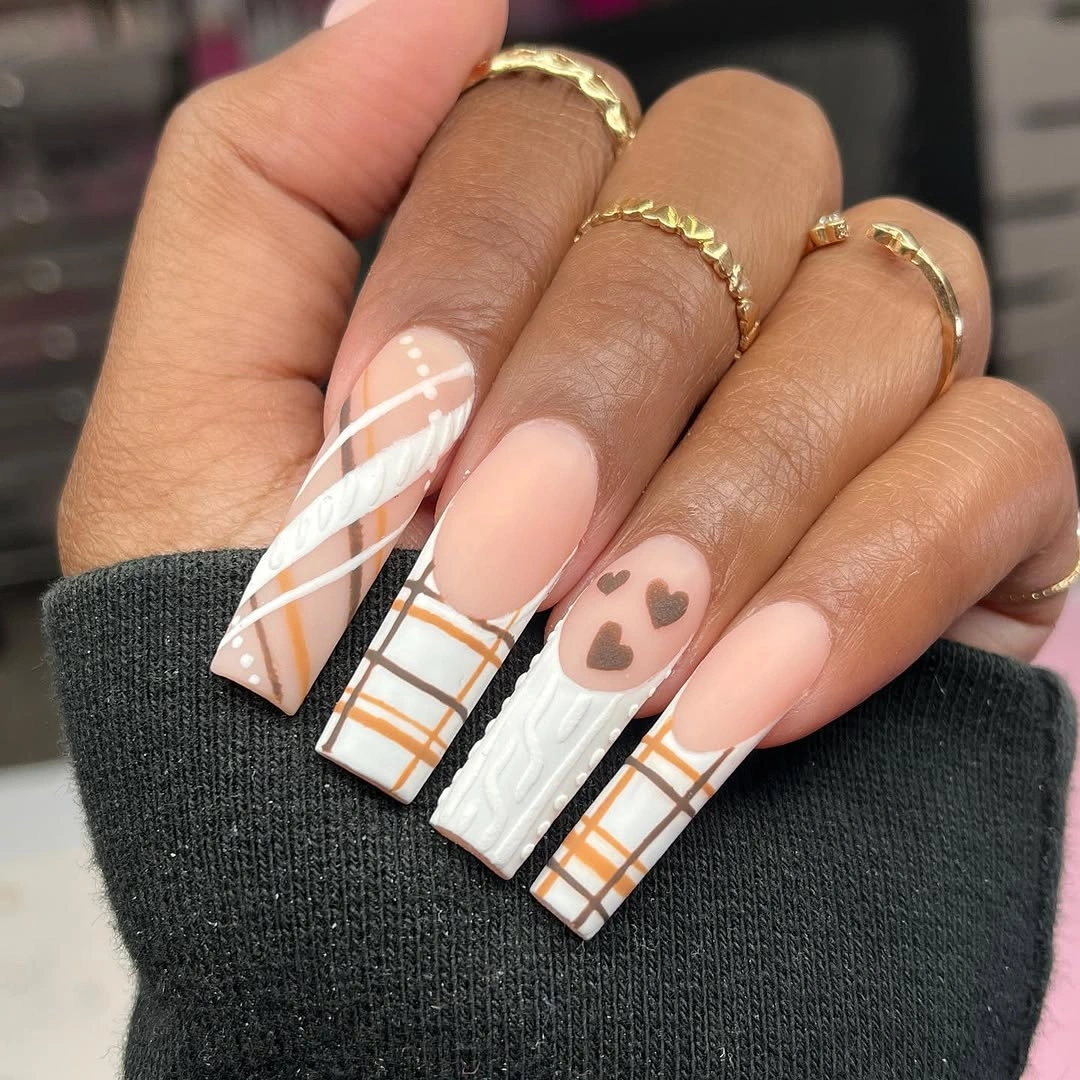
Soft Plaid Lines and Two Small Heart Marks
Long square nude-pink nails mix white and tan linear plaid accents with a pale nail carrying two small brown hearts. The plaid gives the set structure, while the hearts add a softer interruption inside the same light palette. Because the base remains nude-pink, the lines and symbols feel related rather than like separate themes placed side by side.
Let the plaid stay on one or two nails and use the hearts as the only rounded motif. That separation makes the detail-first hierarchy easy to read, while the tan lines keep the accent connected to the warm season. If the long square is shortened, reduce the number of plaid lines before shrinking the hearts, since a few clear marks will read better than a dense grid. For more placement references, compare these fall nail design ideas without copying their wording or layout.
The design asks for two kinds of precision: the plaid needs controlled spacing and the hearts need enough open base around them. If both accents become crowded, the soft pink loses its role as breathing room. A simpler version can keep one plaid nail, one heart nail, and solid nude-pink fingers between them so the feature remains visible as the set grows out.
Bright Orange With One Wavy Statement Nail
Short rounded-square nails are bright orange, while one accent nail carries orange, coral, and pale wavy lines. The solid color gives the hand a strong base, and the wave adds movement without introducing a separate print or metallic element. Its placement on one nail is enough because the surrounding orange already repeats the main hue.
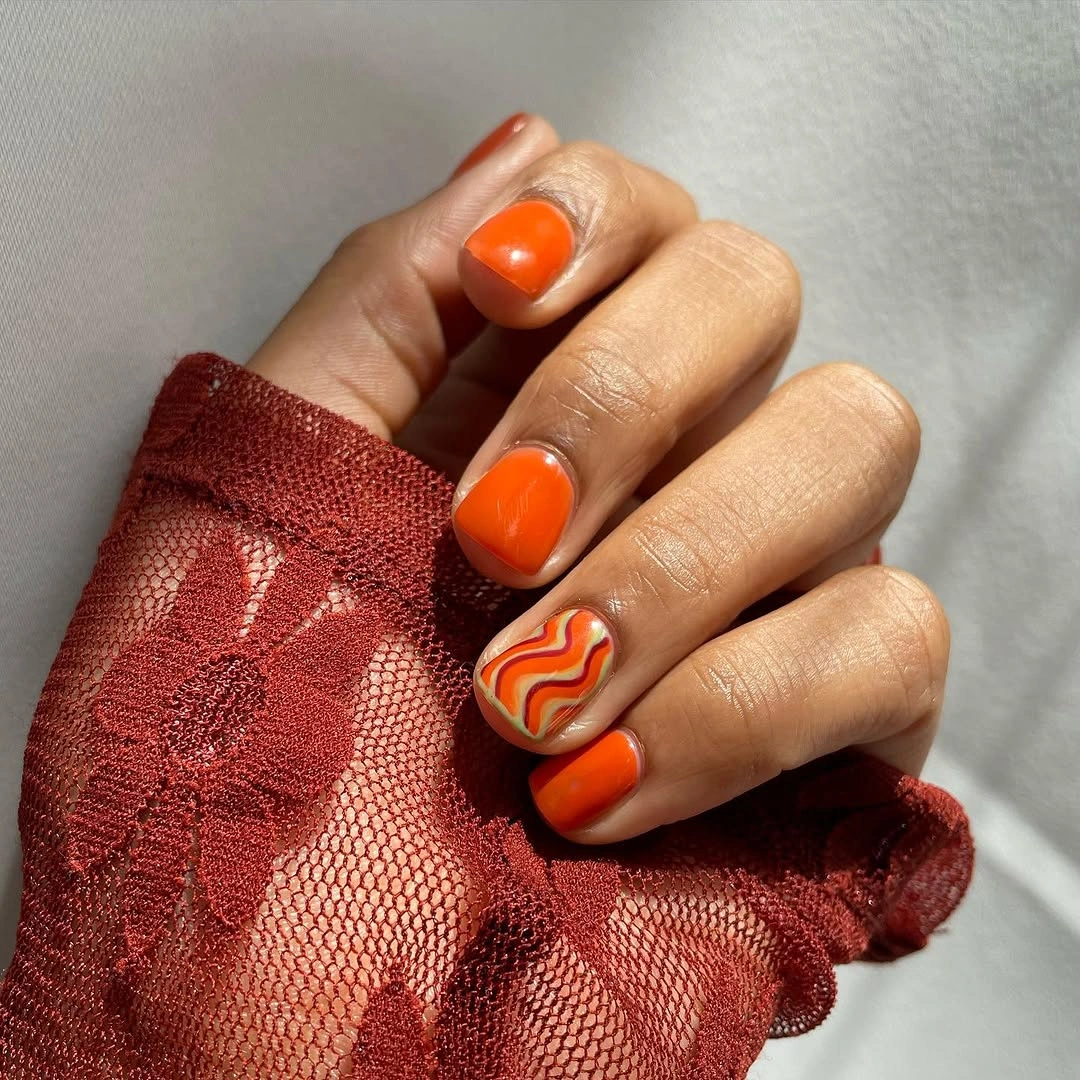
Use one wavy feature when you want fall nails with accent nail contrast to feel direct rather than overdesigned. Rust or burnt orange can make the base more autumnal, while a pale peach line will keep the accent close to the hand. Keep the wave broad and continuous on a short surface so it reads as a gesture instead of a group of tiny marks.
The accent works because the solid nails are visually quiet despite their bright color. Adding glitter, dots, or a second pattern would make the wave lose its job as the only movement. If daily wear calls for less color, keep the orange on two nails, replace the rest with a sheer nude, and repeat one coral curve on the feature nail.
Glossy Burgundy With a Pink Spotted Feature
Long almond nails are glossy burgundy, with one pale pink accent carrying darker spots and a glitter-like edge. The berry base supplies depth and the pale nail opens a bright window, while the small pattern gives the feature a different surface rhythm. The accent is strongest because it breaks the value of the surrounding nails without abandoning the warm red family.
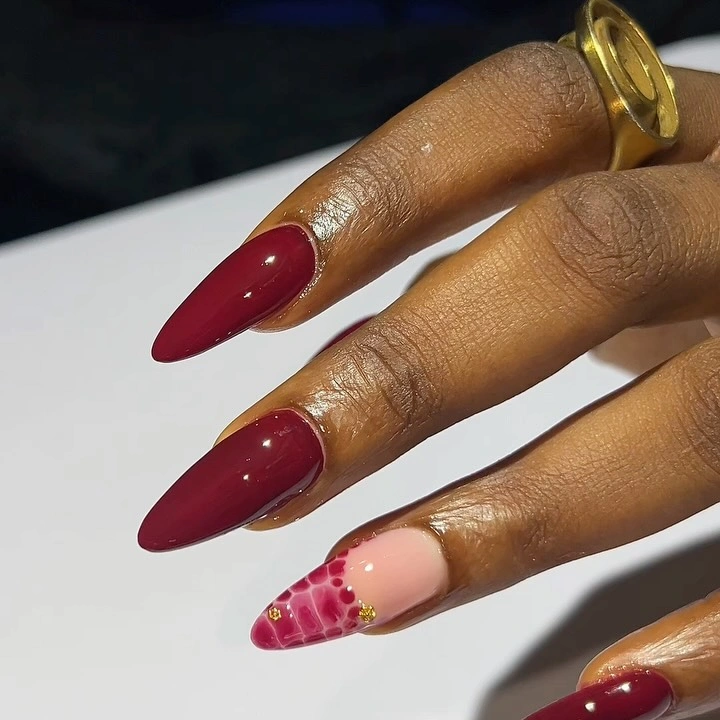
Keep the burgundy uninterrupted on most fingers and let the pink accent hold the pattern. A berry or muted rose base can soften the contrast, while a thin metallic-like edge is enough to separate the motif from the border. For a shorter almond, use larger spots and fewer of them so the design remains readable instead of becoming a dark cluster.
Long almond nails already create a dramatic line, so the feature nail should not also carry several competing colors. If the glitter-like edge becomes too bright, remove it and keep the pale spotted field; the burgundy will still provide enough contrast. The practical choice is to protect the empty space around the spots, because it is what lets the accent breathe.
Periwinkle Solids With Glitter and Abstract Marks
Short square nails use periwinkle blue, with one gold-glitter accent and another pale nail carrying blue and yellow abstract strokes. The cool solid color repeats across the hand, while the two features split the attention between sparkle and linework. That division is controlled because both accents remain small and share the same blue family.
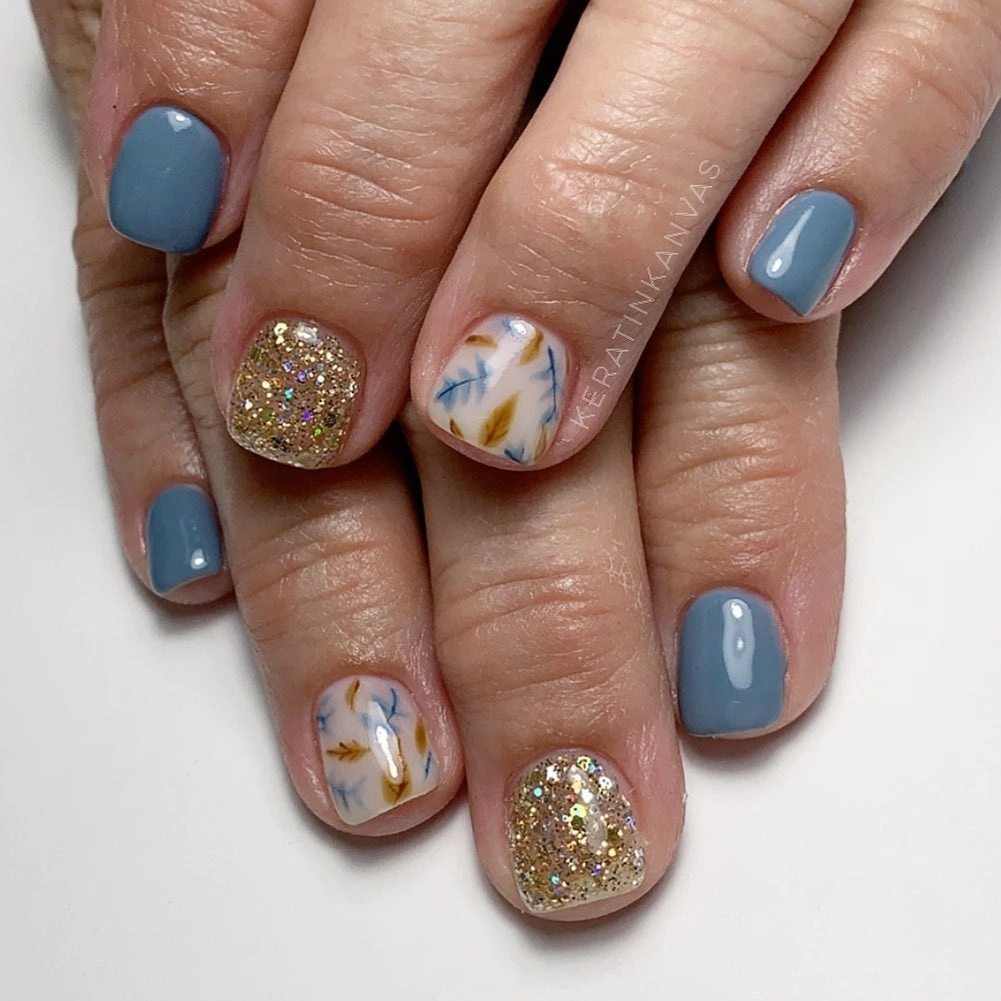
Choose this layout when the accent nail idea needs more than one texture but still benefits from a clear anchor color. Keep the glitter dense on one finger and the abstract strokes open on the other, then let the remaining periwinkle nails stay plain. A muted slate-blue or dusty cornflower shade can move the look closer to fall without changing its structure.
Two feature nails can work when their jobs are different, but they should not be equally complicated. If the abstract nail already contains several colors, use a simple glitter field rather than adding another motif. Short squares make the rule especially useful because a small surface has less room to separate competing details.
Muted Patchwork With Lines and Metallic Dots
Long square nails combine brown, mauve, nude, and taupe panels with fine linework, a soft plaid-like accent, and small metallic-looking dots. The palette is muted enough to connect the different treatments, so the eye notices the changes in placement before it sees a clash of colors. Each nail contributes a different texture, but the neutral family keeps the overall rhythm grounded.
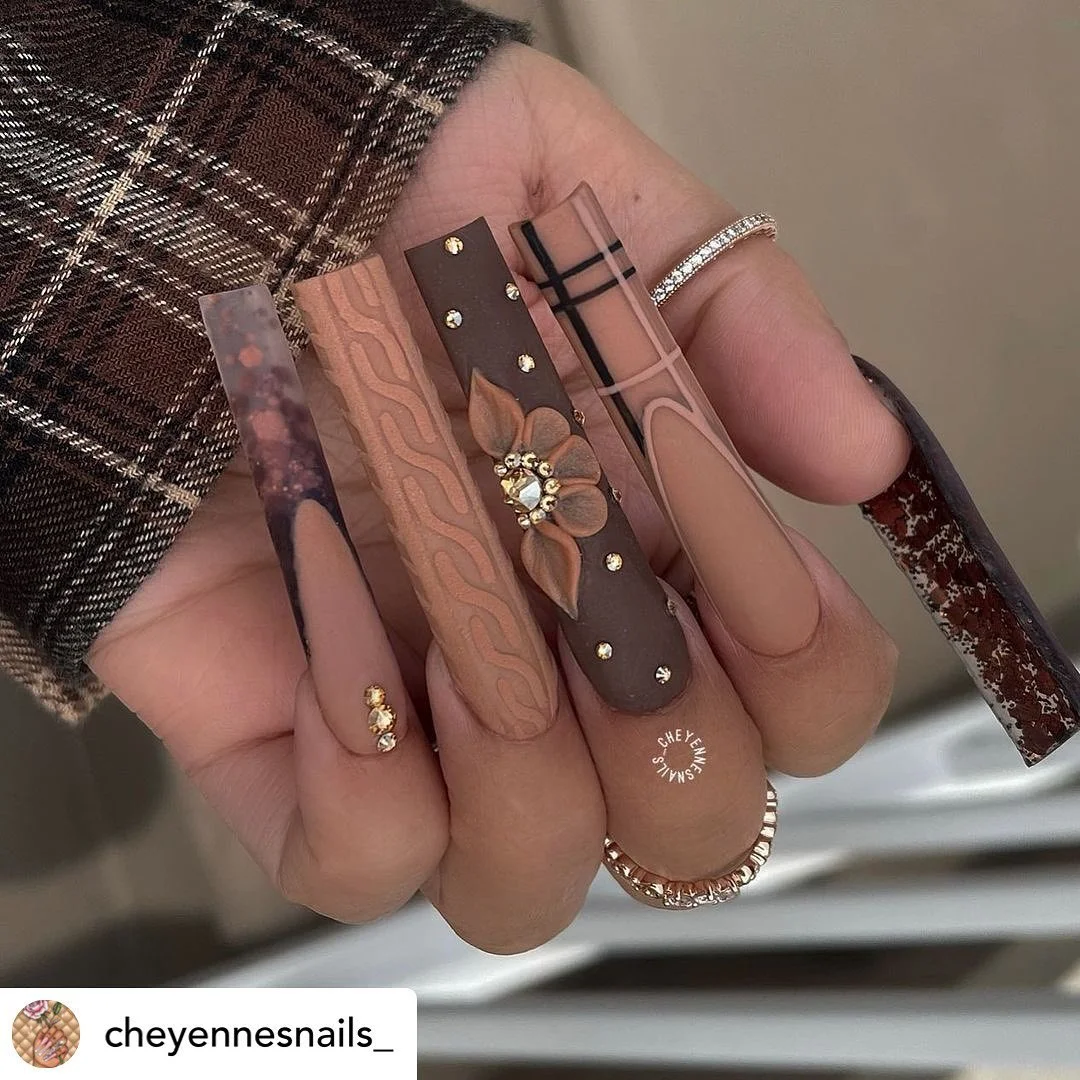
Use a patchwork approach when a single accent nail is not enough to express the mood, but keep one neutral shade repeating across several fingers. A brown or taupe panel can be the anchor, while mauve and nude provide lighter interruptions. If the surface feels too full, keep the plaid and metallic dots and remove the extra linework rather than adding more color.
The longer shape gives every treatment space, yet it also makes the set vulnerable to visual fragmentation. The eye needs one dominant direction, such as vertical lines or a repeated taupe panel, to keep the accents connected. Shortening the nails is not the first repair; reducing the number of independent features is more effective.
Nude and Burgundy With One Pumpkin Motif
Medium oval nails use a pale nude base, a glossy burgundy accent, and one orange pumpkin-like seasonal motif with tiny dark dots. The burgundy acts as the strong solid feature, while the pale illustrated nail supplies the seasonal note without covering the whole hand. The oval shape softens both accents and keeps the motif from feeling too square or graphic.
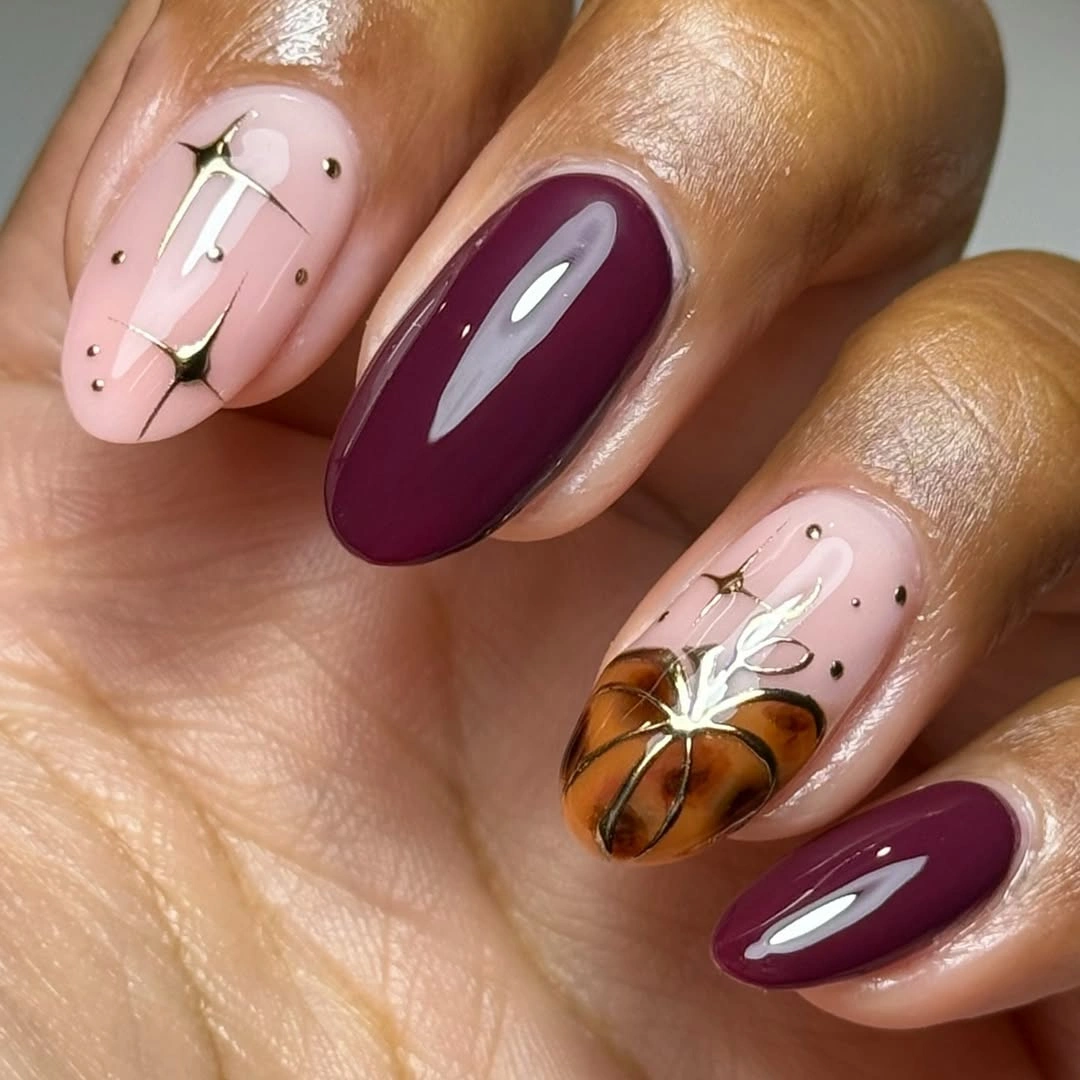
Keep the pumpkin-like detail small and surround it with plain nude so the illustration remains a point of interest rather than a theme covering every finger. A rust or amber accent can make the orange more autumnal, while the burgundy can shift toward plum. For a quieter arrangement, repeat the burgundy on both hands and keep the motif to one nail total.
Literal seasonal motifs work best when the rest of the manicure leaves them room to speak. If the dark dots multiply or the illustration spreads too far, the accent can become harder to read as a single shape. The easiest adaptation is to simplify the motif, not to add another decorative nail, because the burgundy already provides the necessary contrast.
Orange, Burgundy, Leaf, Stripe, and Glitter
Short square nails alternate orange and burgundy solids with pale accents carrying gold glitter, light leaves, and black-and-white striping. The warm solids provide a repeated base, while the pale features act like small panels where each accent language can be seen separately. The set is busy by design, but the orange and berry colors keep the visual temperature consistent.
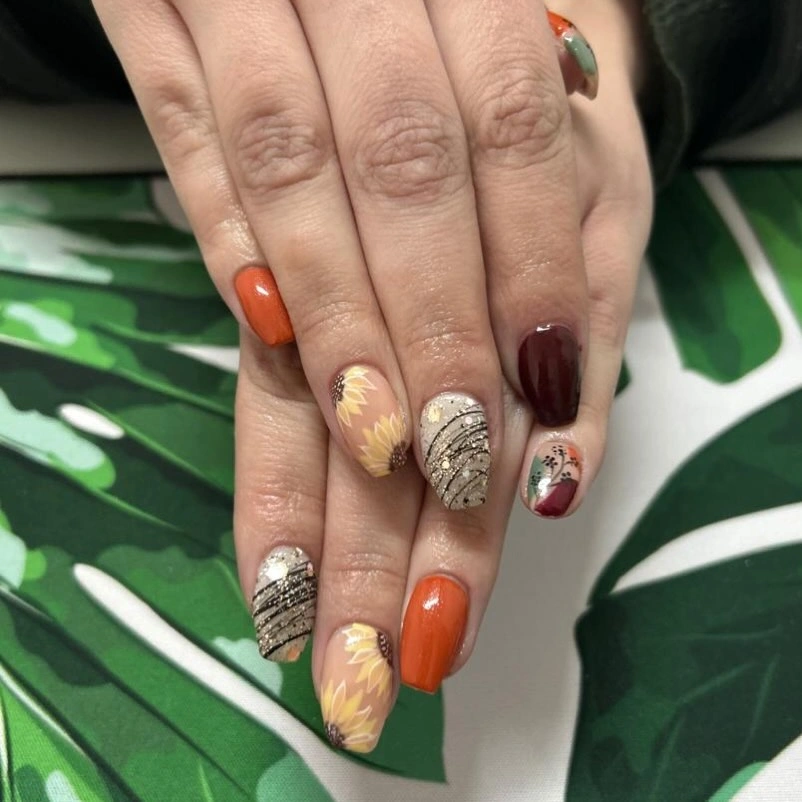
When using several fall nails with accent nail treatments, repeat the anchor colors and choose one accent language to dominate. Leaves will make the palette feel softer, stripes will make it more graphic, and glitter will make it more reflective. If all three are kept, place them on separate fingers and leave the orange or burgundy solids between them.
The limitation is not that there are too many details, but that each detail competes for the same first glance. A shorter set benefits from removing one treatment entirely, especially if the pale accents become visually equal. Keep the warm solids intact because they are the structure that lets the decorative fingers read as accents instead of separate examples.
Coral Coffin Nails With Directional Stripes
Long square-coffin nails use a coral-orange base with cream and tan geometric stripes, plus a small green accent and a few curved line details. The stripes lengthen the visual field and reinforce the long shape, while green acts as a small interruption inside a warm palette. The accent is graphic because the lines have direction, not because the set relies on a dense pattern.
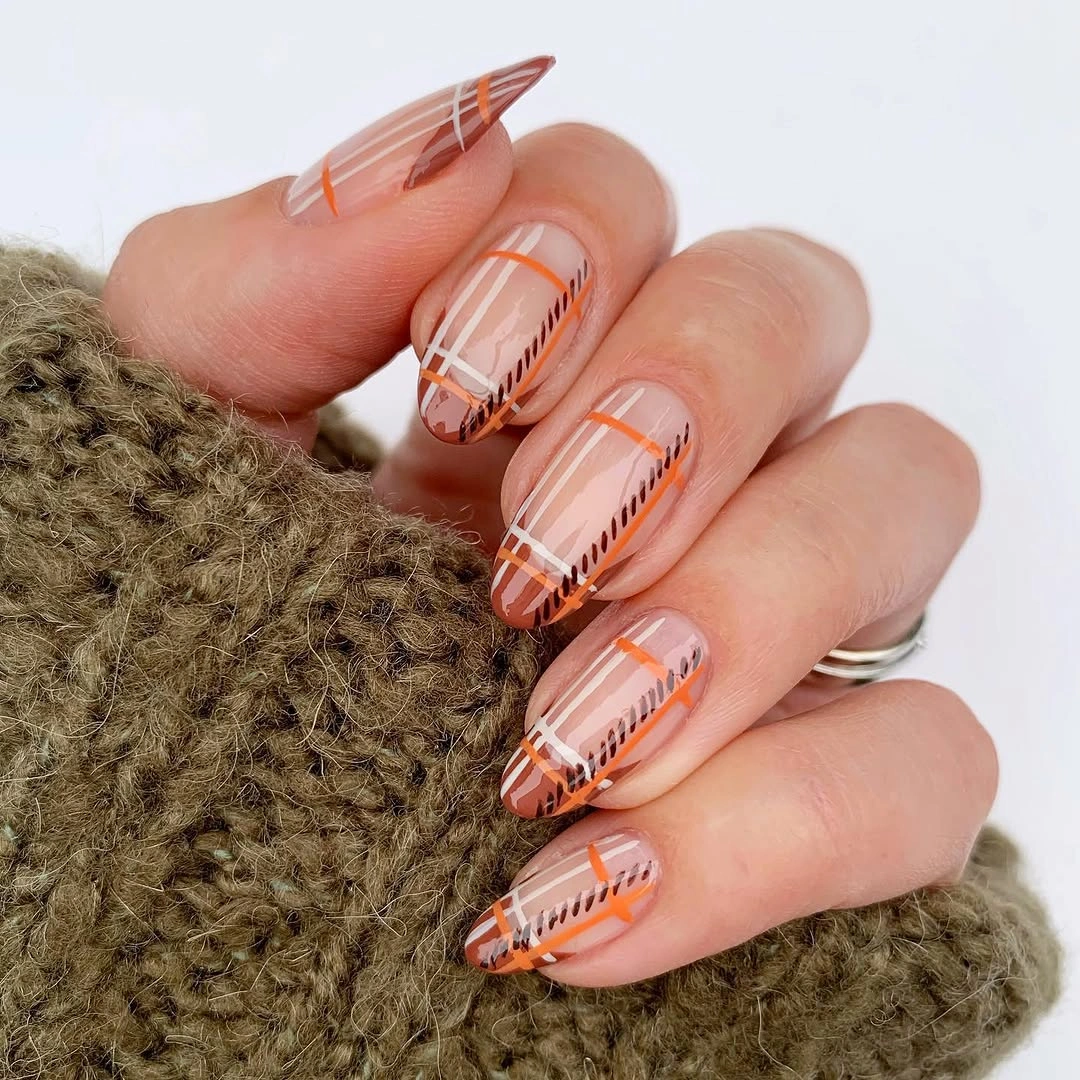
Keep the coral dominant and let the cream lines remain thin enough to show the base between them. A rust base will soften the brightness, and a muted olive can replace the small green detail without losing the seasonal relationship. When adapting to a shorter square, use fewer stripes but maintain their direction so the shape still benefits from the visual movement. For a more structured reference, compare the idea with graphic geometric fall nails while keeping the same rule of clear spacing.
Long coffin nails can carry several lines, but a stripe that reaches the wrong edge may make the tip look wider or shorter. Decide whether the lines should lengthen, frame, or cross the nail, then repeat that job consistently. If the green accent becomes distracting, remove it before changing the coral and cream structure that defines the design.
Peach Squares With Repeated Orange Linework
Long square nails have a peach base with orange and white diagonal or vertical linework repeated across the set. Unlike a single feature nail, the accent is the line system itself, and the repeating direction makes every finger contribute to the same idea. The pale base keeps the warm lines visible while preventing the design from becoming a solid orange field.
Use repeated linework when you want the manicure to feel coordinated without making every nail identical in detail. Keep the orange line slightly stronger than the white so the eye has a clear path, and choose a rust shade if the peach feels too bright. A medium square can carry the pattern if the lines remain broad enough to avoid merging.
Repetition creates its own maintenance issue: one broken direction can stand out more than a missing motif would. Leave some peach space around each line and avoid filling every corner. If you want a simpler version, keep the line system on two accent nails and use a solid peach or warm nude on the rest.
Nude Almonds With Gold and Bronze Framing
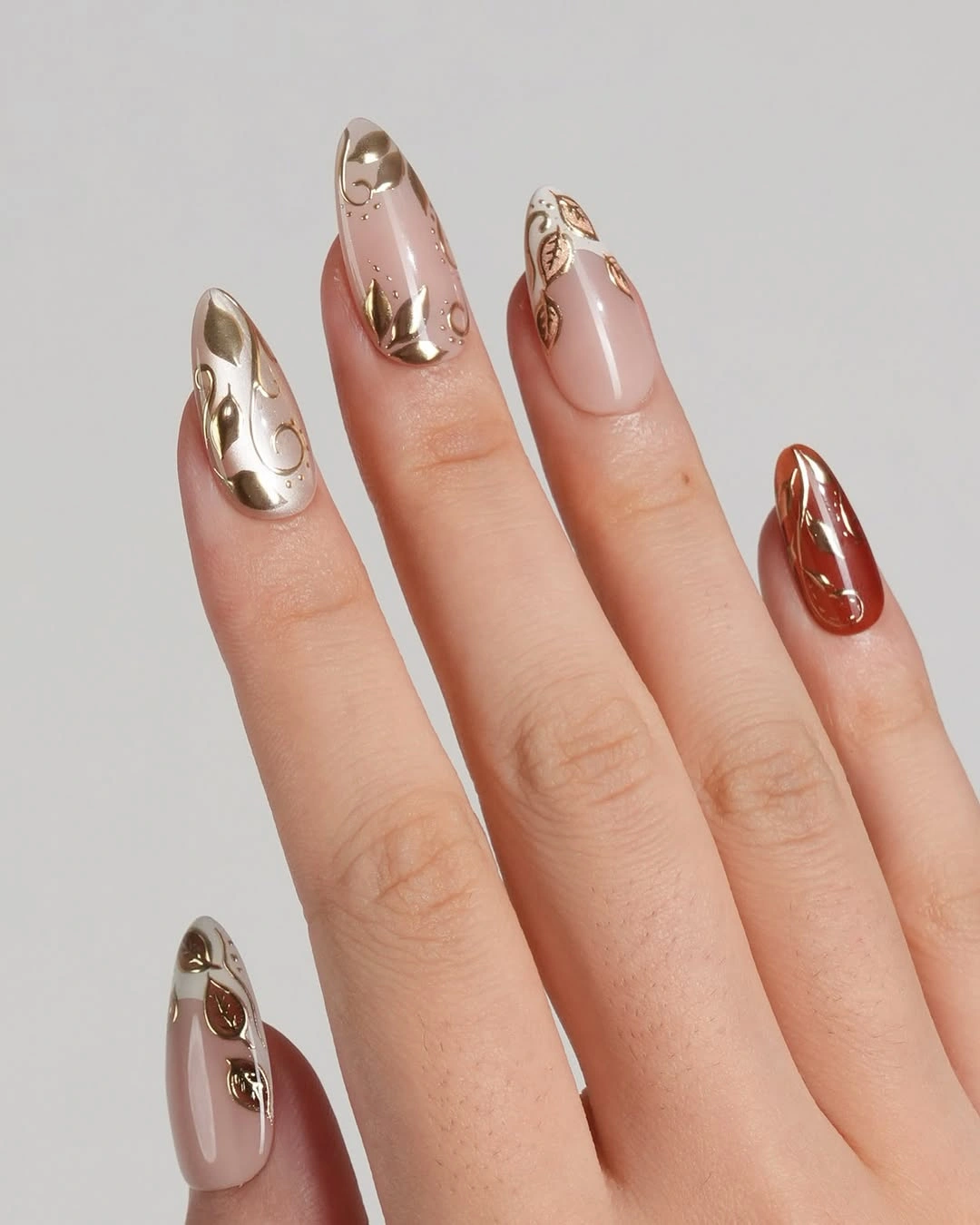
Long almond nude nails feature reflective gold-like abstract swirls and metallic edging, with one dark copper-brown accent. The nude base gives the shine a clear stage, while the bronze accent supplies the deeper note that keeps the reflective details from floating away. The swirls follow the almond direction, so the metallic finish supports the shape rather than flattening it.
Let metallic detail stay close to the tip or side when you want a polished accent without covering the whole nude base. Gold can shift toward champagne, and the copper accent can become a muted brown if the contrast feels too strong. A medium almond will preserve the framing effect while lowering the commitment of the long silhouette.
Reflective edges attract attention to every change in curvature, which makes placement more important than adding more shine. Keep the swirls sparse and let one dark accent explain the warm metal relationship. If the surface begins to look overly ornate, remove one metallic line and keep the nude space intact rather than adding another solid color.
Brown Almonds With Two Completely Different Accents
Long almond nails are glossy brown, with one accent carrying curved red, orange, blue, and green bands and another showing cream-and-black animal-like spots. The dark brown base is the common ground, but the two feature nails intentionally disagree in motif and color. That contrast makes placement the story: one finger supplies movement, the other supplies irregular texture.
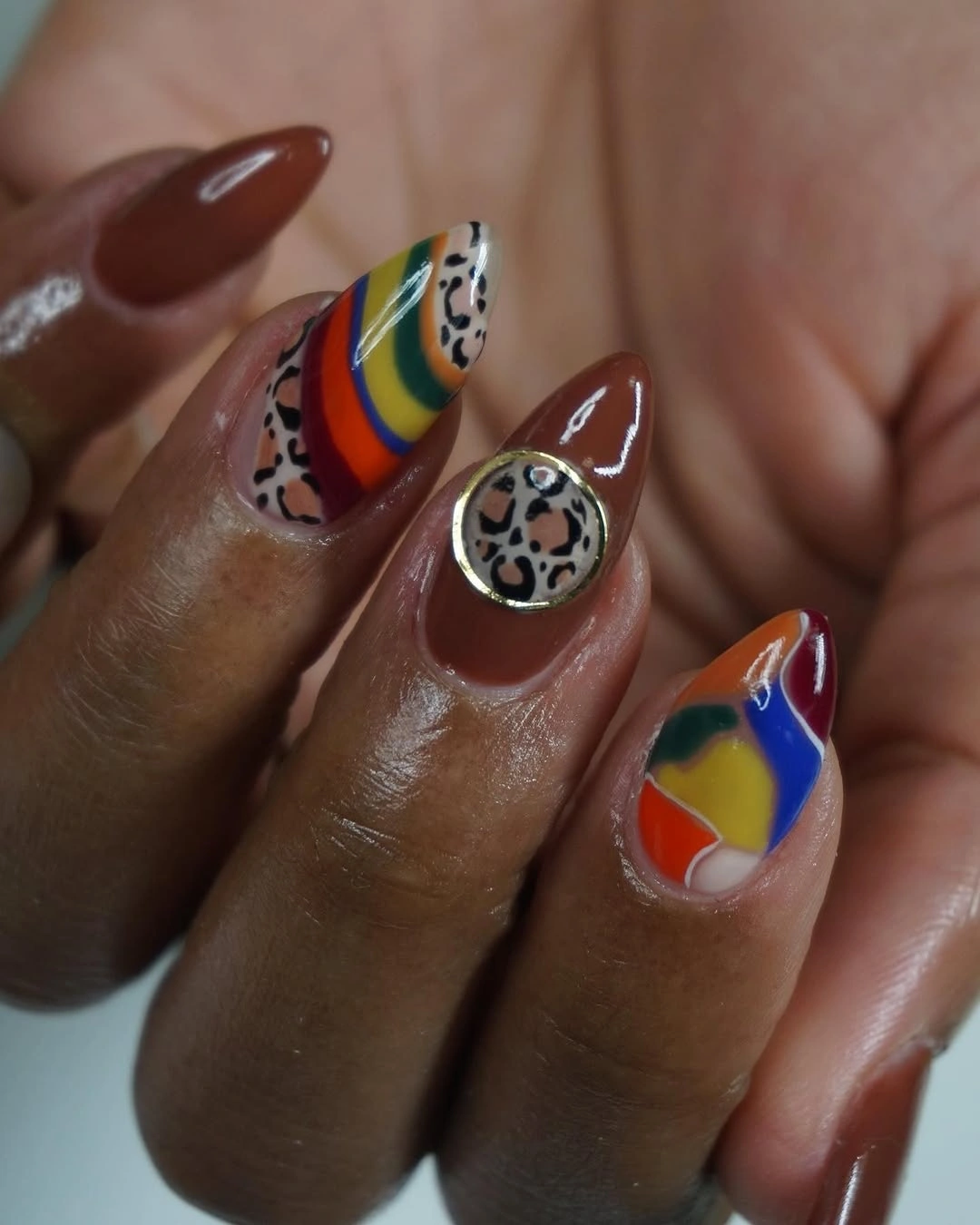
Use two different accents only when the supporting color is strong enough to hold them together. Keep the brown solid on the remaining fingers, and let the multicolor bands remain curved while the animal patches stay rounded and separate. If you want to simplify, choose one feature treatment rather than trying to blend both into a third pattern.
The design is expressive, but the long almond shape already provides a strong silhouette, so adding more detail would reduce clarity. Place the two accents apart from each other if possible and keep their surfaces visually distinct. The practical question is not whether both motifs are attractive; it is whether the hand has enough quiet brown space to make their difference readable.
Glossy Red With One Butterfly-Like Detail
Short rounded-square nails are bright red-orange and glossy, with one pale accent featuring a small orange-brown pumpkin or floral motif. The vivid solid field gives the accent high contrast, while the light nail creates a clear pause where the seasonal illustration can be seen. The rounded shape keeps the strong red from becoming too severe and makes the accent feel compact.
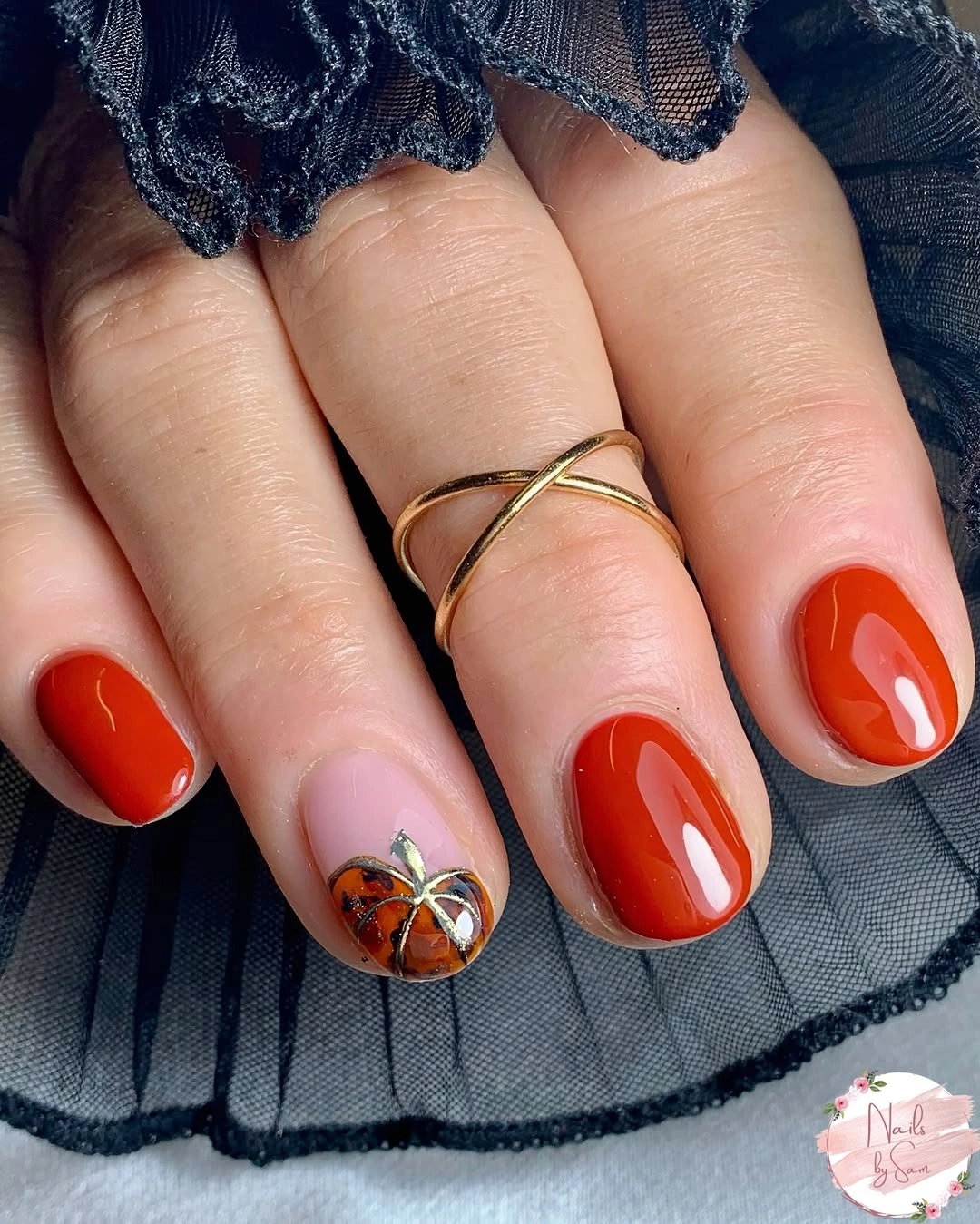
Let the illustration remain small when the base is already saturated. A red-orange shade can move toward rust, and the pale accent can shift toward cream, but the supporting nails should stay solid so the motif remains the only detailed area. For a lower-key version, keep the illustration on one hand and use the red on every other nail.
Bright color can make tiny lines look sharper than expected, so detail density should be kept low. If the accent becomes difficult to read, simplify the motif to one leaf, petal, or curved mark rather than adding a contrasting background. The clean red field is already doing enough visual work to make a single small feature visible.
Nude Pink With a Small Black Bow Outline
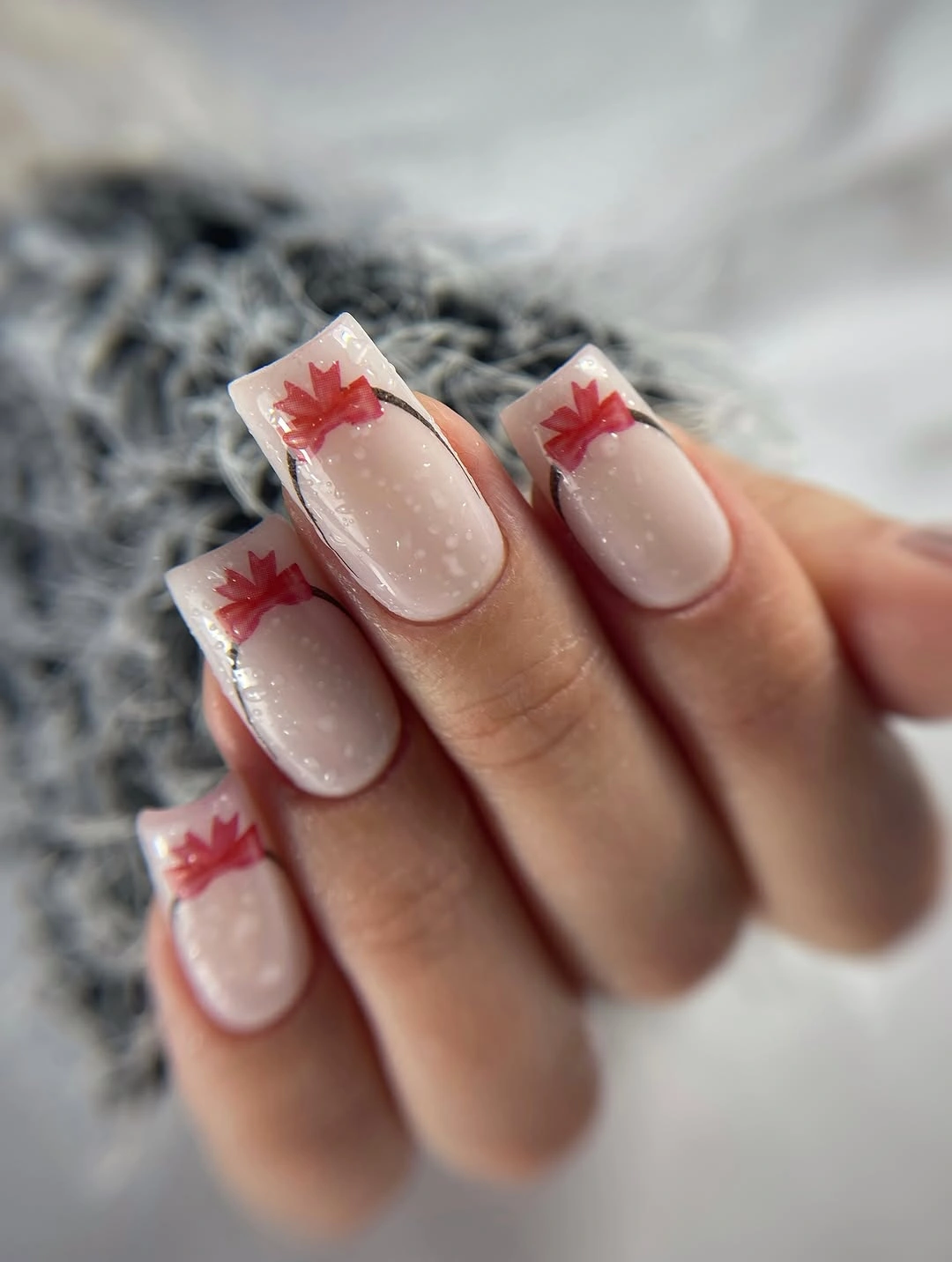
Short square nude-pink nails carry one small black outlined butterfly or bow-like motif near the tip of an accent nail. The base is almost sheer, so the dark outline has a disproportionate visual effect and becomes the first detail the eye finds. Keeping the motif close to the tip also lets the rest of the nail remain open and soft.
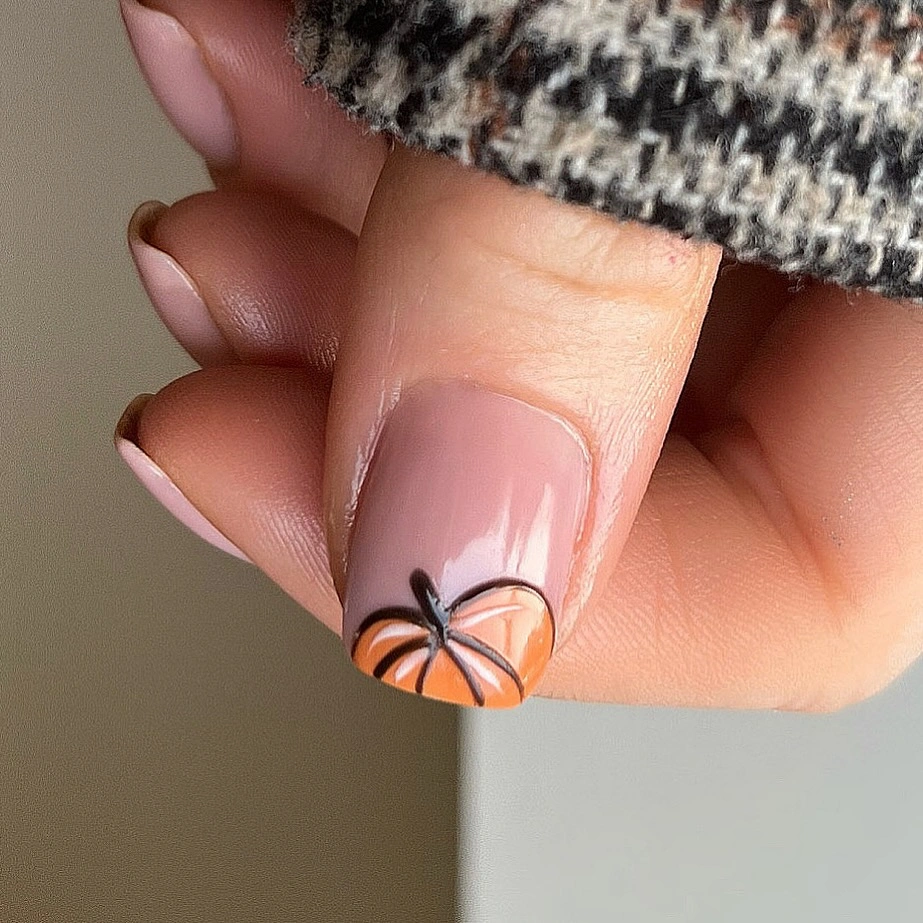
Use a single outline when you want fall nails with accent nail personality without a full illustration. Brown or deep burgundy can replace black for a warmer interpretation, and the motif can be moved slightly inward if the tip needs to remain clean. Keep the surrounding nails plain so the accent does not lose its small-scale charm.
Small outlines are easy to overwork because extra strokes do not necessarily make the symbol clearer. A single loop or pair of wings can be enough, especially on a short square where the open base is part of the design. If the motif feels too literal, remove one line and let the shape become an abstract mark rather than adding another accent nail.
Green Tips With One Glitter Accent
Medium-to-long coffin nails alternate nude bases, deep green French-like tips, a full green nail, and one fine champagne-glitter accent. Green appears both at the edge and as a solid anchor, so the color repeats without covering every surface. The single glitter nail adds reflection, but the nude areas keep the set light enough for the tip placement to remain clear.
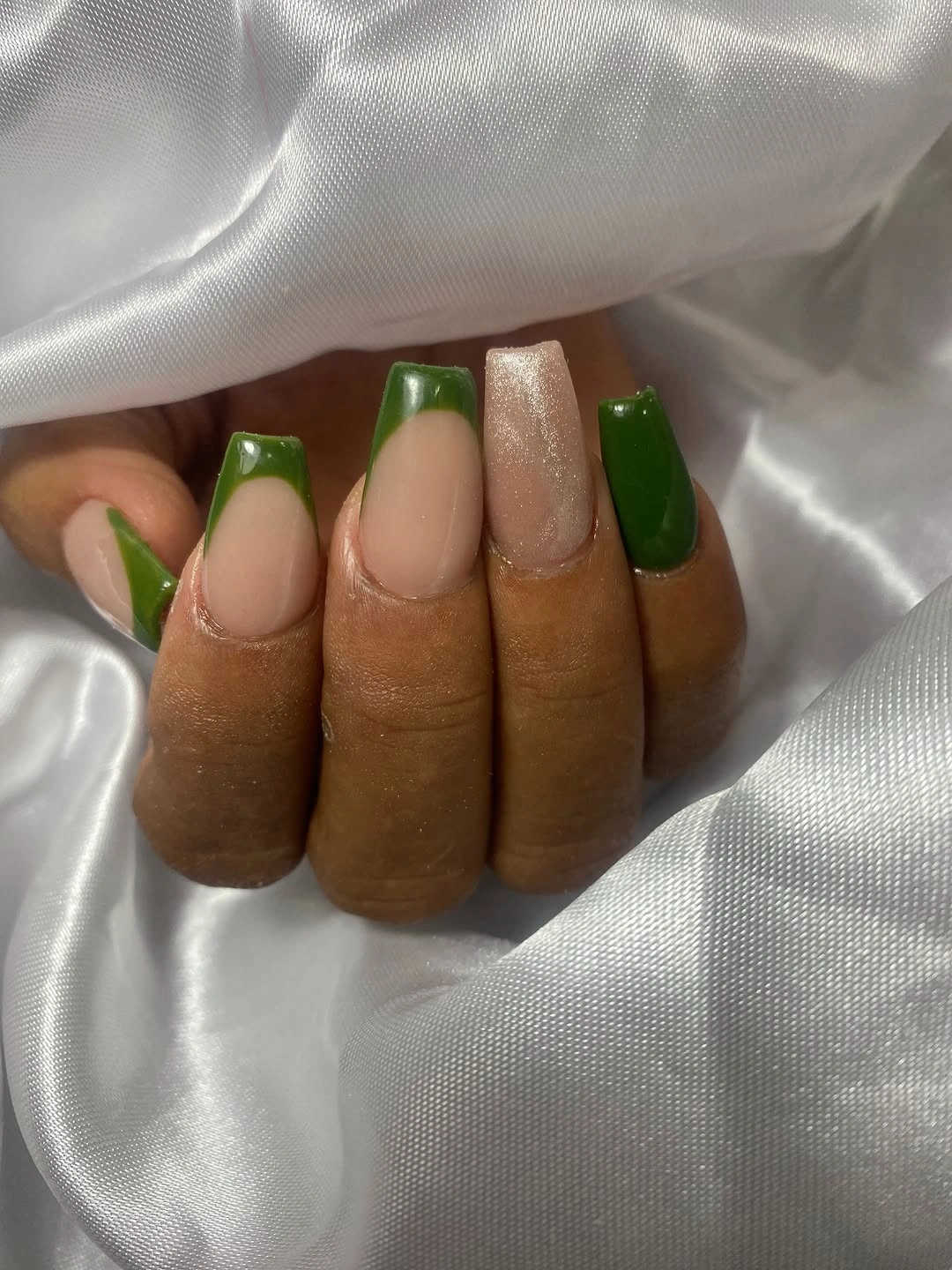
Use green at the tip when you want an accent to follow the shape rather than sit in the center. A muted olive will soften the contrast, while a deeper forest shade will make the nude base look brighter. Keep the champagne glitter fine and isolated so it supports the green instead of turning the design into a second focal group.
Coffin nails have a broad edge, which means a thick tip can quickly dominate the entire design. Narrow the green band first if the result feels heavy, then keep the solid green nail as the visual anchor. A medium length offers a practical middle ground because it preserves the tip geometry without making the accent surface too large.
Tortoiseshell, Pale Pink, and Fine Gold Lines
Long almond nails combine a tortoiseshell-like brown accent, pale pink, white, and nude nails with thin gold lines and small gold details. The warm patterned nail supplies organic movement, while the pale fingers give the metallic marks room to sit cleanly. Gold acts as a connector between the brown pattern and the softer bases, keeping the palette from splitting into separate groups.
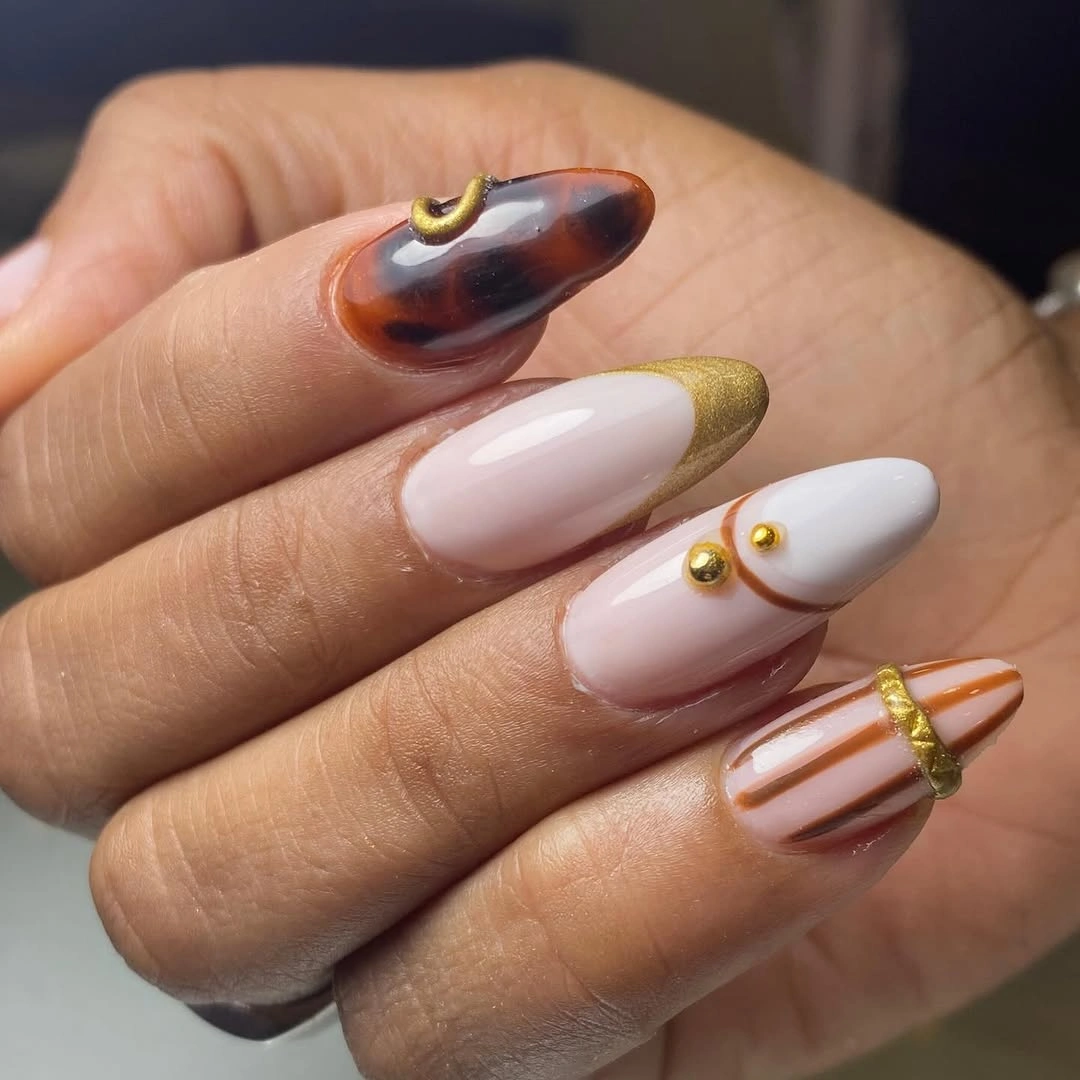
Let the tortoiseshell remain the strongest feature and keep the gold lines thin enough to support it. Pale pink or cream can replace the white, and a shorter almond will make the mixed palette feel more compact. If you want a simpler version, keep one tortoiseshell nail, one gold-lined nude nail, and repeat the pale base on the rest.
Several warm details can blur together when each accent is equally reflective or patterned. Leave the tortoiseshell mostly open and use gold in small, intentional placements rather than a full metallic surface. The design becomes easier to maintain when the pattern stays on one nail and the remaining accents use only line and space.
Chocolate Almonds With One Framed Leopard Mark
Medium almond nails are glossy chocolate brown, with one nude accent carrying a small leopard-like pattern framed by a dark line. The brown field has enough depth to make the nude feature feel bright, while the dark frame keeps the irregular spots from drifting into the surrounding surface. The motif is compact, so the shape remains the first structural signal.
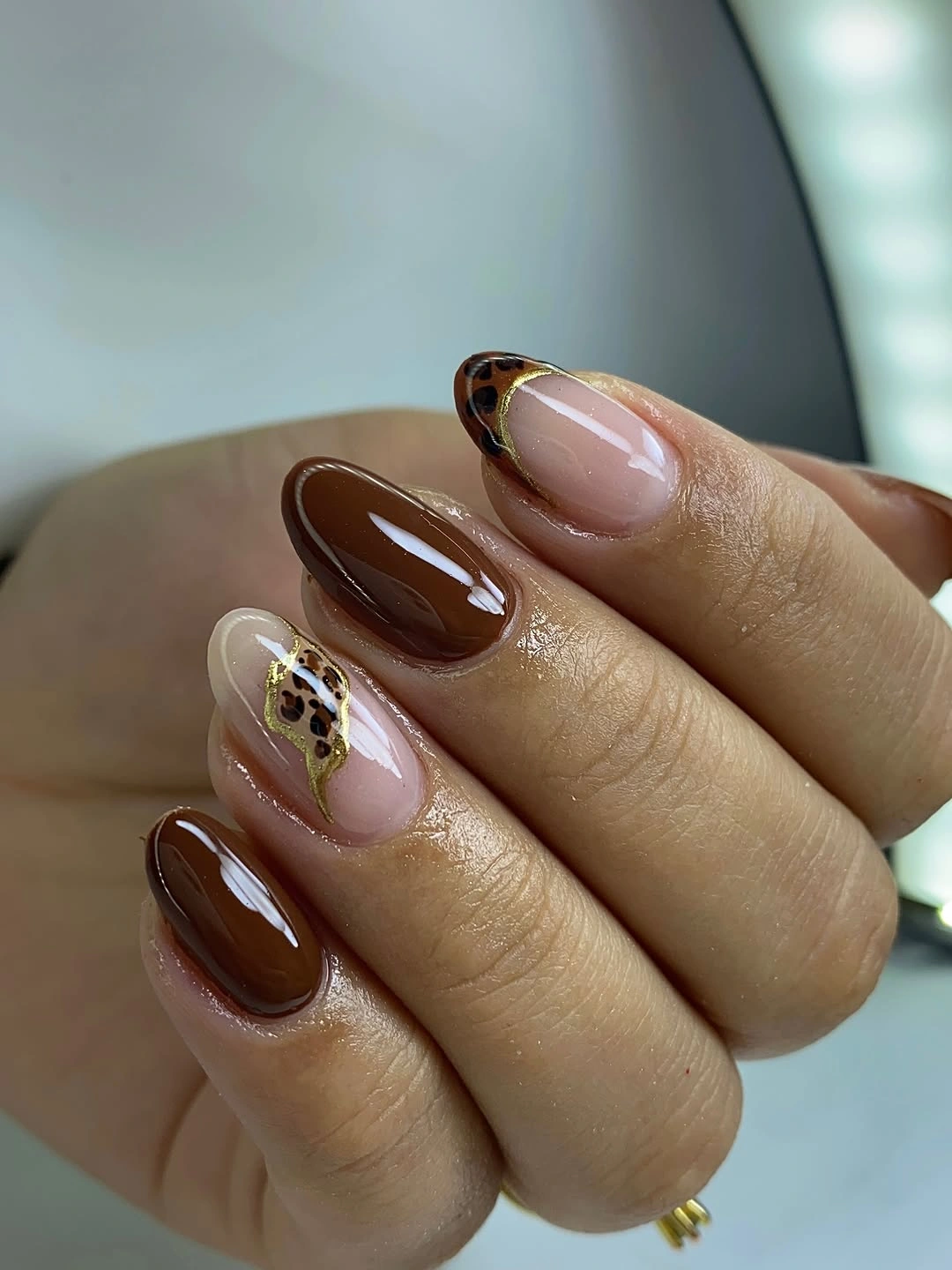
Use one animal-like accent when the base color already has a strong identity. A warm taupe or caramel nude can soften the feature, while espresso brown will make the contrast more cinematic. Keep the pattern to a few clear spots and avoid repeating it on every nail, because the strength comes from the interruption.
The frame gives the small print a boundary, but it also creates a hard edge that can look heavy on a short surface. If you shorten the almond, use larger spots and a thinner border. A clean brown base on the other nails will keep the design balanced and will make any changes in the accent easier to notice.
Blush Coffins With Plaid and Fine Line Drawings
Long coffin nails use sheer blush-pink bases with red-brown line drawings, plaid-like panels, and small star or cross marks. The open base keeps the long silhouette light, while the warm lines add direction and the small symbols provide tiny stops for the eye. Each detail is fine rather than solid, so the surface remains visible underneath.
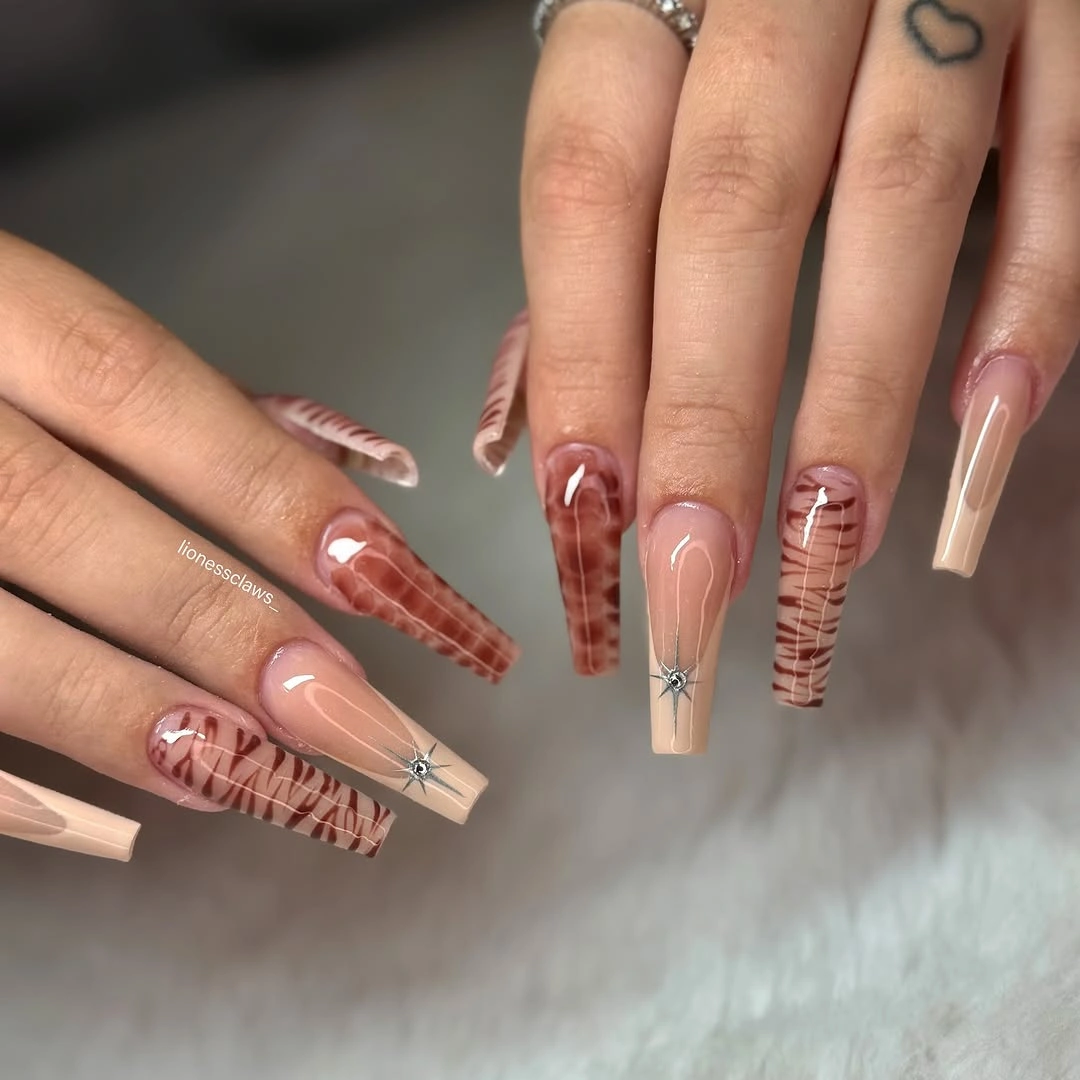
Keep the linework on two or three nails and use the sheer blush as the repeated anchor. Red-brown will feel softer than black and can be shifted toward cocoa for a deeper autumn palette. If you want to adapt the idea to a shorter square, keep one plaid panel and one small symbol instead of trying to reproduce every line.
Long coffin nails can make fine details feel elegant, but they also tempt the design toward overfilling the available space. The open blush areas are not empty mistakes; they are what separate the symbols and keep the panels readable. Remove a line before adding color if the composition feels crowded, because the structure already has enough visual information.
Black Solids With White Abstract Zebra Accents
Short oval nails alternate glossy black with white accents covered in black abstract zebra or leaf-like marks and a tiny warm dot. The black nails create a strong repeated field, while the pale accents open the hand and give the marks room to move. The warm dot is deliberately small, so it reads as a final punctuation mark rather than another motif.
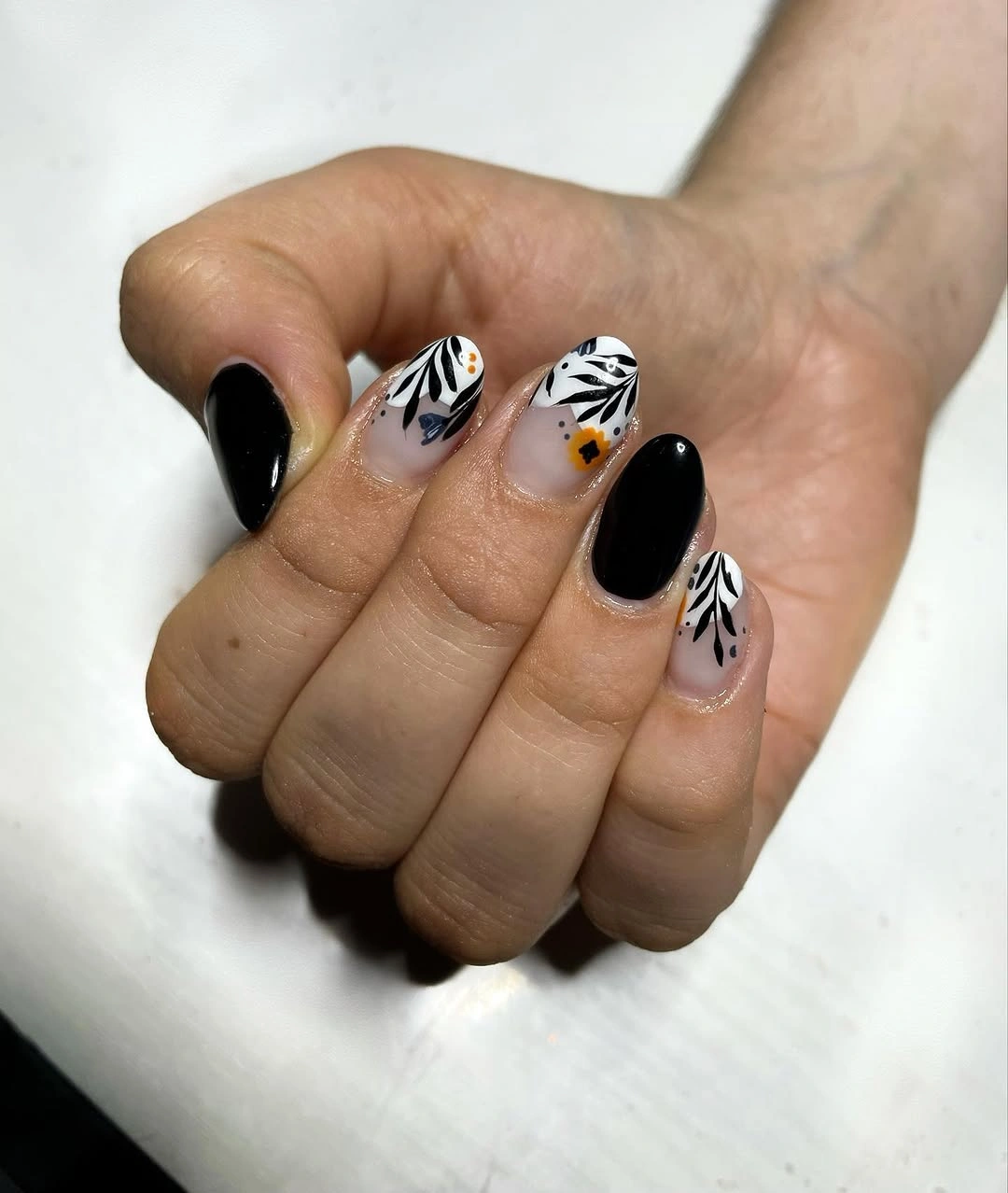
Use the white accent on one or two nails and keep the black solids glossy and uninterrupted. A cream base with dark brown marks will make the contrast warmer, while a muted orange dot can tie the detail to fall. Keep the strokes broad enough to remain visible on the short oval and avoid shrinking them into fine noise.
Black and white already create maximum value contrast, so the small warm dot should not grow into a third feature. If the pattern feels too active, remove the dot or use one patterned nail instead of changing the whole palette. The oval shape helps soften the graphic effect, but spacing remains the practical key.
Brown and Nude Squares With Wavy Texture
Short square nails mix nude and glossy brown solids with pale accents carrying brown, cream, and orange wavy or braided lines. Nearby warm neutrals keep the varied lines connected, while the solids give the eye a place to rest between the decorative nails. The accents suggest texture through their line direction rather than through a high-contrast print.
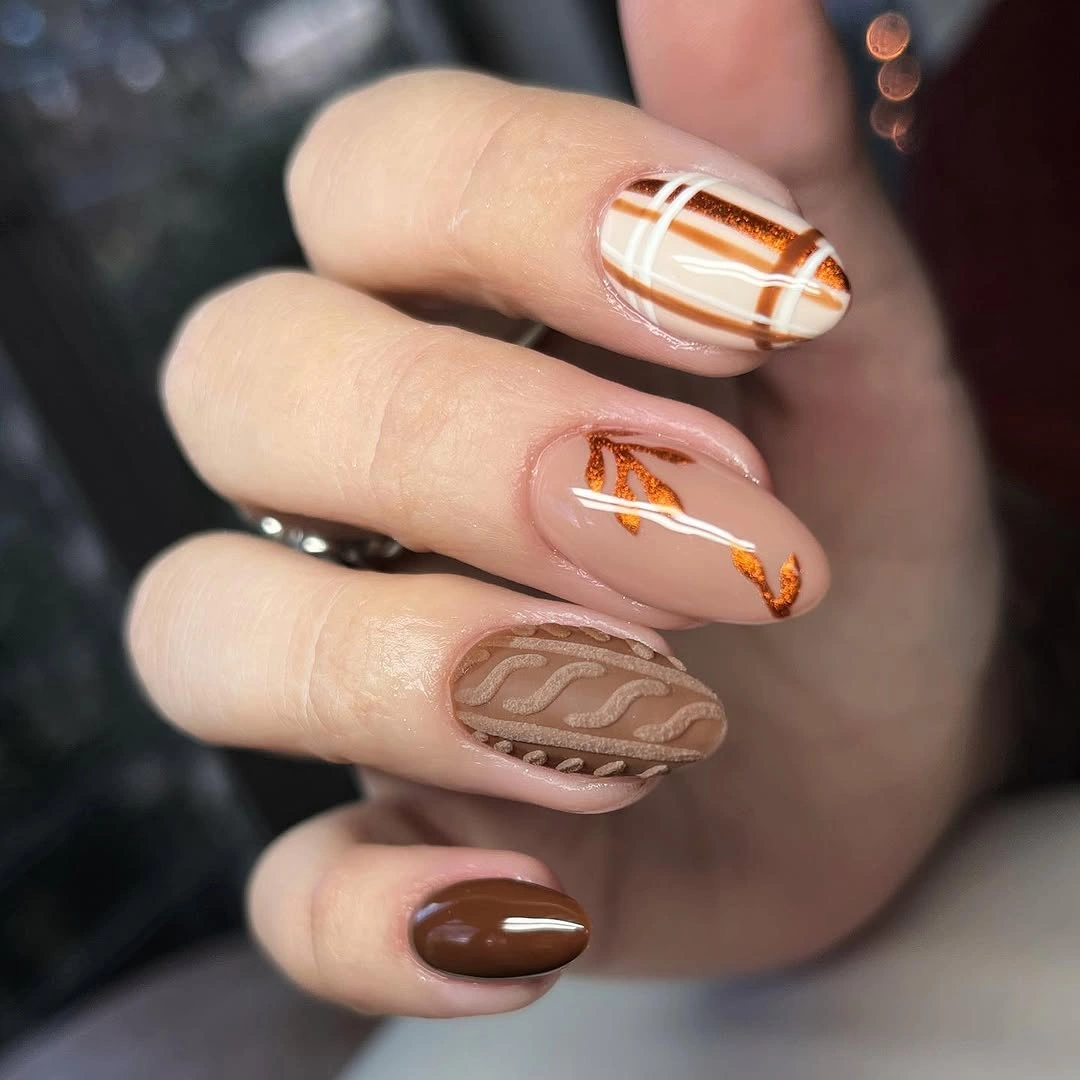
Use warm waves when a fall accent nail should feel textured but not loud. Keep brown as the anchor, let orange appear only in small sections, and use cream to separate the lines. A shorter square will still carry the idea if the waves remain broad and the accent is limited to one or two fingers on each hand.
Wavy lines can lose their rhythm when every nail changes direction, so decide whether the movement should curl, braid, or drift before repeating it. The supporting brown solids do not need another treatment. If the design needs simplifying, remove one line color and preserve the contrast between the warm neutral base and the pale accent.
Sheer Nude With Sparse Brown and Gold Curves
Short-to-medium oval nails are sheer nude with thin brown, white, and gold curved lines placed near the tips and one vertical accent line. The base remains transparent-looking and light, while the curves add a narrow frame that changes the edge without covering it. The design is intentionally sparse, so every line has enough space to remain distinct.
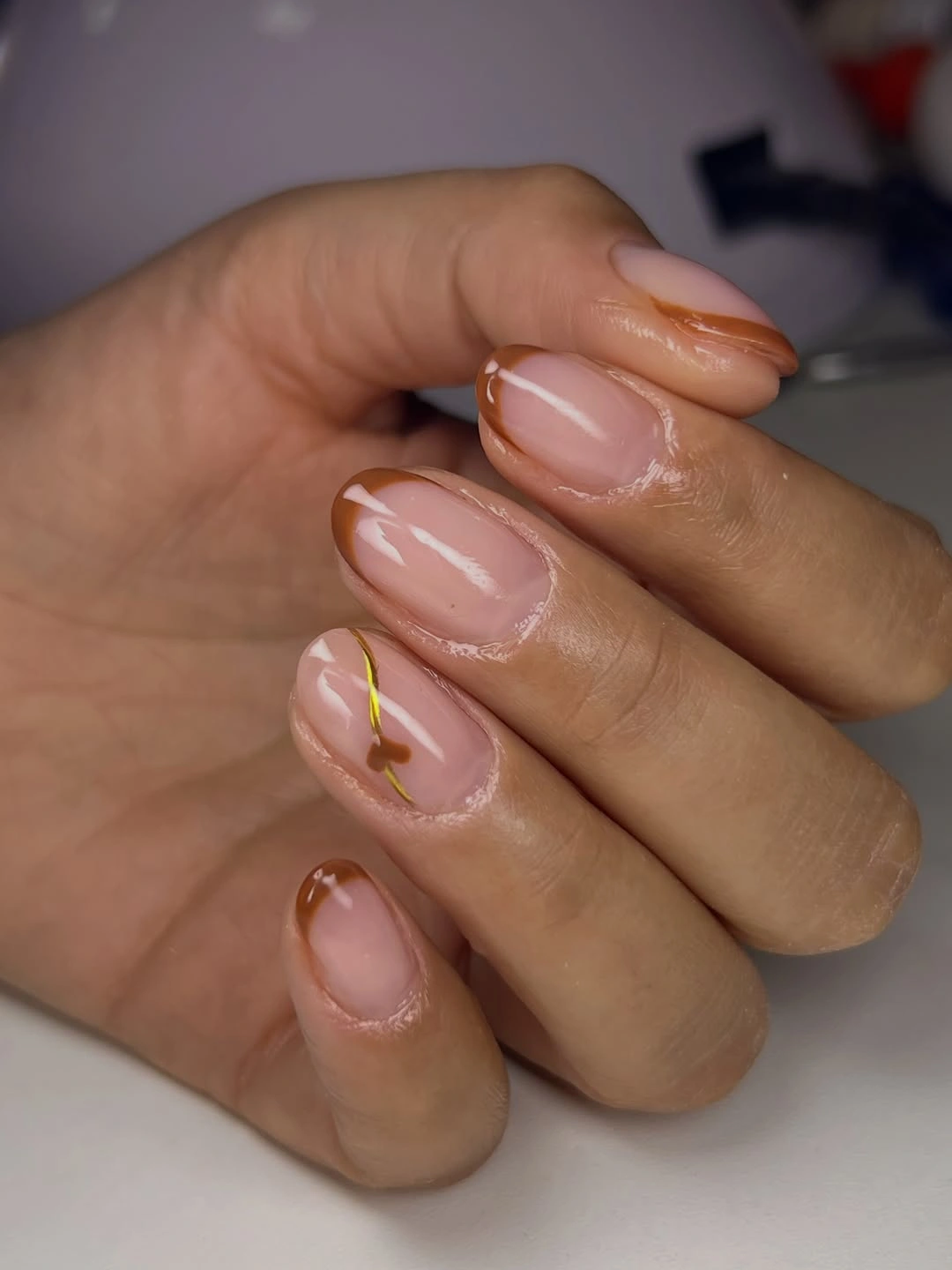
Keep the lines close to the tip when you want a low-density accent that can grow out gracefully. Brown can become rust, and gold can shift toward bronze, but the pale base should stay visible so the design does not become a full color block. This restrained structure also pairs naturally with subtle fall nail art ideas when you want to compare detail levels.
Sparse linework has a quiet maintenance advantage because small changes do not immediately destroy a complex motif, but uneven spacing can still catch the eye. Repeat a general curve rather than forcing identical geometry, and keep the vertical line on one nail as a deliberate exception. If the shape is shortened, move the curves slightly inward so the edge remains clean.
Chocolate Tips and Warm Floral Accent Nails
Long almond nails use a sheer nude base with chocolate-brown and gold French-like tips, plus two floral accent nails in warm brown and orange. The tips define the silhouette, while the flowers repeat the same warm family inside the pale field. The two accents feel connected because the gold and brown appear both at the edge and in the botanical details.
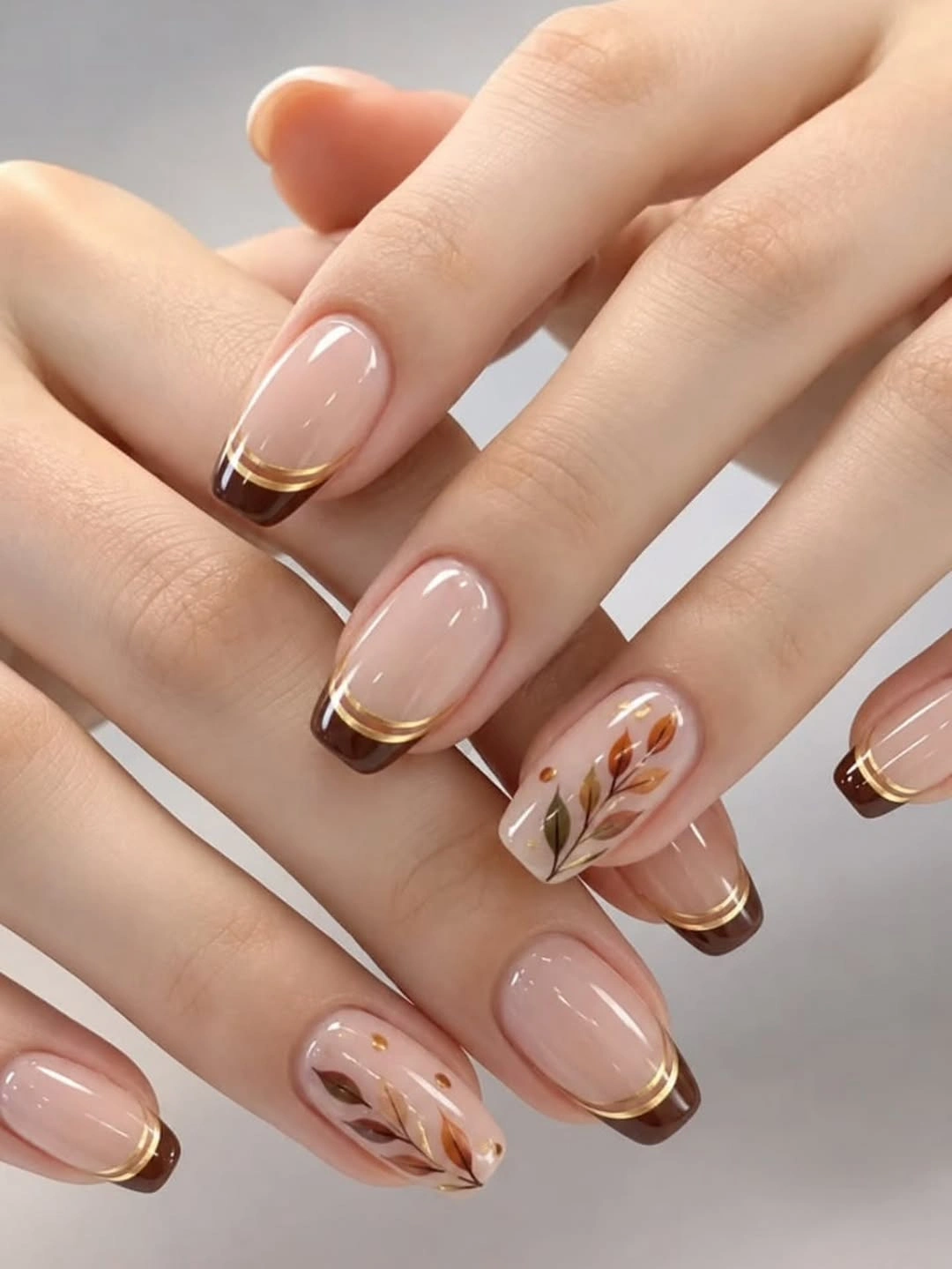
Let the dark tip remain thinner than the nude surface so the almond shape stays light, then use one floral nail per hand instead of filling every finger. A caramel or rust floral can replace the orange, and a bronze line can replace the gold when the contrast needs softening. The design has enough detail already, so supporting nails should stay clean.
The flowers create more visual information than a plain tip, which means their placement should be spaced across the hands rather than clustered together. If the long shape is shortened, keep the floral accents near the center and use a narrow brown edge. That preserves the relationship between perimeter and motif without forcing the design into a crowded square.
Muted Sage With One Delicate Botanical Accent
Medium oval nails alternate muted sage green and nude pink, with one nude nail carrying fine pale and gold botanical details. The sage repeats as the stable color field, while the nude accent offers a lighter surface where the delicate lines can be read. Gold appears only in small touches, so the design closes on detail and spacing rather than strong contrast.
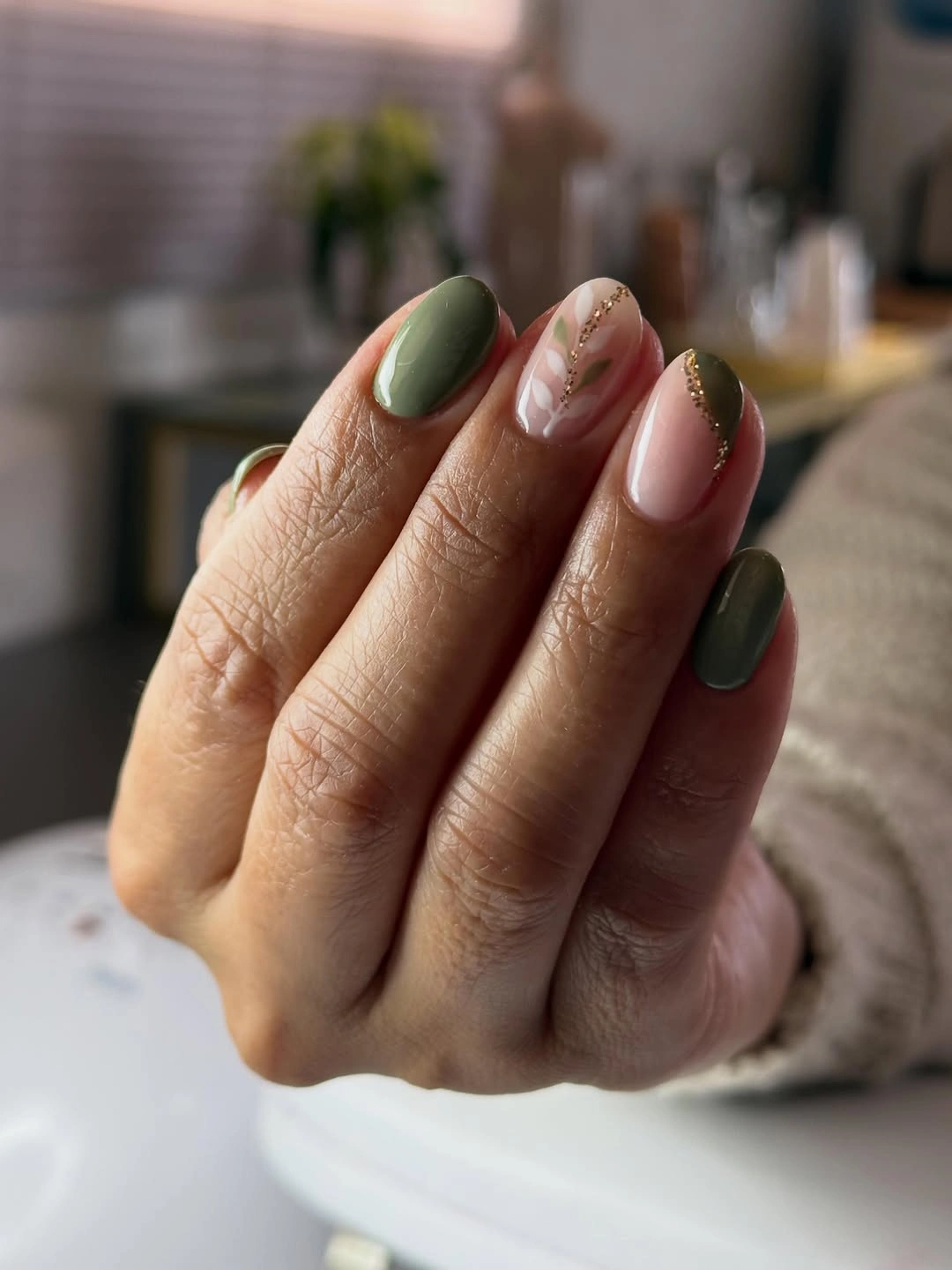
Keep the botanical accent to one nail and repeat the sage on the remaining fingers so the feature stays easy to identify. A dusty olive can deepen the palette, while a warmer blush base will bring the nude accent closer to the season. If you want a simpler result, use one pale leaf or gold line and remove the smaller marks around it.
The quiet finish depends on not overexplaining the accent. Too many gold details can make the nude nail feel decorated instead of delicate, and too much pale linework can disappear into the base. Leave open space around the motif and let the sage provide the final contrast, because the strongest accent is the one that knows when to stop.