
Before a pumpkin is painted, its place within the manicure decides whether the orange motif feels focused or merely scattered across every nail. A tiny face can punctuate a quiet base, a repeated line can make a round fruit read more clearly, or a ghost can give the orange a cooler counterpoint. Paying attention to placement is what turns seasonal nail art from cluttered to deliberate.
Before choosing a design, decide whether the pumpkin should be the focal point, a supporting accent, or one part of a broader spooky pattern. That choice controls how much black line work, white space, and extra color the hand can carry. For a more restrained seasonal starting point, these October nail colours show how a limited palette can still feel timely.
Mini Pumpkins on a Quiet Pink Base
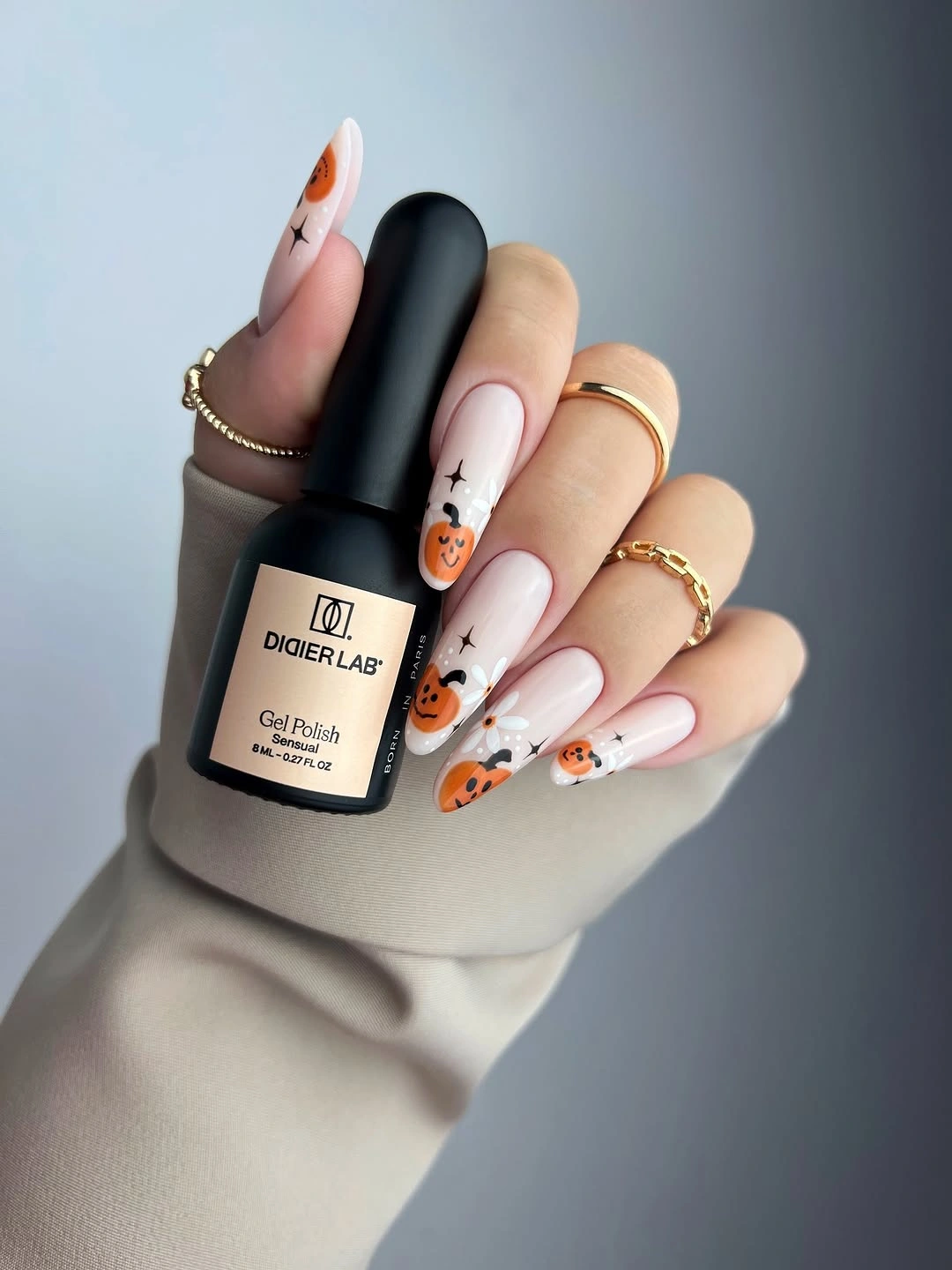
Short almond nails keep a pale pink base, then place small orange pumpkins near the tips and leave several nails almost open except for black stars or a tiny ghost. The spacing is the important detail: orange appears in compact spots rather than as a full-hand wash. That restraint lets the rounded pumpkin shapes stay readable at a short length without crowding the fingertips.
Black marks are used like punctuation here, not as a second dominant color, so the soft background still has room to breathe. A white ghost on one nail also gives the orange faces a clean contrast without forcing every nail into a different scene. If the small motifs start to blur, reduce the number of stars before making the pumpkins larger.
This direction is practical for someone who wants a Halloween reference that can still look calm from arm’s length. A shorter version could keep one pumpkin and one ghost per hand while leaving the remaining nails plain pink. The tradeoff is subtlety versus instant recognition, and this set clearly chooses detail that rewards a closer look.
Orange Vines Along Long Nude Squares
Long nude square nails use orange pumpkin forms, green vine strokes, slim white ghosts, and a few warm brown accents across separate fingers. The design stays organized because the nude base remains visible around each motif instead of becoming another competing color. Orange is distributed in small rounded areas, while the vines create a lighter, more directional line between them.
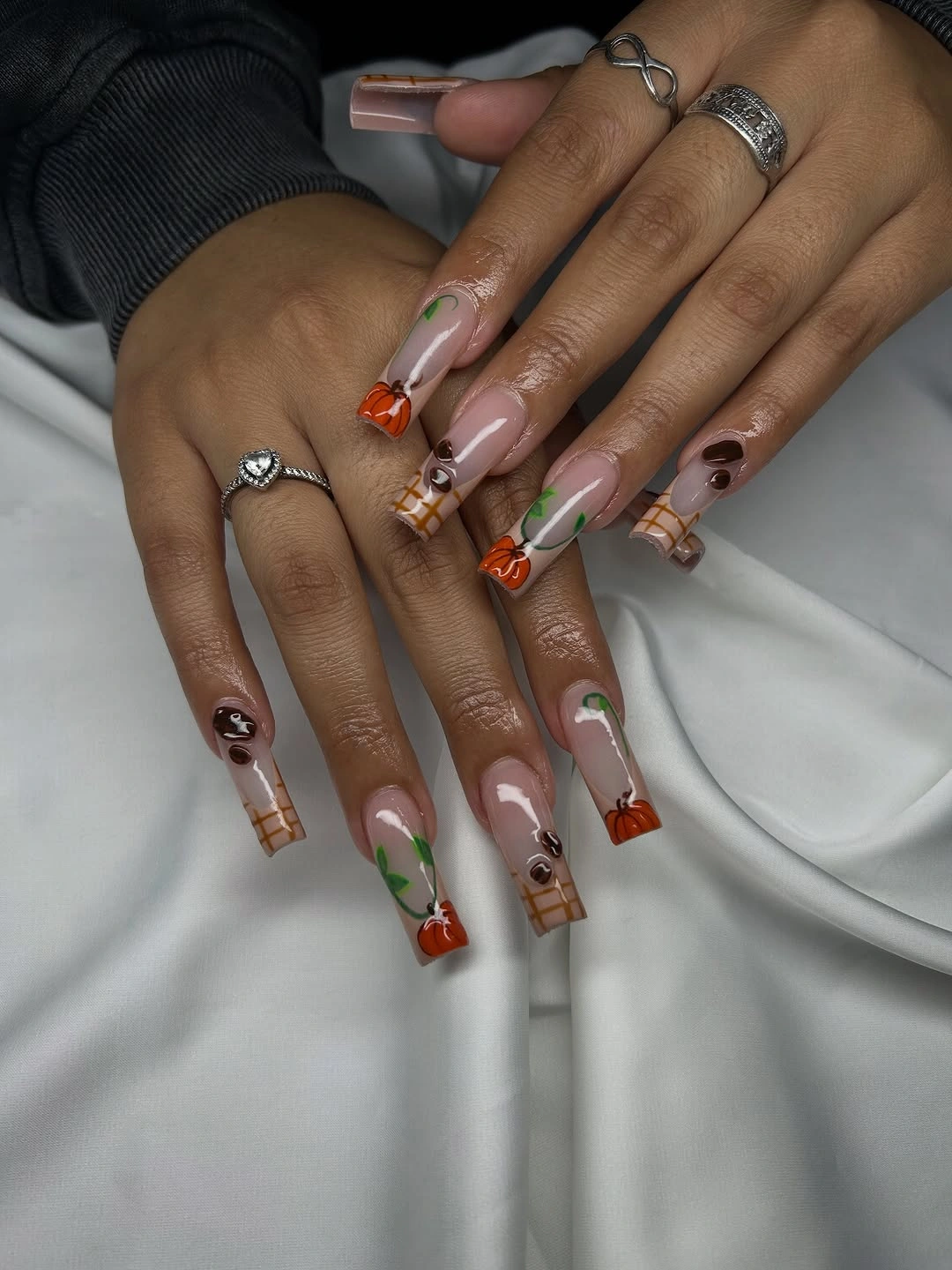
The contrast between the straight square tips and the curling green lines keeps the manicure from becoming too rigid. White ghost details act as small light breaks, especially beside the warmer pumpkin orange. For a less decorative adaptation, retain the vine on one nail and the pumpkin on another, then let the remaining nails use only a thin orange edge.
Length gives this layout room for several motifs, but it also means every extra line is highly visible when the hand moves. If a full set feels busy, the same palette can work with orange French tips and one vine accent. Preserve the nude negative space, because it is what prevents the seasonal elements from merging into a single dense pattern.
Gray Nails With Pumpkin Faces and Webs
A muted gray base gives these medium-length nails a cooler Halloween mood, with orange jack-o-lantern faces, a black bat, and a silver-toned web detail placed across the set. The gray makes the orange look warmer without requiring a black background. One darker textured accent also keeps the pale nails from reading as a uniform flat surface.
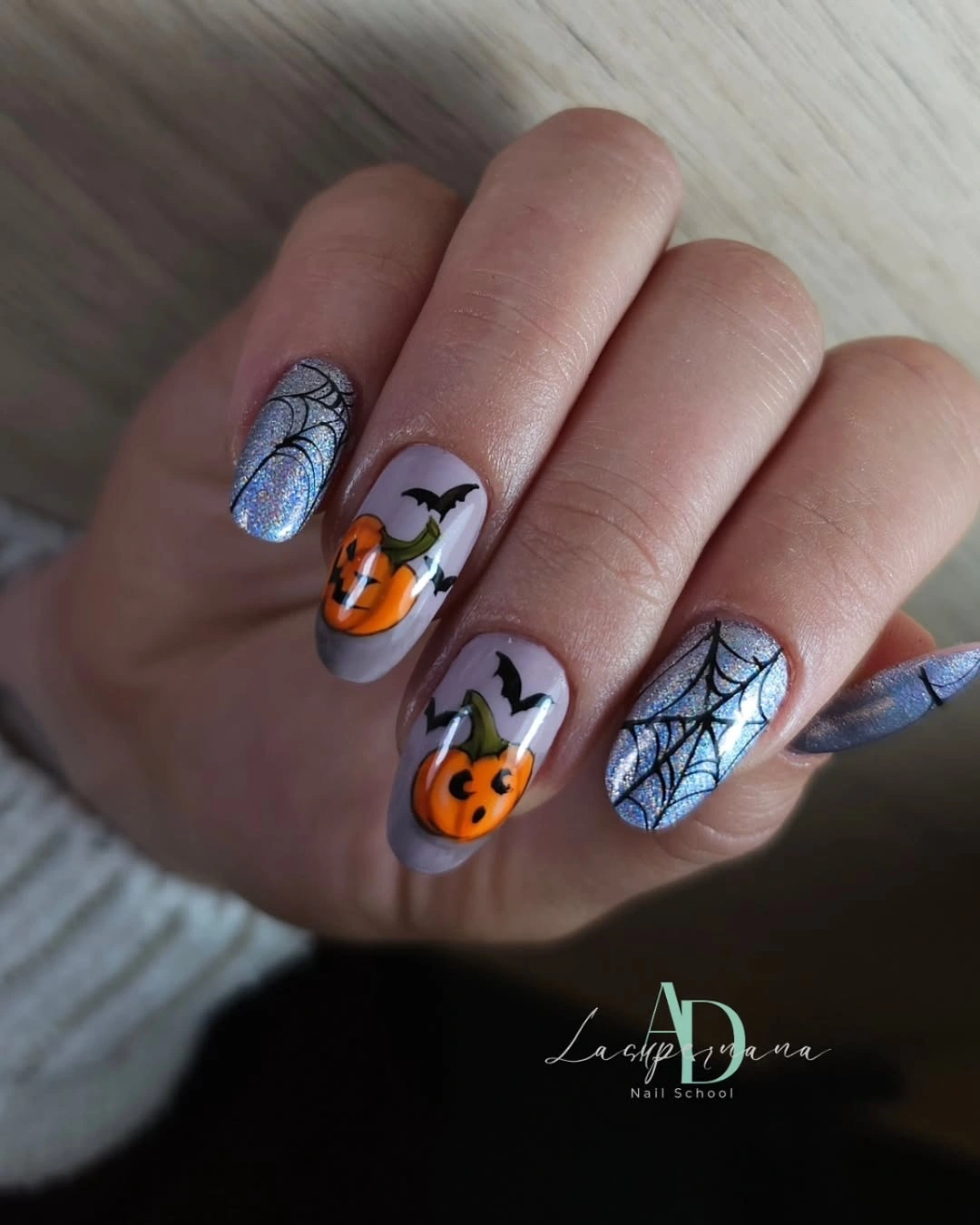
The pumpkin faces work because they sit on separate nails from the web and bat, allowing each icon to keep a distinct outline. Black is concentrated in small silhouettes and line work, so it sharpens the design rather than swallowing the gray base. A softer recreation could replace the detailed web with one thin curved black line near a corner.
Gray is a useful choice for anyone who finds orange-and-black combinations too loud but still wants the seasonal orange cue. The only caution is that a very dark gray could reduce the visibility of the black bat and face details. Keep a visible value difference between background and line work so the miniature artwork does not disappear.
Neon Stitches and Pumpkin Faces on Clear Nails
Long clear-looking nails alternate neon orange panels, stitched green sections, black webbing, a pumpkin face, and drip-like red marks. Each finger carries a different visual note, yet the palette is limited enough that the set still belongs together. The strongest contrast comes from bright orange against black outlines, with green used as a small stitched interruption.
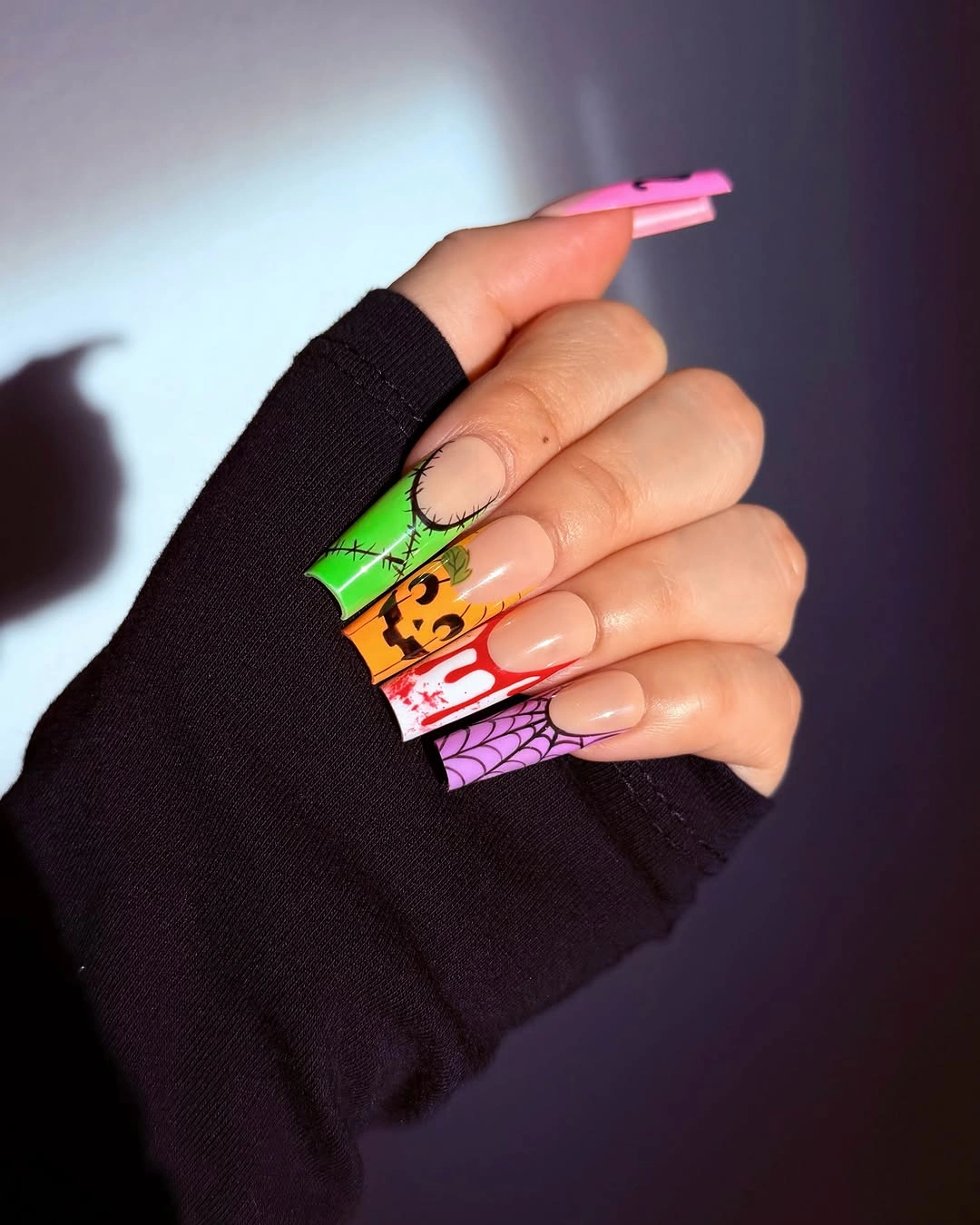
Because several nails are highly decorated, the transparent-looking portions are essential rather than empty. They create breaks between saturated blocks and make the painted symbols feel more graphic. If the red detail feels too intense, swapping it for a thin black drip would keep the edge without introducing another warm color that competes with the pumpkins.
This is a maximal option, and the amount of line work will be more noticeable as the nails grow out or as small edges wear. A simpler version could choose either stitched green panels or webbing, not both, and still retain the after-dark energy. Keep the orange pumpkin face as the anchor, since it gives the many separate symbols one clear seasonal center.
Lilac Stripes With Small Bats and Pumpkins
Medium almond nails pair lilac stripes with pale pink base areas, then add black bats, orange pumpkins, and small black details across individual fingers. The unexpected purple changes the mood from classic orange-and-black toward something softer and more playful. Vertical stripe placement also gives the rounded nails a little extra length visually without relying on a dark full-cover color.
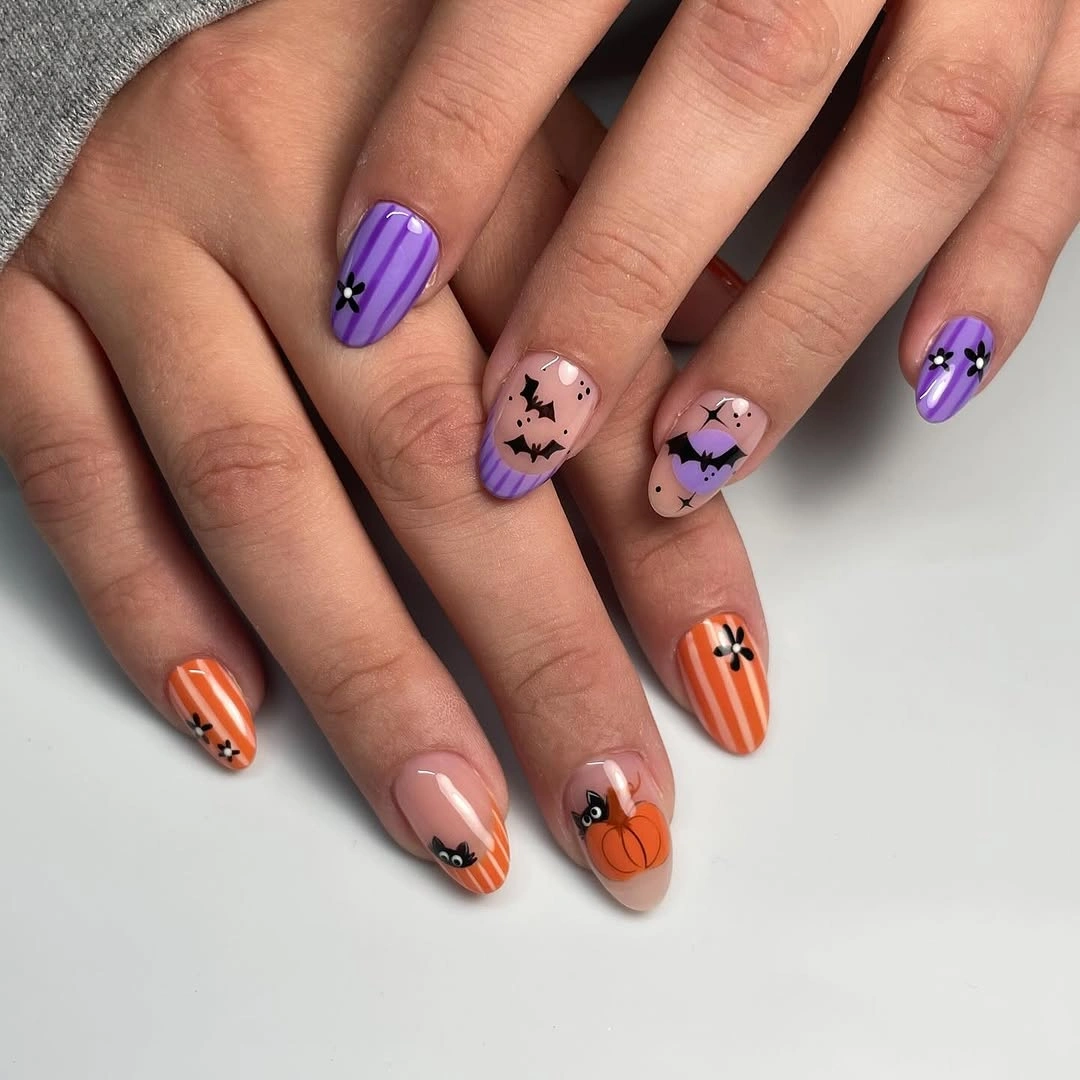
Orange is most effective here because it appears as a compact accent against the lilac rather than dominating every nail. The bat shapes are equally small, so neither motif overwhelms the striped fingers. A less busy version could use lilac on two nails, one pumpkin on another, and a single black bat near a tip while leaving the rest pale.
Colorful seasonal art can feel more wearable when the spooky icons are miniature and the base stays light, as this set demonstrates. The caution is that too many stripe widths can look uneven at a short length. Choose one stripe direction and let the orange and black motifs provide variation instead of adding more decorative pattern types.
Ghosts, Webs, and Bright Orange Points
Long pointed nails use bright orange glitter, black webs, a white ghost, and a pumpkin face against pale and dark areas. The sharp nail shape strengthens the graphic direction, especially where thin black web lines run toward the tip. Orange is not treated as a background; it becomes a bright point that moves the eye through the darker patterning.
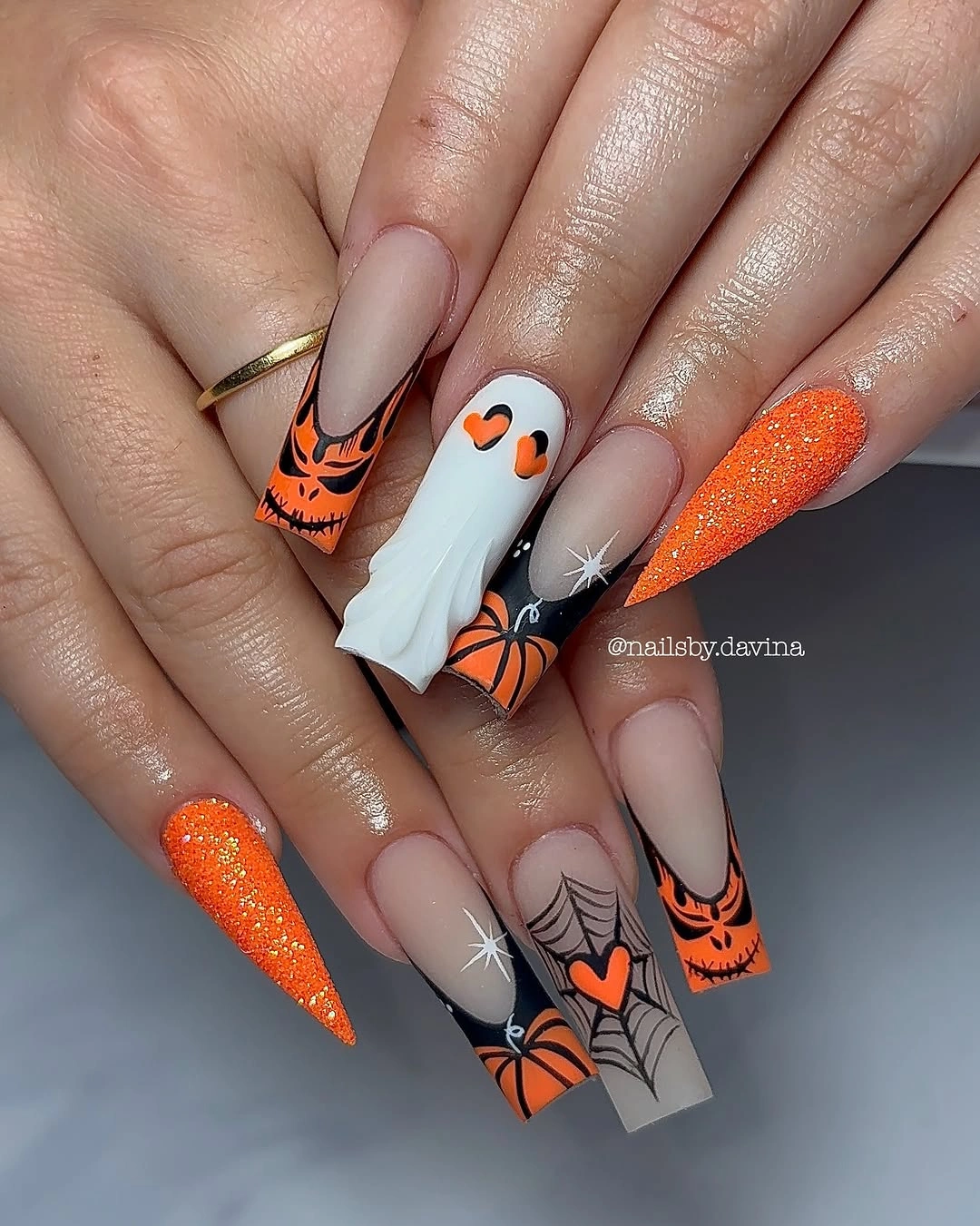
The ghost is valuable because its clean white silhouette gives the eye a pause between webbing and orange sparkle. A few nails remain lighter, which stops the design from becoming a solid black-and-orange field. To make it easier to wear, keep the web on one or two nails and let the remaining fingers use orange, white, or a simple pumpkin detail.
Pointed shapes make detailed tips very visible, but they can be less convenient for someone who prefers a low-maintenance hand feel. The color story would translate well to a softer almond outline with shorter web lines. What should remain is the contrast between bright orange points, black thread-like marks, and one pale ghost shape.
Sample Tips With Bats Ghosts and Pumpkin
These nude almond sample tips show a black web, small bats, white ghosts, and a single orange pumpkin across separate nail shapes. The layout is especially instructive because every icon is isolated enough to evaluate on its own. Against the warm nude base, black line work stays crisp while the orange pumpkin reads as a small but unmistakable focal accent.
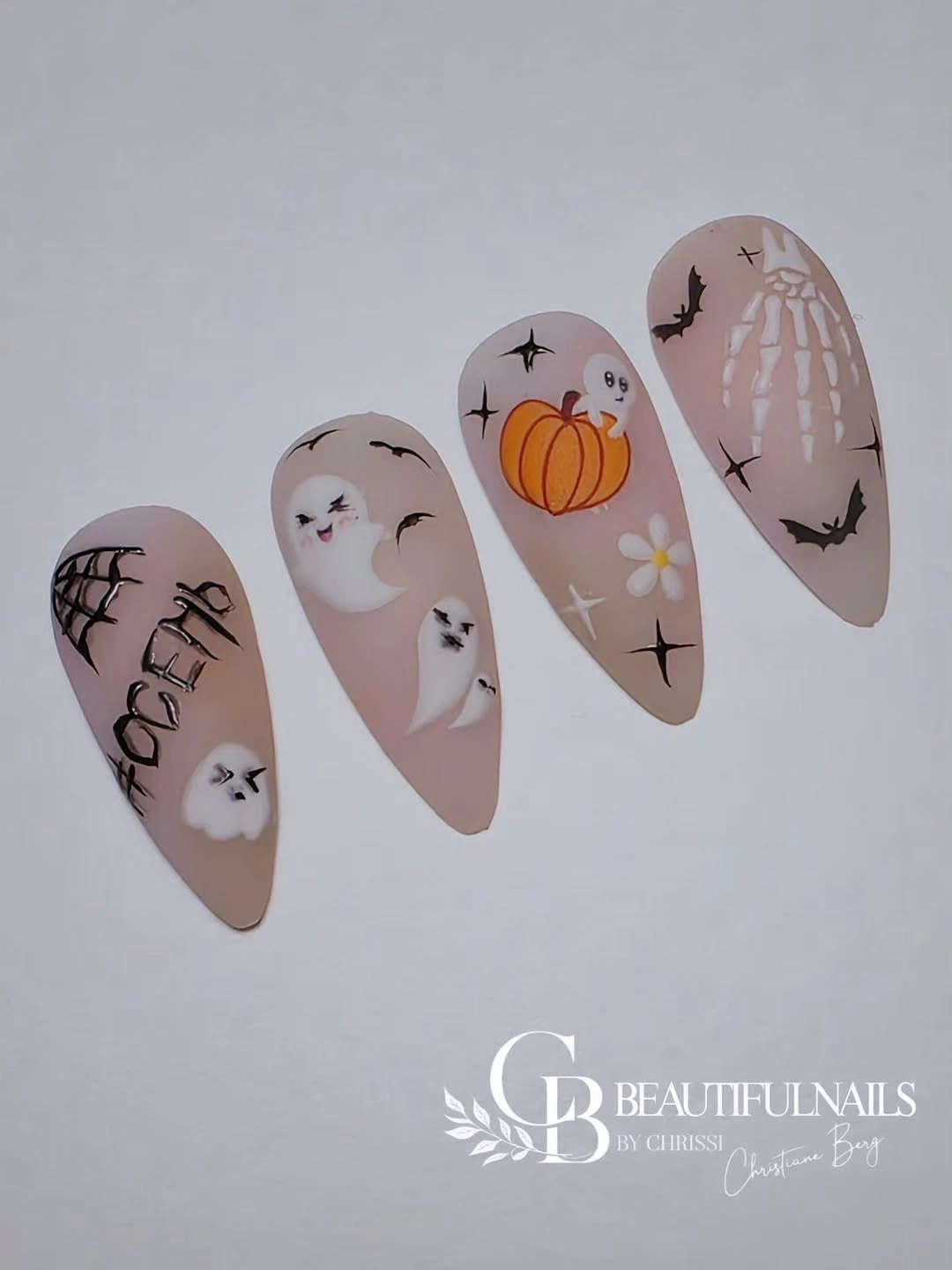
The collection proves that Halloween nail pumpkin designs do not need a full dense set to communicate the season. One pumpkin can carry the warm color, while bats and ghosts provide the contrast and movement. If choosing only two motifs, pair the pumpkin with a ghost for softer contrast, or with a web for a more graphic result.
Individual tip ideas are useful when recreating a look at a shorter length because they can be edited without losing the basic palette. Avoid shrinking every icon onto one nail, which would make the design hard to read. Let each finger do one job, then repeat black only where it helps the orange motif hold its outline.
Pale Pink Mix With Graphic Black Details
Pale pink almond nails alternate white ghosts, orange pumpkins, webbing, and bold black-and-white graphic accents, with each finger using a distinct arrangement. The pale base gives the heavier black details room, especially where a small ghost sits near a cleaner area. Orange appears less often than black, which makes each pumpkin feel intentional rather than repetitive.
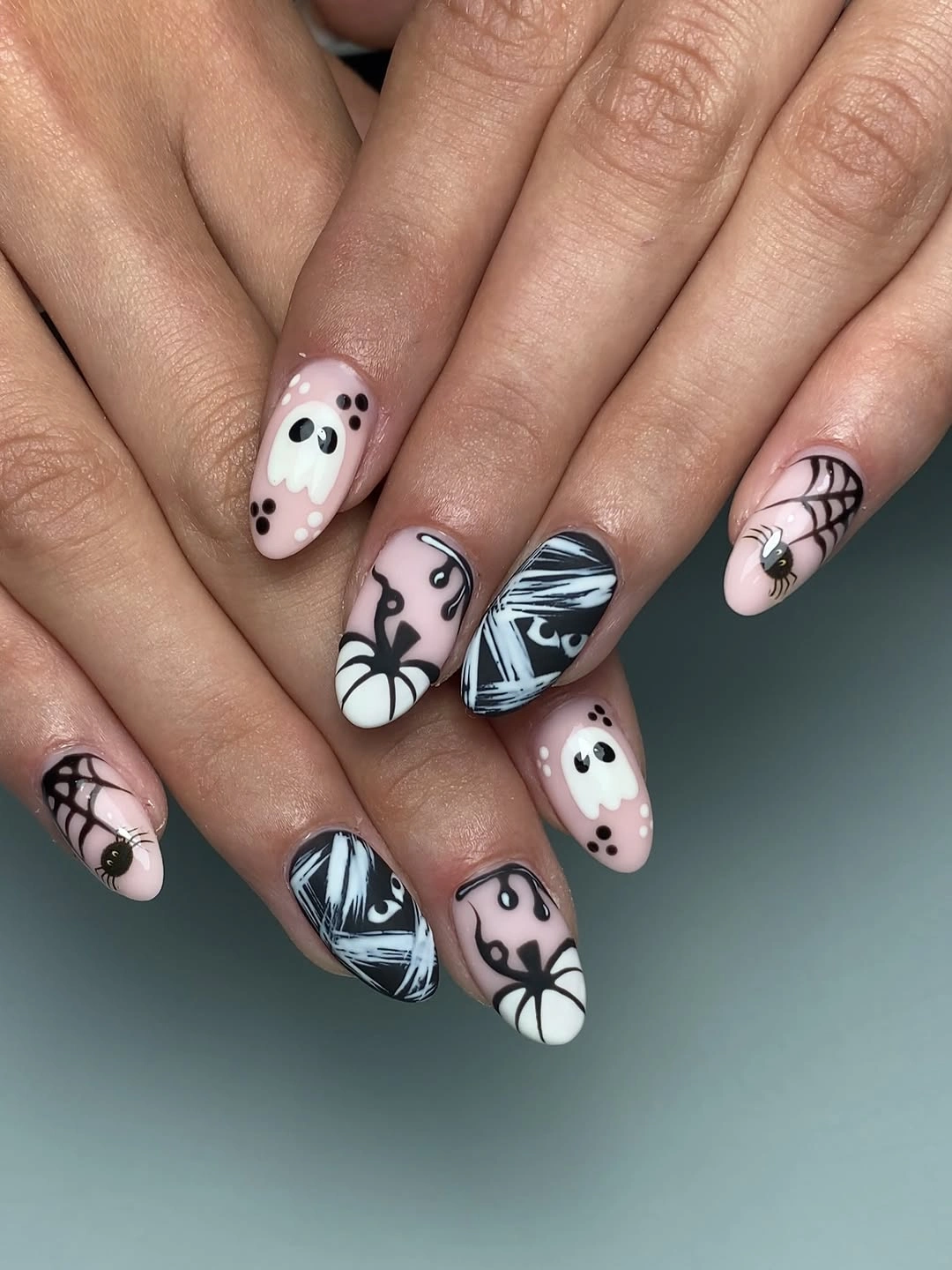
What makes this set balanced is the change in scale between broad graphic blocks and tiny icon work. A large black-and-white accent can sit beside a delicate pumpkin because the pink base remains consistent across the hand. For a calmer adaptation, remove one of the more graphic nails and replace it with plain pink, retaining only the ghost and pumpkin as seasonal signals.
Multiple motif styles can be compelling, but they need one stable base color to avoid reading as unrelated sample nails. Pale pink does that work here while still keeping the result soft enough for daytime wear. Keep the pumpkin marks rounded and small, because enlarging them would compete with the already strong black patterning.
Bat Silhouettes Over Open Pink Squares
Long pale pink square nails use black bat silhouettes, fine web lines, and one small white ghost while leaving broad stretches of the base uncovered. The design feels airy because the icons gather near selected tips and edges rather than filling every center. That open placement turns the pink into a visible design element rather than merely a background color.
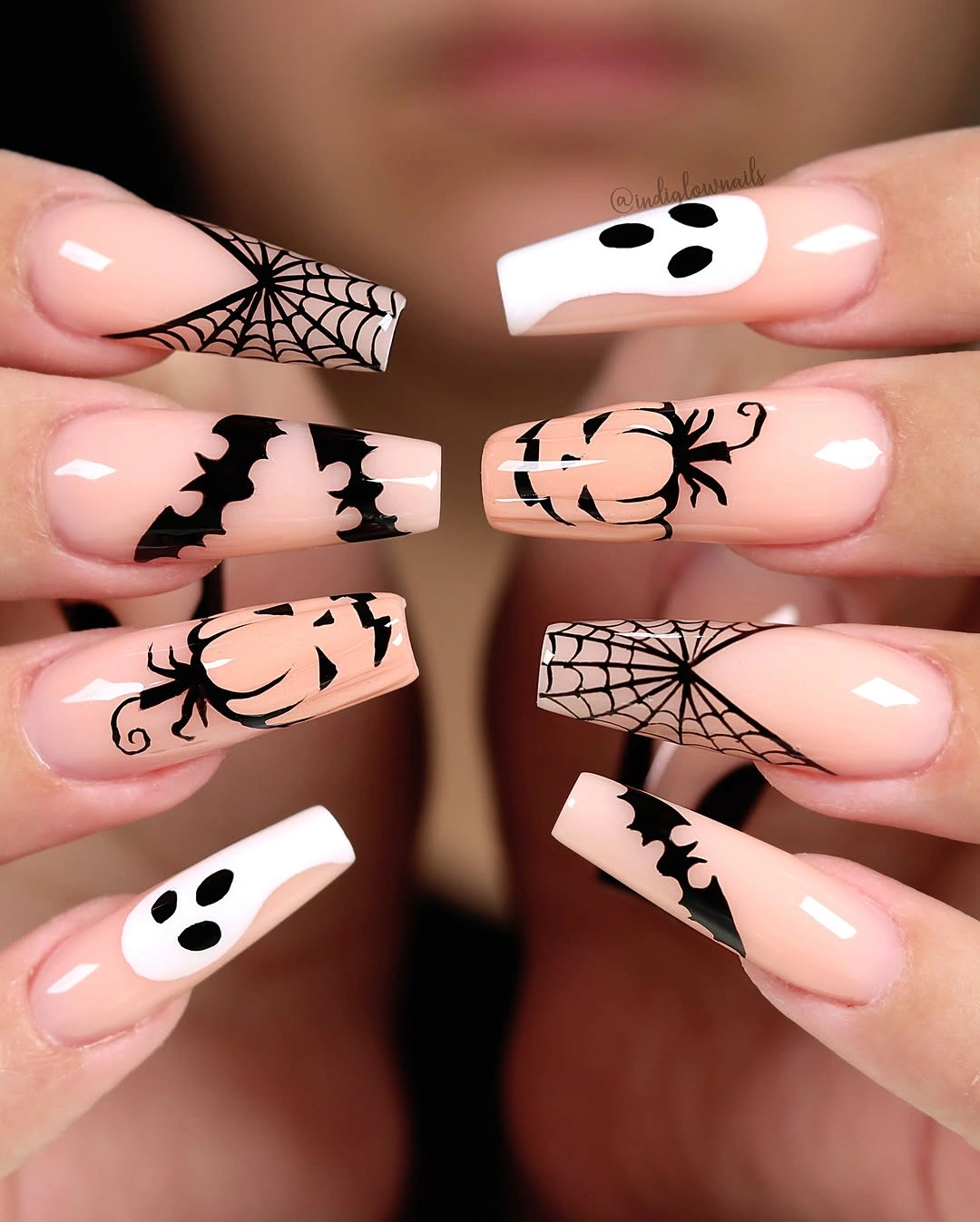
Black is sharply defined here, but the amount is modest enough that the hand still looks light. A white ghost creates a different kind of contrast from the bats, adding a small bright shape against the pink. If you want a simple Halloween nail idea with pumpkin later, one orange accent nail could be added without disturbing the spare web-and-bat arrangement.
Square length gives plenty of room for web lines, though very fine black strokes can be the first detail to look uneven as time passes. A shorter version should concentrate the web at one corner and let the bats occupy only one or two nails. The negative space is the part worth protecting when adapting this polished, airy layout.
Bronze Swirls Beside Brown Pumpkin Portraits
A display of long tips mixes brown-orange pumpkin portraits, deep red-black shapes, nude bases, and metallic-looking bronze swirls. The warm palette is richer than bright candy orange, so the pumpkin motif reads more autumnal and ornamental. Gold-toned accents are placed on only a few nails, which keeps their reflective surface from overpowering the illustrated faces.
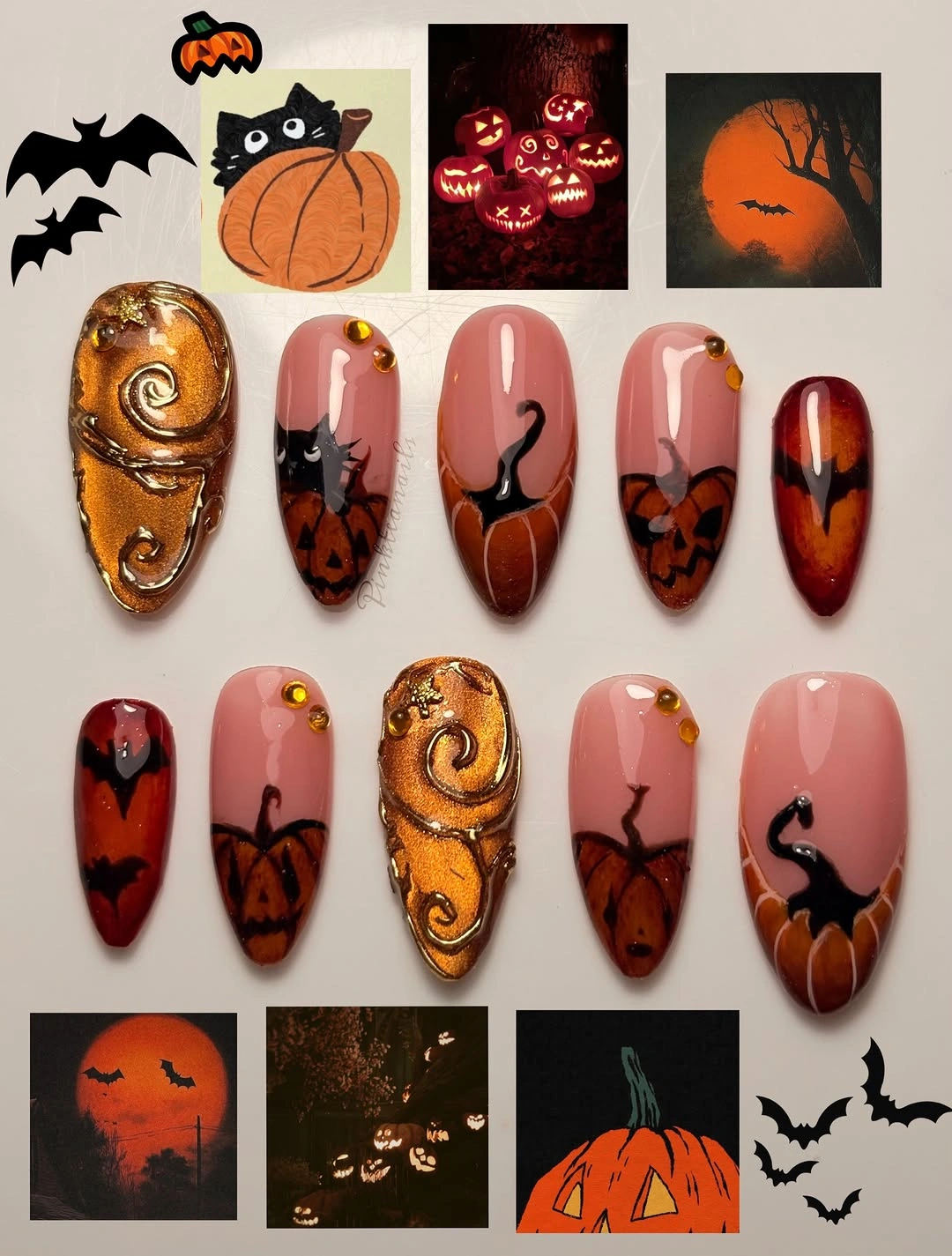
The small pumpkin faces work because they are framed by darker outlines and separated from the most reflective nails. Those metallic-looking swirls provide texture without needing another illustrated motif. Someone who wants less detail could choose a single brown pumpkin nail beside two nude nails with one small bronze curve, then keep the rest in a related deep red or warm neutral.
Warm brown and bronze can be a thoughtful alternative to high-contrast orange and black, but the palette needs enough darkness for the pumpkin shapes to stay visible. Avoid adding bright purple or neon green to this version, since that would break its burnished direction. The strongest feature is the selective shine beside the softer, hand-drawn-looking pumpkin art.
Sheer Nude With a Tiny Pumpkin Outline
Short sheer-looking nude nails use a fine gold accent, small leaf-like marks, and one restrained orange pumpkin outline rather than a full illustrated scene. The visible surface remains mostly calm, which makes the tiny seasonal detail feel considered. Warm metallic notes gather near the edges, giving the manicure a gentle glow without competing with the natural-looking base.
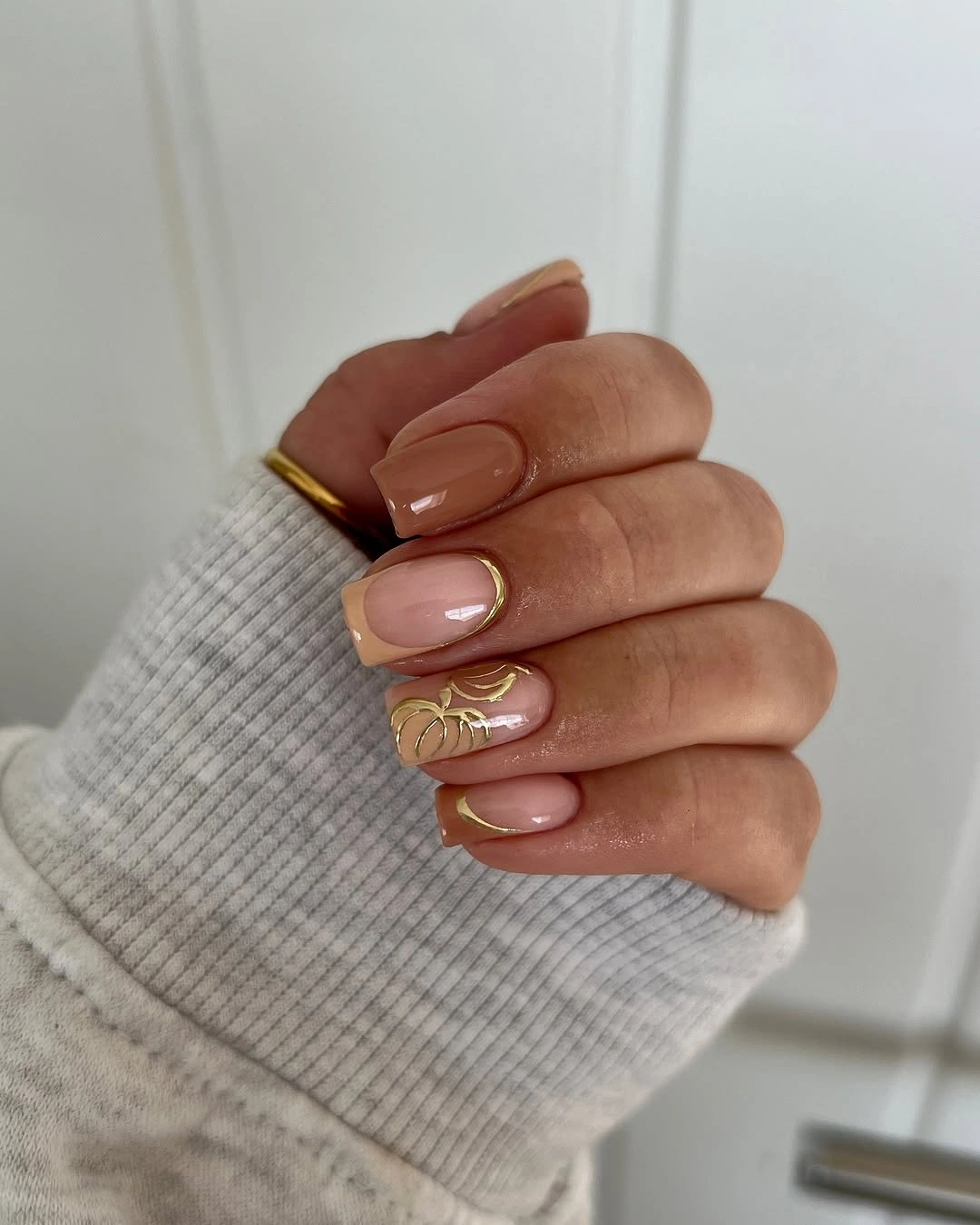
This is a useful reminder that a pumpkin motif can function almost like jewelry when it is kept small and placed on a single finger. The light base and delicate gold marks make the orange less cartoonish than it would be against black. If the outline seems too subtle, add a second small pumpkin rather than turning every nail into a filled orange shape.
A restrained design usually handles day-to-day outfits more easily, although fine details can be less visible from a distance. That is not a flaw if the goal is a quiet seasonal nod. Keep the nude surface clear and let the tiny outline remain the surprise, because larger black motifs would change the whole balance of this minimal approach.
Lavender Squares With Ghost and Calendar Marks
Long lavender square nails place a white ghost, a pumpkin face, calendar-like number marks, a silver star, and dark line details across separate fingers. The cool purple base gives the seasonal orange a different energy than a nude or black background would. White and silver act as small light points, helping the illustrated details remain clear within the more saturated color field.
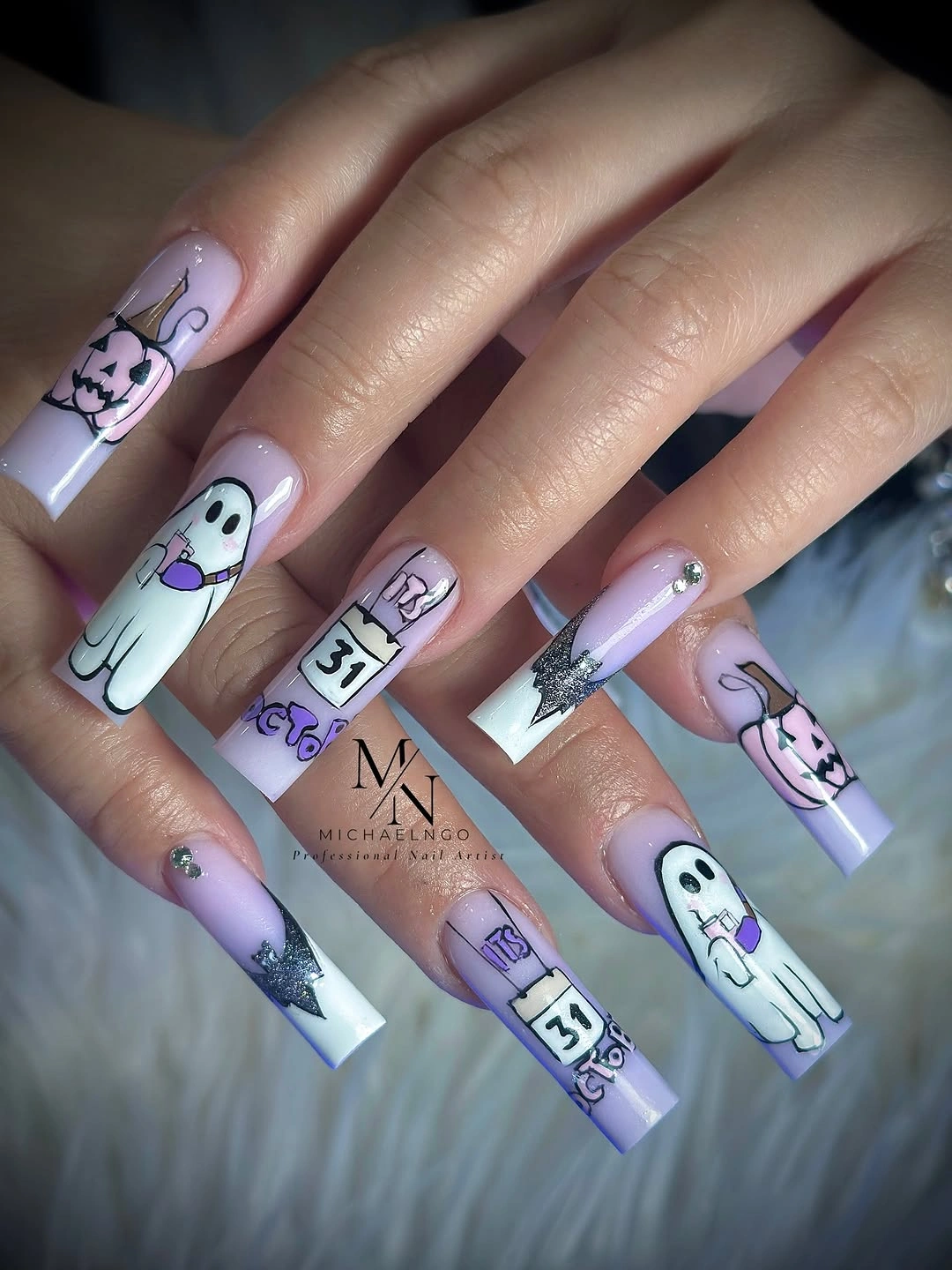
The best visual choice is the separation of symbols: the ghost occupies one nail, the pumpkin another, and the number-like marks get their own pale panel. That keeps the manicure from asking one finger to explain the entire theme. A softer version could retain lavender and the white ghost, then use one orange pumpkin as the only warm accent.
Long squares make this sort of graphic lettering and character art easier to see, but they also reveal uneven spacing quickly. Keep any small number marks simple rather than overly intricate if working at home. The lasting idea is the cool-lavender field interrupted by a white ghost, one orange face, and restrained metallic sparkle.
Textured Green Accent With Pink Pumpkin
A mixed-color manicure uses a raised-looking green sweater texture, a pink pumpkin nail, a small deer face, and soft brown-pink companion nails. The pumpkin is unusual because its warm motif is softened into pink rather than bright orange, while the green texture supplies the stronger contrast. That split makes the set feel autumnal and playful without leaning on standard Halloween colors.
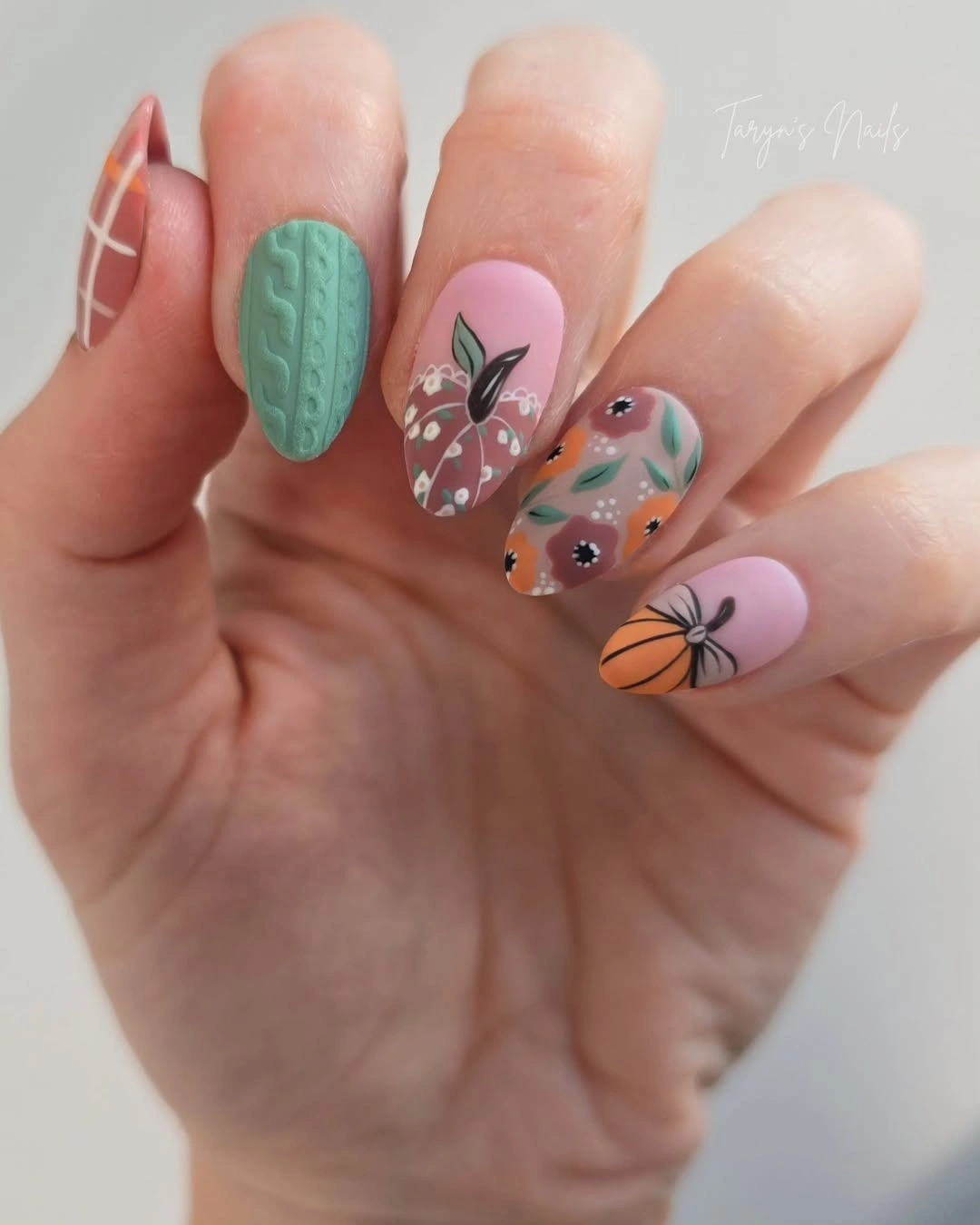
Texture is the focal decision here, so the other nails wisely use simpler drawn motifs and flatter color fields. The pink pumpkin works because it echoes the softer base colors instead of competing with the green accent. If the textured effect feels like too much, a solid muted green nail can preserve the palette while allowing the pumpkin and deer details to remain visible.
This combination is better suited to someone who enjoys a more decorative, story-like manicure than a single spooky icon. Several gentle motifs need breathing room, so do not add bats, webs, and heavy black lines on top. Keep the contrast between the tactile-looking green surface and the rounded pink pumpkin, which is where the design gets its personality.
Warm Orange Panels With Floral Pumpkin Details
Long square nails combine warm orange pumpkins, black outlines, pale floral petals, stitched shapes, and a white ghost across separate panels. The orange sections stay graphic because they are edged in black, while the flowers soften the larger motifs with small pale breaks. A dark sleeve nearby makes the warm colors stand out more clearly without becoming part of the manicure itself.
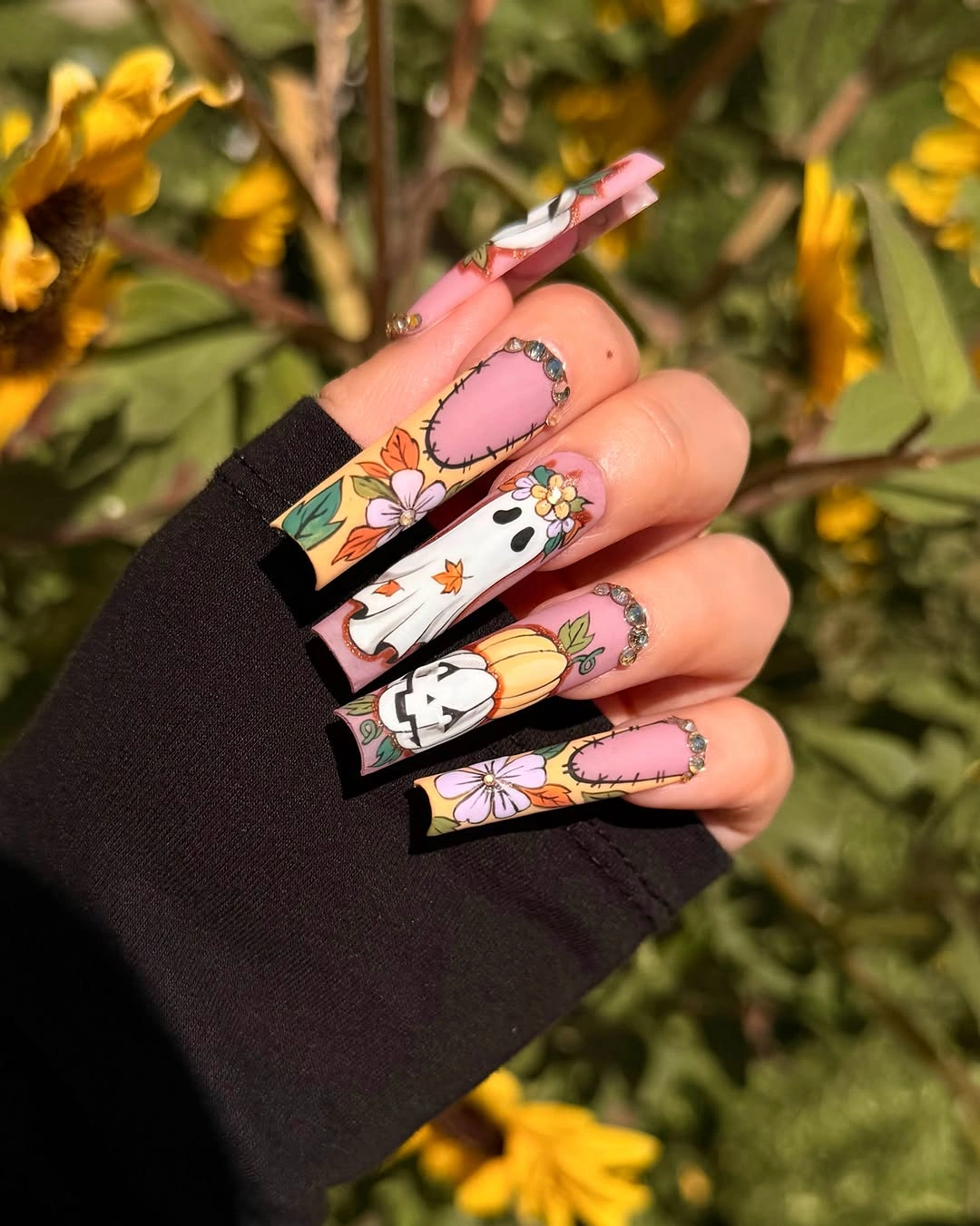
There is a lot happening, yet the set remains readable because flowers, pumpkins, stitches, and ghost elements receive different nails rather than overlapping everywhere. The repeated black outline acts as a visual rule across the hand. To simplify the look, keep orange pumpkins on two nails and place one flowered accent beside them, leaving the ghost for a separate white nail.
Long square shapes give these framed designs a poster-like quality, but they demand clean spacing along the sidewalls. If that level of detail feels high-maintenance, use a shorter square with a single pumpkin panel and one floral corner. The key is retaining the warm orange-and-pale flower contrast, not reproducing every illustrated symbol.
Glossy Orange Pumpkins With Fine Black Lines
Glossy orange almond nails are painted to resemble pumpkins through thin black vertical lines, small black faces, and compact green stems. The design is unusually focused because nearly every nail repeats the same rounded fruit idea instead of switching between several spooky icons. Fine dark lines give the orange depth, while the pale neighboring accents keep the set from becoming an uninterrupted orange block.
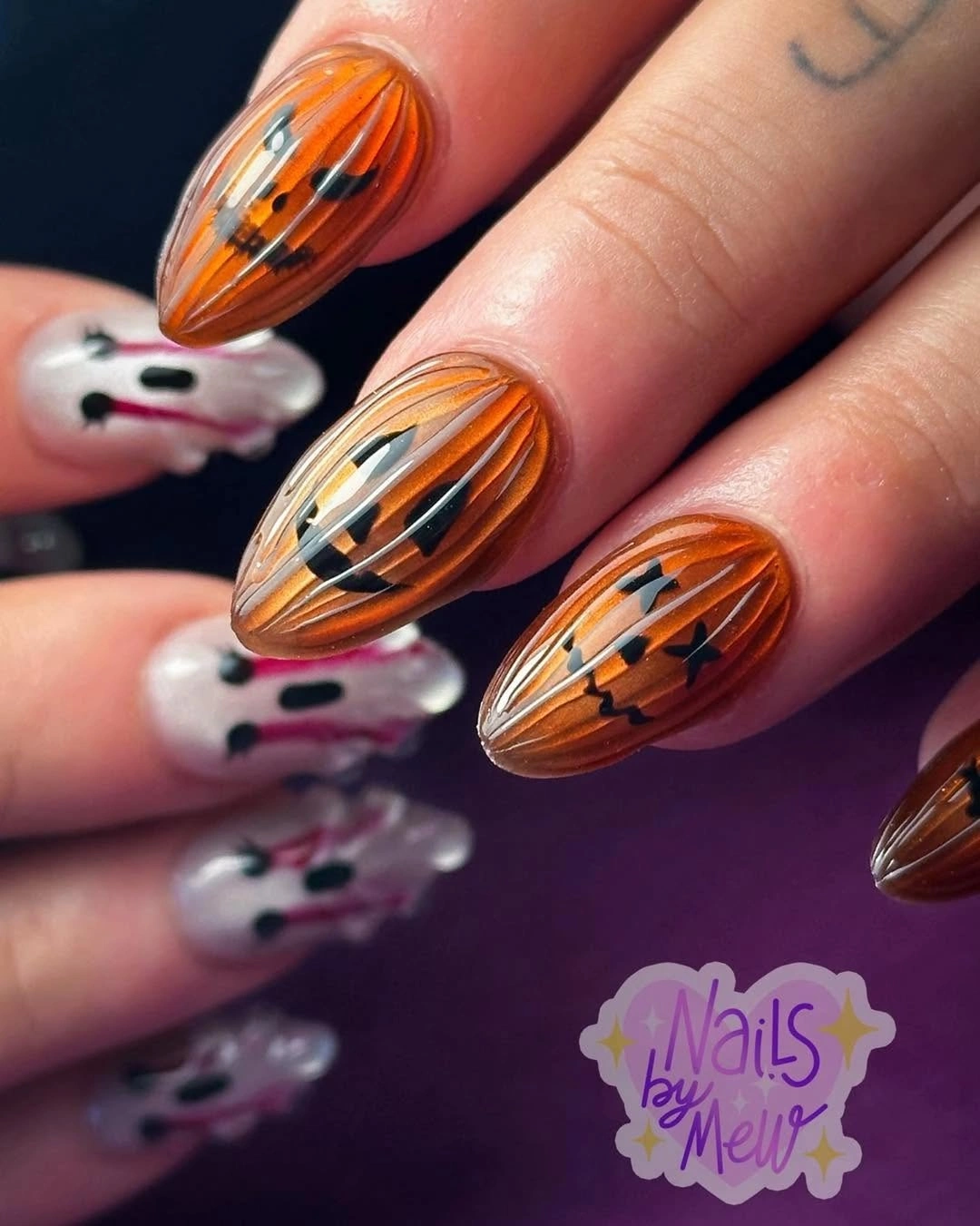
Repeating one motif can be stronger than using a different character on every finger when the motif itself has enough structure. Here the vertical black lines suggest pumpkin segments, and the tiny faces add a playful change of expression. A more subtle variation could paint only two pumpkin nails and use translucent orange tips on the others, preserving the color story with less illustration.
Fine black segment lines need enough contrast to remain visible, especially once the nail moves away from direct light. Avoid making them too close together, which can turn the rounded shapes into visual noise. These October nail designs offer another useful contrast between icon-led and line-led seasonal choices.
Small Pumpkins With Raised Yellow Flowers
Long pale nude nails pair small orange pumpkins with raised-looking yellow flowers, green leaves, and a clean light base. The pumpkin art sits low and compact, allowing the flower details to add a softer seasonal counterpoint. Warm orange and yellow are close enough to feel connected, while green leaves create just enough cool contrast to separate the shapes.
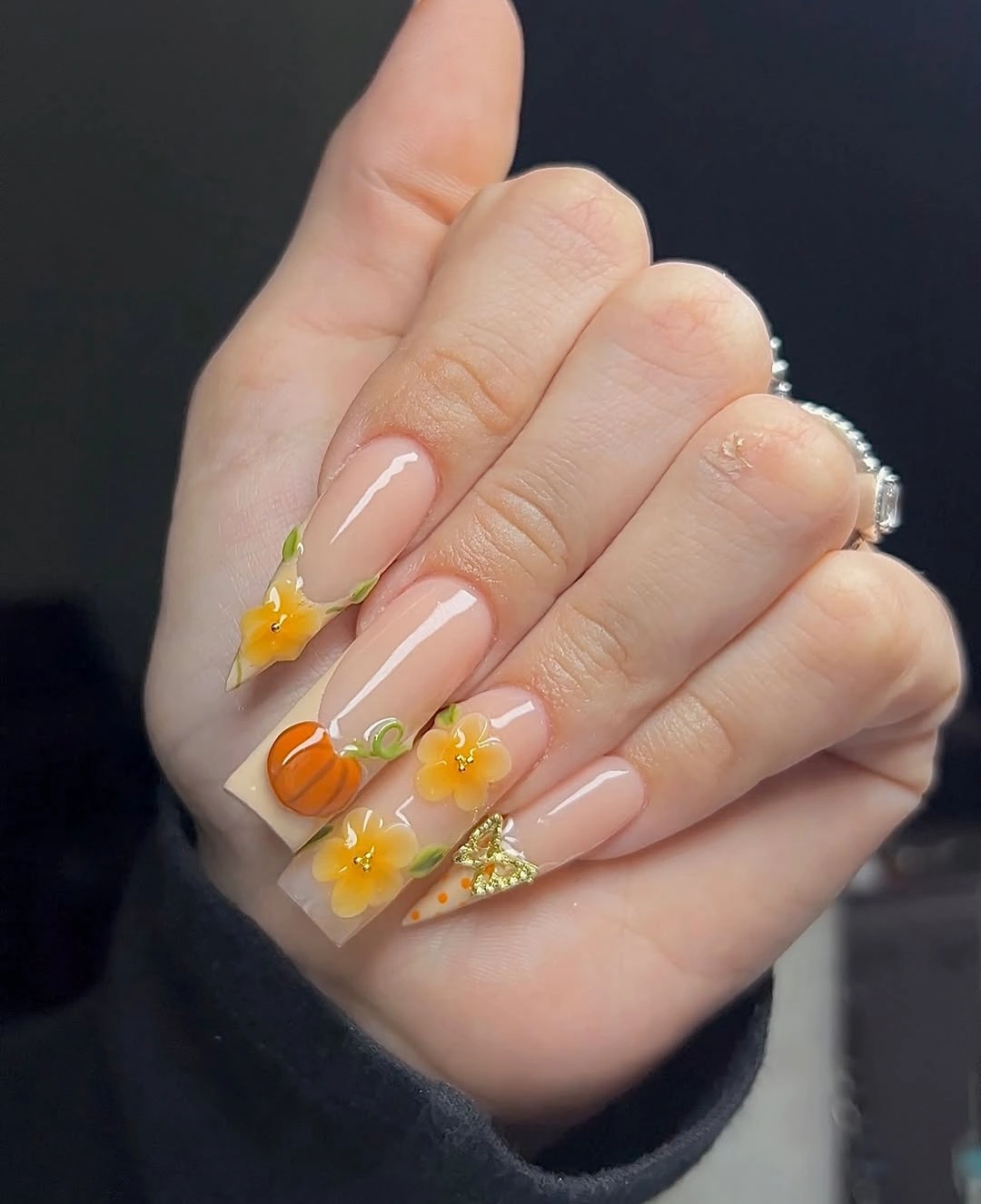
The flower accents keep the pumpkins from reading as a single Halloween-only message, which gives the manicure a gentler early-autumn direction. Placement remains important: each decorative cluster occupies part of a nail rather than covering every visible surface. A reduced version could use one pumpkin and one flower per hand, with the other nails left nude or given only a small leaf.
Decorative raised-looking elements can catch attention quickly, but too many would make the surface feel visually busy. Keeping them limited allows the pale base to remain calm and makes the orange fruit more distinct. The design succeeds when the flowers soften the pumpkins instead of competing with them for equal importance.
Pink Stitches With Black Web Linework
Long pink almond nails use black web lines, stitched marks, a white ghost, and one orange accent to create a softer take on spooky nail art. The pink background changes the usual severity of black webbing, making the line work feel decorative rather than heavy. A single orange detail anchors the Halloween color story without taking over the whole set.
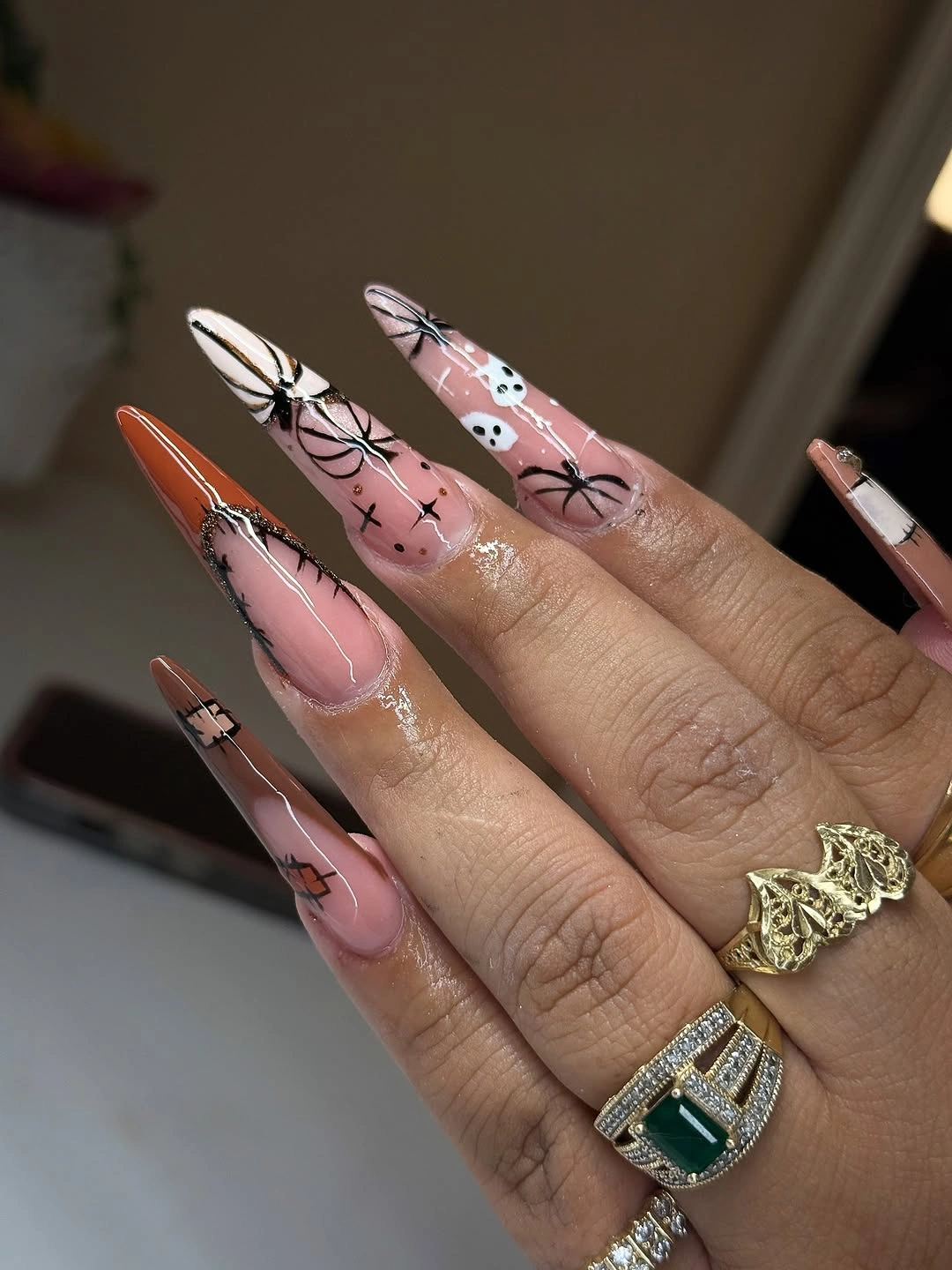
Stitched marks and web lines have similar graphic weight, so they need to be separated across different nails to remain legible. The white ghost offers relief from the fine black drawing and keeps the composition from becoming all outline. If recreating it at a shorter length, choose either a stitched nail or a web nail and let the ghost be the main character.
The pink-and-black pairing is especially useful when you want a seasonal manicure that does not rely on a dark base. It can look busy if every finger carries a line pattern, so leave at least one nail almost plain. Protecting those quiet pink areas is what allows the ghost, web, and orange accent to keep their individual impact.
Pink Squares With One Tiny White Ghost
Short pink square nails pair a small white ghost with bright pink stitched panels, black line work, and a few simplified decorative marks. The ghost is intentionally tiny against the larger pink surfaces, making it a surprise rather than a full character nail. Black outline segments give the square shape a more graphic edge and stop the color from looking overly sweet.
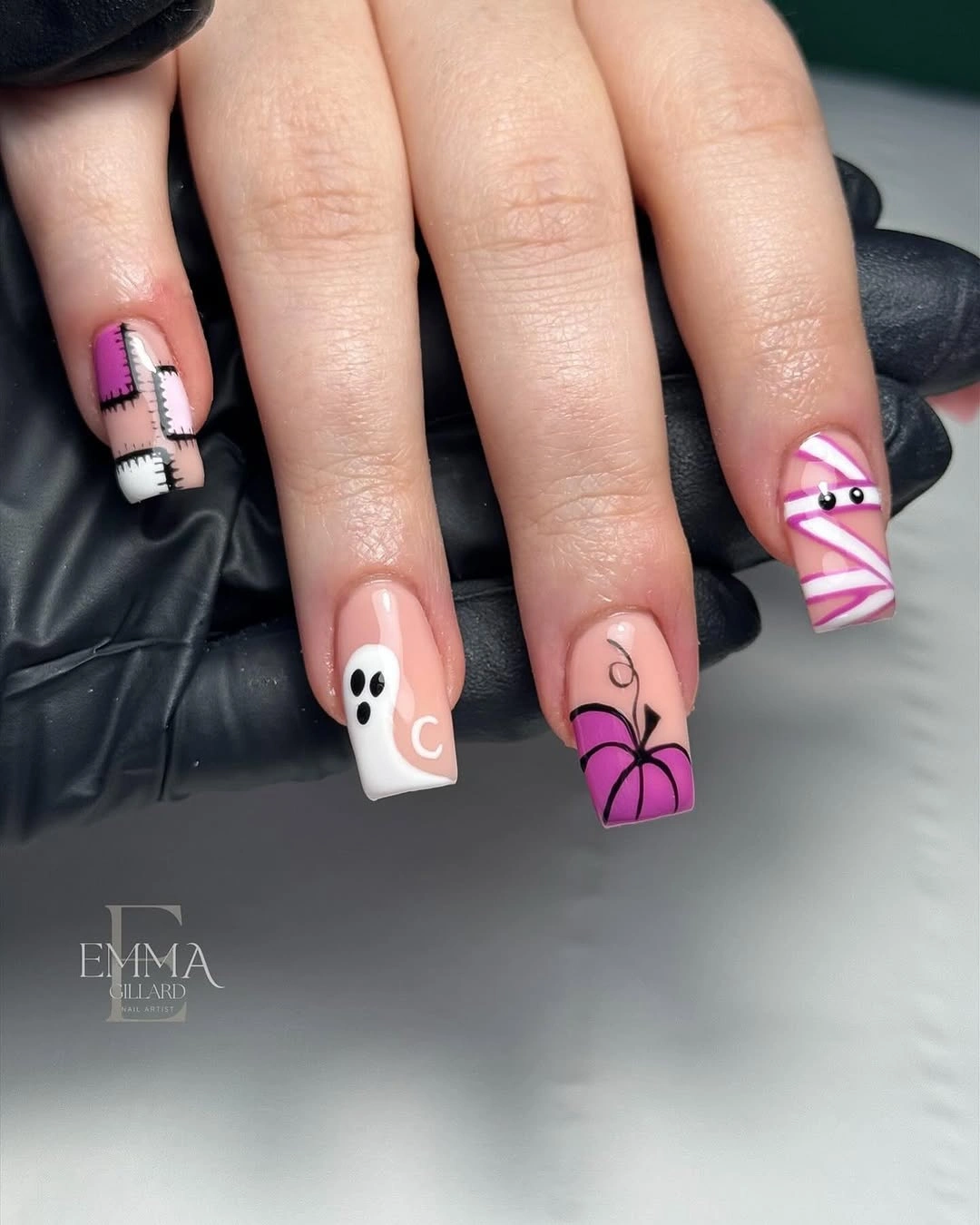
The visual hierarchy is clear: pink supplies the largest areas, black defines the structure, and white becomes the smallest bright accent. That is why the ghost remains visible even though it is not oversized. For a simpler set, use one pink stitched accent and one ghost nail, then keep the other nails a clean pale pink with a thin black edge.
Short squares are a good canvas for bold blocks because they make wide color areas feel intentional, but very fine symbols need to stay simple. Avoid crowding the tip with too many marks where the shape narrows visually. The strongest adaptation retains the large pink fields and lets the white ghost appear once as a crisp, friendly interruption.
Glittery Pumpkin Relief on Nude Almonds
Medium nude almond nails feature raised-looking orange pumpkins with glittery surfaces, small green stems, and a few subtle dark details. The sculptural-looking fruit becomes the main event because the surrounding nails stay close to the nude base. Orange sparkle is concentrated within each pumpkin shape, which gives the design texture without requiring a full glitter background.
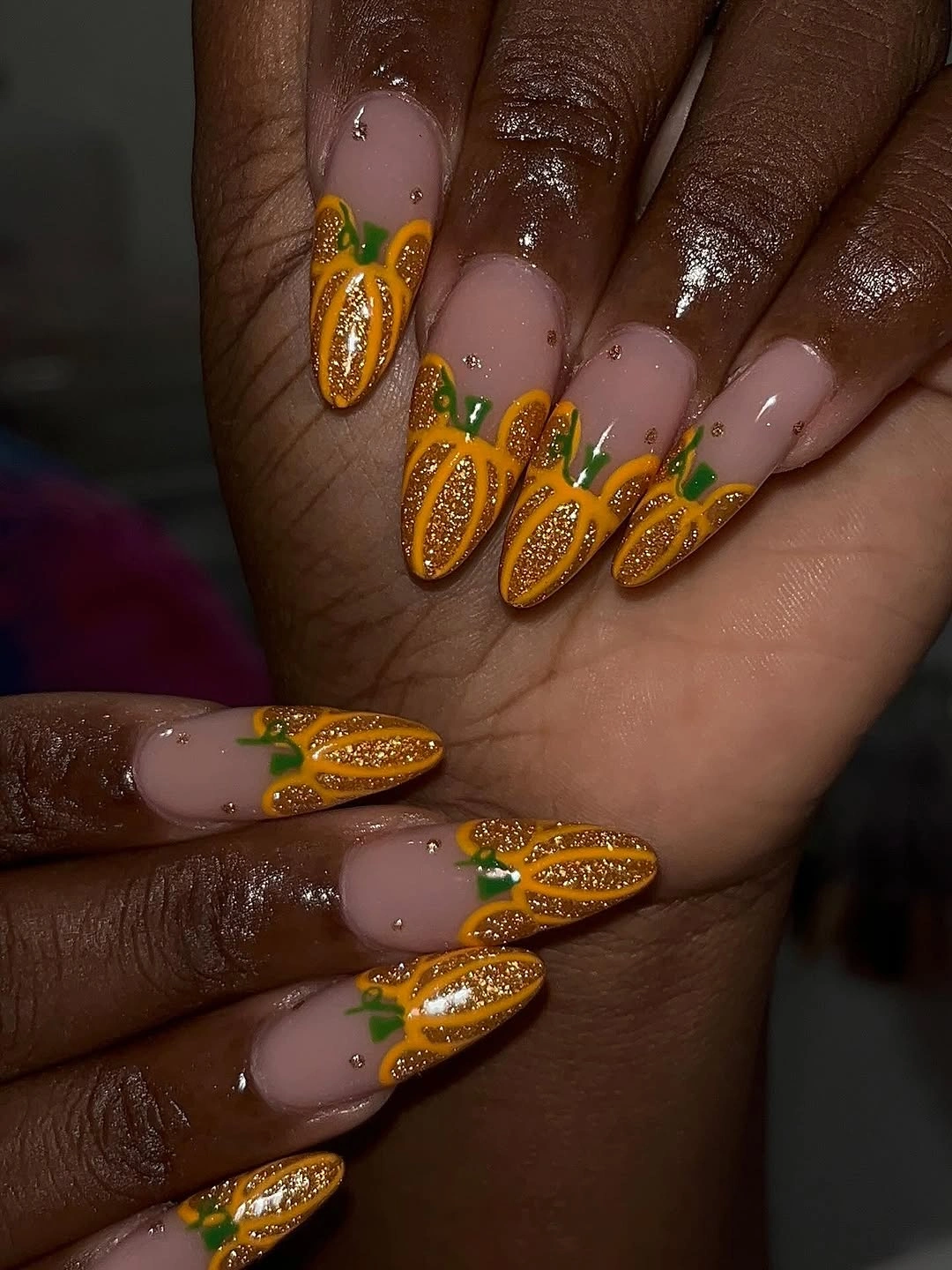
Dimensional-looking accents need contrast around them, and the uncluttered nude areas provide exactly that space. Tiny green stems create a useful color break at the top of each orange form, making the pumpkins easier to identify. If a full hand of raised details feels excessive, use the effect on two accent nails and carry orange onto the others with a thin flat line.
Highly textured art may be more noticeable in daily use than a painted surface, so keep the number of raised-looking details controlled if you prefer a low-key feel. Their beauty lies in the selective sparkle, not in covering every nail. A neutral base remains essential because it gives the orange pumpkins enough contrast to look intentional and not merely decorative.
Pink Webs With Bats and White Ghost
Long pink square nails use black spiderwebs, a small ghost, bat silhouettes, black stripes, and fine line details across pale surfaces. The pink base prevents the dark graphics from feeling too severe, while the square tips make the web patterns look clean and architectural. A tiny white ghost offers a bright midpoint among the black designs and keeps the hand visually light.
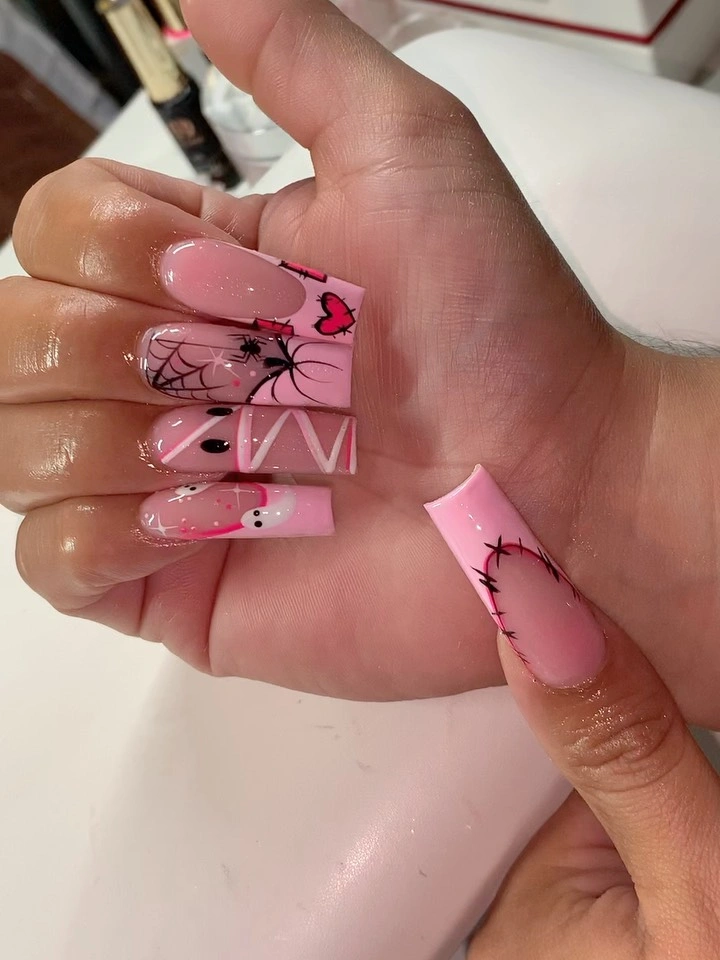
Webs and stripes can compete because both are line-heavy, but separating them onto different nails gives each pattern a chance to read. The bats are simplified into small silhouettes rather than detailed drawings, which is the right scale for this crowded but organized layout. A toned-down option could keep the web, one ghost, and one black stripe, then leave the rest pink.
With a long square profile, horizontal stripes can shorten the appearance of the nail if they are too wide or repeated too often. Keep them narrow and reserve the broader visual space for the web. The design works when the black marks feel like varied punctuation on pink, with the ghost serving as the clearest pale focal point.
Soft Pink Ghosts With Tiny Orange Pumpkins
Short soft-pink nails mix small orange pumpkins, white ghosts, tiny flowers, and restrained dark marks across a compact rounded shape. The floral details lighten the spooky motifs and make the set feel playful rather than intense. Because the icons are small, the pink base remains visible around them and keeps the hand from looking crowded at this practical length.
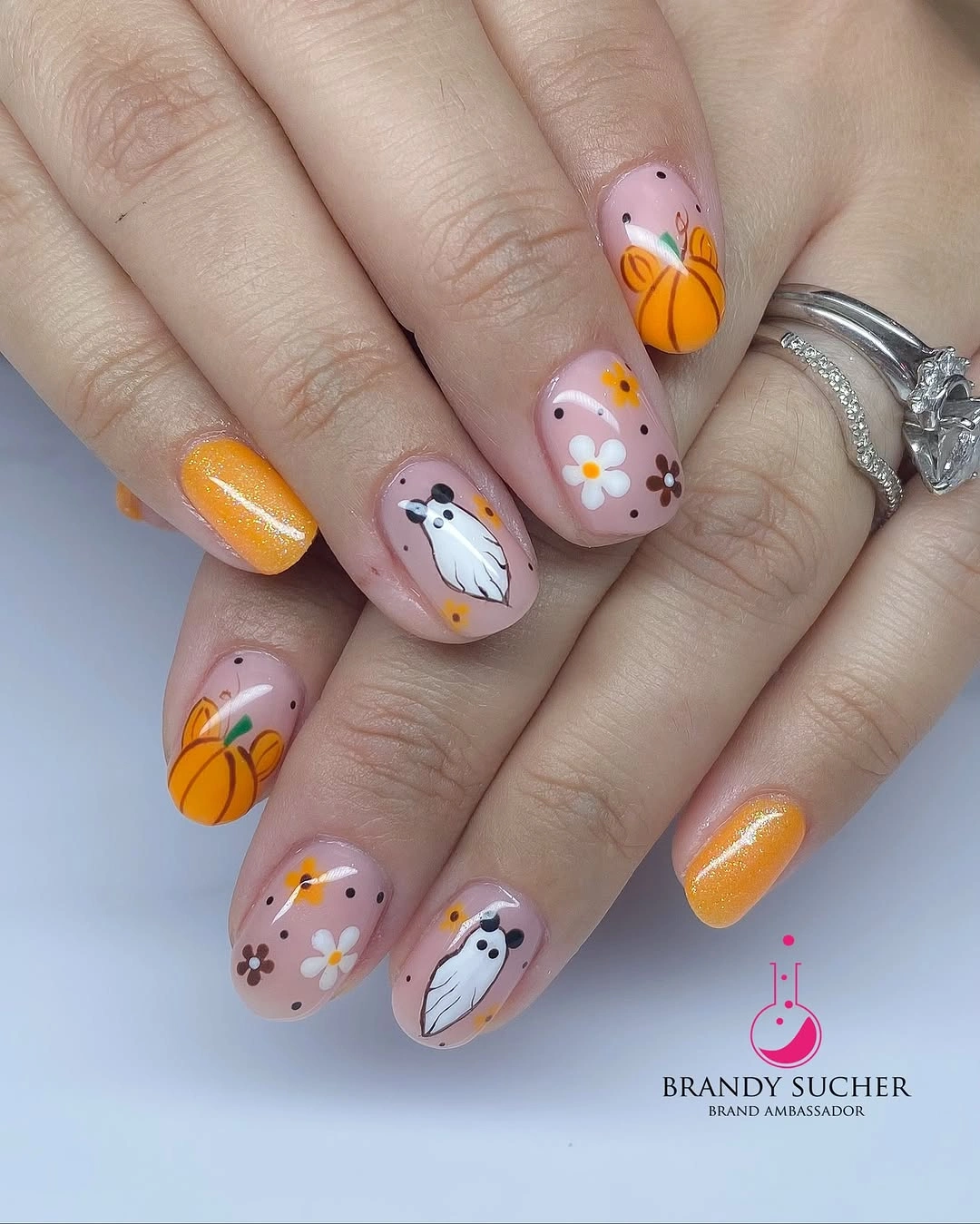
Orange and white appear in balanced little clusters, so neither the pumpkin nor ghost becomes the only visual story. The flowers act as gentle filler, but they do not need to appear on every finger to achieve that softening effect. For a simpler version, select one ghost, one pumpkin, and one floral accent, then let the rest stay pink with a small dot or star.
Compact seasonal art asks for clean proportions, since large faces or flowers could quickly overpower short nails. Keeping the motifs near the center or tip gives each one an easier outline. The most useful part of this manicure is its friendly scale: it proves short nails can carry pumpkins and ghosts without losing their everyday ease.
Leopard Print With Pink Pumpkin and Ghost
Long nude square nails combine leopard print, a pink pumpkin, a white ghost, black letters, and gold glitter across separate fingers. The mix is bold, but the palette is held together by nude space and small touches of pink, black, and metallic warmth. The pumpkin becomes more unexpected because it shares the set with animal pattern instead of standard orange-and-black Halloween cues.
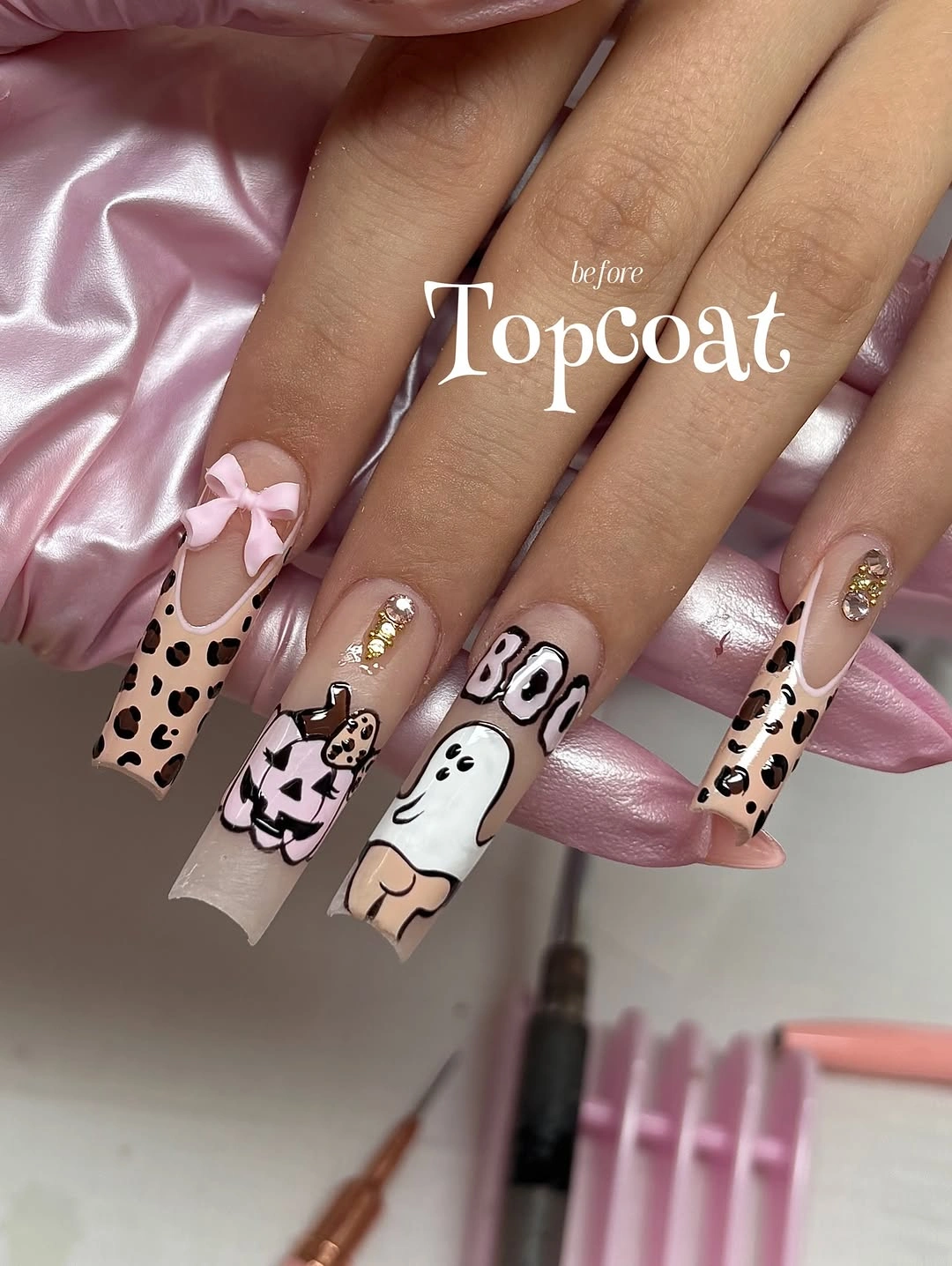
Leopard print is visually busy, so the pink pumpkin and white ghost wisely receive their own nail space rather than being layered on top of spots. Gold glitter adds a small reflective accent that ties the warm animal pattern to the softer pink. If the full combination feels too eclectic, use leopard on one nail, a pumpkin on another, and let the remaining nails stay nude with a tiny ghost.
This kind of mixed manicure benefits from a clear edit, especially as new ideas tempt you to add more symbols. Keep the print, pumpkin, ghost, and sparkle as the main four ingredients and skip extra webs or bats. The result is strongest when the unusual pink pumpkin remains a focal surprise against the grounded nude-and-leopard framework.